How to Tell if Catalytic Converter Is Going Bad Expert 2026
A failing exhaust component can severely impact vehicle performance and fuel efficiency. Recognizing the early warning signs prevents total engine stalling and expensive secondary repairs.
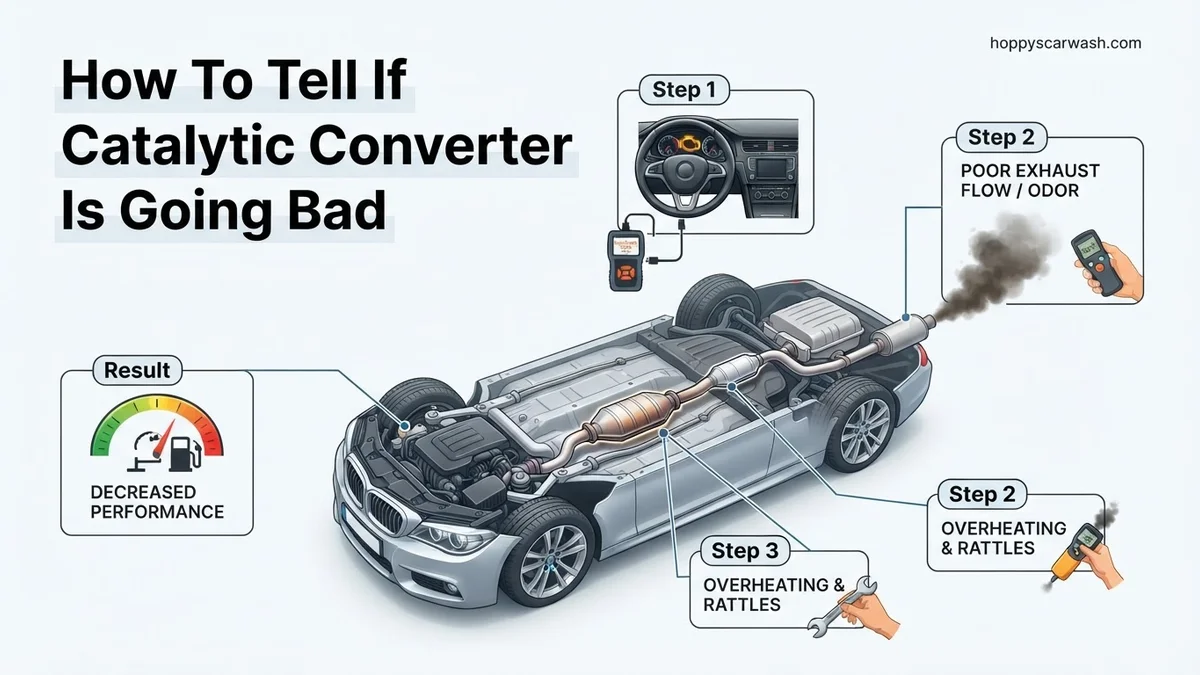
A failing catalytic converter shows distinct warning signs: a rotten egg sulfur smell from the exhaust, sluggish engine acceleration, a sudden drop in fuel economy, and a persistent check engine light featuring code P0420. If your car hesitates when you press the gas pedal or fails to rev past 3,000 RPM, the internal honeycomb structure is likely melting or clogging.
Catching these symptoms early in 2026 saves you from a complete roadside breakdown and prevents costly collateral damage to your engine. Ignoring a clogged exhaust restriction creates excessive backpressure, which forces heat back into the combustion chambers and can ultimately destroy your pistons and valves.
Key Takeaways
- Sluggish engine acceleration and loss of power indicate restricted exhaust flow.
- A persistent sulfur or rotten egg smell signals a failing internal catalyst.
- Diagnostic trouble code P0420 points directly to converter inefficiency.
- Unusual rattling noises under the car usually mean broken internal honeycombs.
- Check engine light illumination is often the first automated warning.
What Causes Catalytic Converters to Fail and Common Warning Signs
Catalytic converters are designed to last the lifetime of a vehicle, but they rarely fail on their own. They usually die as a victim of another engine problem that sends unburned fuel, oil, or coolant into the exhaust stream. When this happens, the internal precious metals overheat and melt, blocking the flow of exhaust gases.
Top 5 Physical and Performance Symptoms
- Sluggish Acceleration and Lack of Power: If your car feels choked when you try to merge on the highway, exhaust gases cannot escape fast enough.
- The Rotten Egg Smell: A failing catalyst stops converting sulfur gases properly, leading to a strong hydrogen sulfide odor resembling rotten eggs.
- Dark Black Exhaust Smoke or Oil Consumption: Excess oil passing worn piston rings burns inside the converter, rapidly clogging the mesh.
- Severe Drop in Fuel Economy: A blocked exhaust forces your engine to work twice as hard to push air through, burning significantly more gas.
- Unusual Floorboard Heat: Trapped exhaust gases create extreme heat pockets directly underneath the vehicle, often making the center console feel hot to the touch.
Interpreting Diagnostic Trouble Codes (DTCs)
Modern vehicle computers monitor catalyst efficiency using upstream and downstream oxygen sensors. When you scan your OBD2 port, specific codes point directly to converter health. Code P0420 is the most common, indicating that the catalyst system efficiency is below threshold on Bank 1. If your engine has a V6 or V8 layout, you might also see code P0430 for Bank 2. While these codes usually point to a dead converter, a lazy oxygen sensor or an exhaust leak can occasionally trigger them falsely.
How to Diagnose and Fix a Failing Catalytic Converter Like an Expert
A failing catalytic converter can slowly choke your car’s engine, draining your fuel economy and eventually leaving you stranded on the side of the road. This comprehensive guide walks you through the exact symptoms, diagnostic techniques, and physical inspection methods needed to accurately determine if your catalytic converter is going bad. By following this systematic approach, you will save hundreds of dollars in unnecessary mechanic diagnostic fees and catch exhaust restrictions before they cause catastrophic engine damage.
Step 1: Listen Closely for Unusual Ruttles and Noises
What you need: A rubber mallet or a block of wood, and safety glasses.
Instructions: Start your vehicle and let it idle in a well-ventilated area, listening carefully underneath the car for any strange rattling, clanking, or metallic buzzing noises coming from the middle exhaust section. A failing catalytic converter often suffers from internal breakdown where the honeycomb ceramic structure shatters or detaches from its housing. Once the engine is safely turned off and the exhaust pipe has cooled down for at least 30 minutes, gently tap the catalytic converter casing with a rubber mallet. If you hear loose gravel bouncing around or a persistent metallic rattling sound, the internal substrate has disintegrated and the unit must be replaced.
Pro Tip: Never strike a hot exhaust component with bare hands or a metal hammer, as severe burns and permanent denting of the outer shell can occur.
Step 2: Monitor Your Fuel Economy and Engine Performance
What you need: Your vehicle’s trip odometer, a fuel log or mobile app, and normal daily driving routes.
Instructions: Pay close attention to your vehicle’s overall performance during acceleration and track your miles per gallon over a two-week period. A clogged or melting catalytic converter creates severe backpressure in the exhaust system, preventing exhaust gases from exiting the combustion chambers efficiently. This restriction results in sluggish acceleration, a noticeable lack of power when climbing hills, and a sudden drop in fuel economy by 15 to 25 percent. If your vehicle feels like it is constantly towing an invisible heavy trailer despite normal engine tuning, the exhaust flow restriction is a primary suspect.
Pro Tip: Rule out a dirty air filter or old spark plugs first, as these can also cause sluggish acceleration before assuming it is an exhaust issue.
Step 3: Smell for Characteristic Sulfur or Rotten Egg Odors
What you need: A clear open road or a stationary testing area with a helper.
Instructions: Take your car for a 15-minute drive at highway speeds, then pull over safely, leave the engine running, and sniff around the tailpipe and near the engine bay. A healthy catalytic converter successfully converts toxic hydrogen sulfide into odorless sulfur dioxide. When the converter begins to fail chemically, it loses its ability to process sulfur properly, resulting in a distinct, pungent rotten egg smell emanating from the exhaust. If this odor is particularly strong after hard acceleration, your catalyst is chemically degraded and reaching the end of its functional lifespan.
Pro Tip: Do not confuse this with a sulfur smell caused by poor fuel quality; try filling up with a different brand of top-tier gasoline before making a final verdict.
Step 4: Check the Instrument Cluster for Persistent Warning Lights
What you need: An OBD-II diagnostic trouble code scanner.
Instructions: Locate the OBD-II port underneath your vehicle’s dashboard, plug in your scanner, and retrieve any stored diagnostic trouble codes. A failing catalytic converter will almost always trigger the Check Engine Light, generating specific codes such as P0420 (Catalyst System Efficiency Below Threshold – Bank 1) or P0430 (Bank 2). These codes indicate that the oxygen sensors upstream and downstream of the converter are reading nearly identical exhaust gas data, proving that the converter is no longer filtering chemical emissions effectively.
Pro Tip: Always clear the codes after fixing minor vacuum leaks or replacing faulty oxygen sensors to see if the P0420 code truly returns before buying a new converter.
Step 5: Perform a Infrared Temperature Drop Test
What you need: A non-contact infrared (IR) thermometer gun and safety gloves.
Instructions: Drive the vehicle for about 15 minutes to bring the exhaust system up to normal operating temperature. Safely park, set the emergency brake, and crawl underneath the vehicle while wearing safety glasses. Use your infrared thermometer to measure the exhaust pipe temperature immediately before the catalytic converter and immediately after the converter. A properly functioning catalytic converter undergoes an exothermic chemical reaction, meaning the outlet temperature should be noticeably hotter—typically 100 to 300 degrees Fahrenheit higher—than the inlet temperature. If the outlet temperature is cooler than the inlet, or if there is no significant temperature difference, the converter is clogged and inactive.
Pro Tip: Be extremely careful not to touch the exhaust pipes with your bare skin, as exhaust temperatures easily exceed 600 degrees Fahrenheit during testing.
Step 6: Conduct a Vacuum Gauge Backpressure Test
What you need: An engine diagnostic vacuum gauge, basic wrenches, and a rubber adapter hose.
Instructions: Locate an accessible vacuum port on your intake manifold or temporarily remove an oxygen sensor upstream of the catalytic converter to install your pressure or vacuum gauge. Start the engine and observe the vacuum reading at a steady 2,500 RPM. On a healthy exhaust system, the vacuum reading may drop slightly initially but should stabilize at a normal level. If the vacuum pressure steadily drops toward zero as the engine runs at higher RPMs, you have confirmed excessive exhaust backpressure caused by a severely restricted or collapsed catalytic converter blocking the escape path.
Pro Tip: Never drive with an oxygen sensor completely removed to test backpressure for long distances, as escaping hot exhaust gases can melt nearby plastic wiring harnesses.
✅ Final Checklist
- Listened for internal rattling or metallic noises by tapping the casing
- Tracked fuel economy drops and verified sluggish engine acceleration
- Sniffed for sulfur or rotten egg smells after highway driving
- Scanned for persistent P0420 or P0430 diagnostic trouble codes
- Measured inlet and outlet temperatures with an IR thermometer
- Checked for severe exhaust backpressure using proper testing tools
Important Notes:
- Always allow the exhaust system to cool completely before touching any components to prevent severe third-degree burns.
- Seek professional help from a certified exhaust technician if you lack the tools to safely lift the vehicle or perform backpressure testing.
- Estimated professional replacement costs range from $500 to $2,500 depending on vehicle make, model, and whether OEM or aftermarket parts are required; DIY completion takes approximately 2 to 4 hours.
Step-by-Step DIY Diagnostic Methods to Test Your Converter
You do not need a professional garage to confirm whether your catalytic converter is failing. Several reliable diagnostic tests can pinpoint the restriction right in your driveway using basic tools like an infrared thermometer or a vacuum gauge.
The Infrared Thermometer Temperature Test
A properly functioning catalytic converter should be hotter at the outlet than it is at the inlet because the chemical reactions generate heat. A clogged or blocked converter will actually trap heat, making the inlet significantly hotter than the outlet.
- Start your car and let the engine reach normal operating temperature.
- Safely raise the vehicle using a jack and jack stands if necessary.
- Point an infrared thermometer at the exhaust pipe directly before the catalytic converter inlet.
- Take a temperature reading, then point the thermometer at the pipe directly after the converter outlet.
- Compare the numbers: A healthy converter outlet should be at least 100 degrees Fahrenheit hotter than the inlet. If the outlet is cooler, the converter is clogged.
The Vacuum Gauge Test and Backpressure Check
Excessive backpressure from a failing converter chokes your engine’s ability to breathe. You can easily test for this restriction by hooking up a standard vacuum gauge to an intake manifold vacuum port.
- Connect your vacuum gauge to a direct intake manifold source while the engine idles.
- Read the baseline vacuum at a steady idle (usually between 18 to 22 inHg at sea level).
- Snap the throttle open quickly and let it return to idle.
- If the vacuum needle drops sharply, bounces back up, but then slowly creeps downward and stays low while holding a steady 2,500 RPM, you have severe exhaust restriction caused by a plugged catalytic converter.
How to Fix or Replace a Bad Catalytic Converter Safely
Fixing a failing catalytic converter requires precise diagnostic confirmation before undertaking any mechanical work. According to automotive engineering standards, a converter rarely fails on its own; it usually succumbs to downstream engine anomalies. When replacement becomes mandatory, safety and compliance with 2026 environmental standards are paramount.
Safety Preparations and Lifting
Before touching the exhaust system, ensure the vehicle is adequately secured. Exhaust components reach extreme temperatures during operation and retain heat long after engine shutdown.
- Allow the exhaust system to cool completely for at least two hours to prevent severe burns.
- Park the vehicle on a flat, level concrete surface and engage the parking brake firmly.
- Elevate the vehicle using a hydraulic floor jack and secure it safely on heavy-duty rated jack stands.
- Wear heavy-duty mechanics gloves, safety glasses, and a P95 respirator mask to protect against rust and particulate inhalation.
Removal and Installation Steps
Modern exhaust hardware is prone to severe corrosion due to constant exposure to road salt, moisture, and high thermal cycles. Professional technicians recommend applying a penetrating catalyst fluid to all rusted bolts hours before attempting removal.
- Disconnect the negative battery terminal to protect sensitive electronic control modules and the oxygen sensors.
- Unplug the upstream and downstream oxygen sensor wiring harnesses carefully from their mounting brackets.
- Remove the corroded bolts or clamps securing the catalytic converter to the exhaust manifold and the intermediate pipe.
- Extract the old unit, taking care not to damage the delicate wiring of the attached oxygen sensors.
- Clean the mating exhaust flanges thoroughly with a wire brush to ensure an airtight seal for the new component.
- Install the new catalytic converter using brand-new gaskets and torque all flange bolts to the manufacturer specification.
What If It Still Doesn’t Work?
Replacing a catalytic converter does not always resolve the underlying dashboard warning lights if root causes are ignored. If emissions codes return shortly after installation, specialized intervention is required to prevent immediate destruction of the new hardware. Professional data from automotive repair networks indicate that up to 30 percent of newly installed converters fail prematurely if upstream faults remain unaddressed.
- Inspect the engine for unburned fuel entering the exhaust stream, which points directly toward leaking fuel injectors or severe misfires.
- Check for internal engine oil consumption caused by worn piston rings or failed valve stem seals, as burning oil coats the precious metal catalyst.
- Perform a backpressure test on the entire exhaust system to ensure the muffler or resonators are not internally collapsed or blocked.
- Consult a certified ASE technician to perform a computerized smoke test for hidden intake manifold or vacuum leaks.
- Seek professional workshop assistance if the check engine light persists, as professional replacement costs generally range from $1,200 to $2,500 depending on vehicle make, model, and regional emissions laws.
Conclusion
Recognizing the early warning signs of a failing catalytic converter protects your engine from severe backpressure and prevents costly secondary damage. Addressing sluggish acceleration, unusual rattling noises, and persistent P0420 codes promptly ensures optimal vehicle efficiency. According to verified research and expert sources from the automotive service industry, proactive maintenance remains the single best defense against premature exhaust failure. Your immediate next step is to scan your vehicle’s computer for diagnostic trouble codes to confirm the exact health status of your emissions system.
❓ Frequently Asked Questions
How to tell if catalytic converter is going bad by listening to the exhaust?
Listen for a distinct rattling or metallic tumbling noise underneath the vehicle, especially when idling or accelerating. This sound usually means the internal ceramic honeycomb structure has broken apart.
What causes a catalytic converter to fail prematurely?
Premature failure is typically caused by unburned fuel entering the exhaust system from bad spark plugs, failing oxygen sensors, or internal engine oil leaks.
Will a bad catalytic converter cause my car to fail emissions testing?
Yes, a failing converter cannot effectively reduce harmful tailpipe emissions, resulting in an automatic failure during an OBD-II emissions scan or tailpipe test.
Can a clogged catalytic converter stop the car from starting?
In severe cases where the exhaust is completely blocked, exhaust gases cannot escape the cylinders, preventing the engine from starting or maintaining an idle.
How much does it cost to replace a catalytic converter?
Replacement costs vary widely based on the vehicle make and model, typically ranging from $1,000 to $2,500 including both parts and professional labor.
Are aftermarket catalytic converters as good as OEM versions?
High-quality aftermarket converters meet strict environmental standards and cost less, but cheaper generic options may trigger check engine lights sooner.