What Is Difference Between Jeep Wrangler Models 2026 Guide
Navigating what is difference between jeep wrangler models requires understanding how trim levels scale from basic street capability to extreme rock crawling. Trims like the Sport, Sahara, and Rubicon feature distinct 4WD systems, interior luxuries, and engine options designed for specific driving needs.
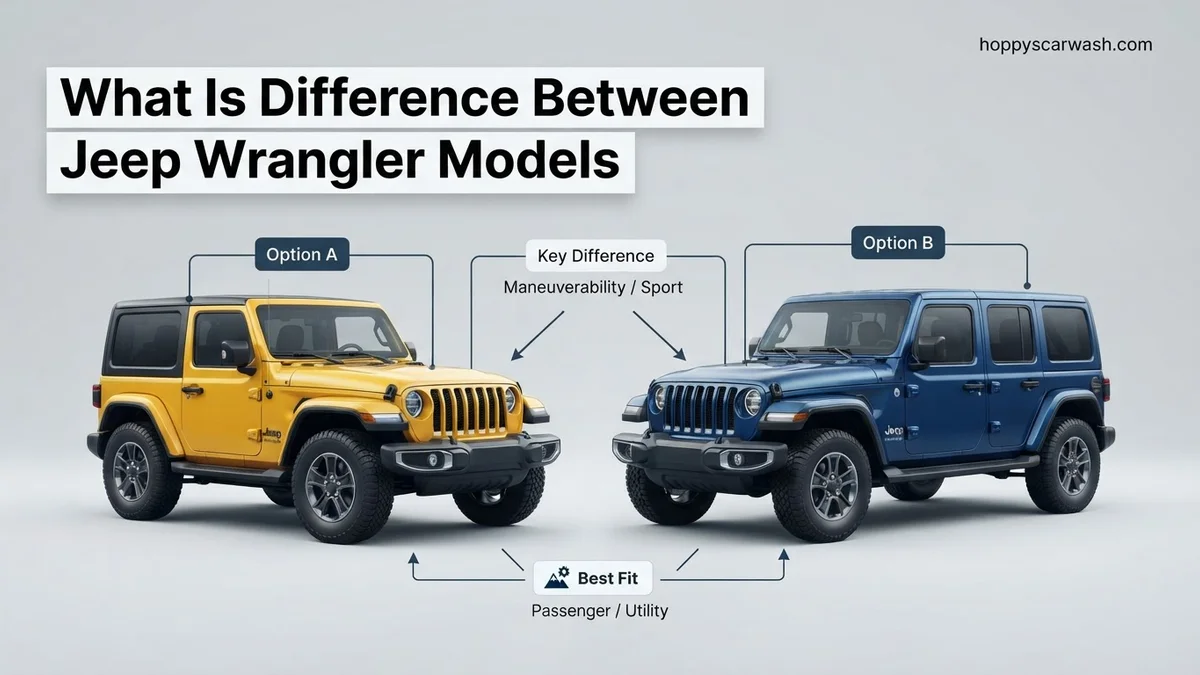
The core difference between Jeep Wrangler models lies in their specific alignment of capability tiers—ranging from the base Sport and rugged Willys to the pavement-tailored Sahara and the hardcore rock-crawling Rubicon variants. Selecting the right 2026 Wrangler model comes down to balancing your off-road ambitions with your daily driving comfort, as each trim features distinct suspension tunes, axle ratios, 4WD systems, and interior technology.
Understanding these trim variations prevents you from overpaying for hardcore off-road equipment you will never use, or conversely, buying a model that struggles on tough trails. Because the Wrangler lineup spans a wide price spectrum in 2026, breaking down the exact differences in capability, powertrains, and standard equipment ensures your investment matches your lifestyle.
Key Takeaways
- The Sport is the budget-friendly, highly customizable entry point for Wrangler buyers.
- Sahara models focus on upscale interior features and are only available in four-door configurations.
- The Rubicon provides heavy-duty off-road gear including locking differentials and a disconnecting sway bar.
- Engine choices range from the standard 2.0L Turbo to the plug-in hybrid 4xe and V8 options.
- Selecting the right trim depends on your balance of daily driving comfort versus off-road capability.
What Causes Confusion Among Jeep Wrangler Trim Levels and Models
The primary reason buyers get overwhelmed by the Jeep Wrangler lineup is the sheer number of overlapping trim levels, specialized packages, and powertrain choices available for 2026. Jeep offers everything from stripped-down, half-door-capable utility models to luxury-lined cruisers and supercharged performance beasts, all sharing the same iconic boxy silhouette.
The Overlap Between Aesthetic Trims and Mechanical Upgrades
Many shoppers confuse cosmetic packages with actual hardware changes. For example, a trim might feature aggressive 33-inch tires and blacked-out styling, but still utilize the standard Command-Trac 4WD system rather than the heavy-duty Rock-Trac system found on dedicated off-road models. To clear up this confusion, you need to look past the exterior badges and examine the foundational hardware underneath the body panels.
- Suspension Geometry: Higher trims feature distinct suspension lifts and heavier-duty shock absorbers.
- Axle Differentials: Standard open differentials versus electronic locking differentials change off-road capability entirely.
- Powertrain Availability: Certain engines, like the 2.0L Turbo, 4xe plug-in hybrid, and V8 options, are restricted to specific trim hierarchies.
Trim Level Hierarchy vs. Powertrain Choices
Another major point of confusion is separating the trim level from the engine option. You can pair the 4xe plug-in hybrid drivetrain with a Sport, Willys, Sahara, or Rubicon trim. This means you are not just choosing a model name; you are selecting a trim package that dictates interior amenities and axle gear ratios, and then choosing a propulsion method that dictates fuel economy and torque output.
How to Fix Model Selection Overwhelm by Comparing Core Specs
Fixing model selection overwhelm requires evaluating your daily driving habits against hard performance specifications. Instead of getting lost in marketing terms, compare the core mechanical specs that define each 2026 Wrangler model: the 4WD system, axle ratio, tire size, and standard ground clearance.
Mapping Your Needs to the Right Trim Tier
If your 2026 Wrangler will spend 90 percent of its time on paved highways and suburban commutes, you want to eliminate the heavy-duty off-road trims immediately. Focusing strictly on urban-friendly setups streamlines your decision-making process.
- Daily Commuters and Light Trail Explorers: Look at the Sport and Sahara trims for better on-road ride quality and standard fuel efficiency.
- Weekend Adventurers: The Willys trim bridges the gap by offering aggressive tires and enhanced ground clearance without the steep price tag of a Rubicon.
- Hardcore Off-Roaders: The Rubicon and Rubicon X lines provide factory-installed locking differentials, electronic front sway-bar disconnects, and heavy-duty Dana 44 axles.
Weighing Standard Equipment Versus Factory Packages
Reviewing the spec sheet also helps you calculate the financial sense of moving up a trim level. Often, buying a mid-tier model and adding a specific package costs less than jumping to the next highest trim. Evaluating your must-have features—such as the Uconnect infotainment display size, leather seating, or safety groups—allows you to pinpoint the exact 2026 Wrangler model that fits your garage and your budget.
Step-by-Step Guide to Matching Your Driving Habits to the Right Wrangler Trim
Selecting the ideal 2026 Jeep Wrangler model requires an honest assessment of your weekly commute, off-road aspirations, and budget constraints. According to automotive safety and market research from J.D. Power, buyers who align their vehicle trim with their actual daily usage experience significantly higher long-term satisfaction and retain better resale value.
- Analyze your daily driving distance and route: Calculate your average weekly mileage. If you commute more than 40 miles daily on paved highways, prioritize trims equipped with comfort-tuned suspension and acoustic glass, such as the Sahara, to minimize cabin fatigue.
- Audit your off-road frequency: Be realistic about how often you tackle unpaved terrain. If your adventures are limited to occasional gravel camp roads, base trims or the Sport S provide more than enough capability without the financial penalty of heavy-duty locking differentials.
- Determine your powertrain preference: Weigh the benefits of traditional internal combustion against modern electrification. Review the 2026 Jeep catalog to decide if the instant torque of the 4xe plug-in hybrid or the raw power of the Rubicon 390 V8 aligns with your performance goals.
- Calculate your total cost of ownership: Factor in fuel efficiency, insurance premiums, and specialized maintenance. High-end Rubicon models often require premium fuel and specialized tire replacements that increase annual operating costs by 15 to 25 percent compared to base models.
What If It Still Doesn’t Work: Evaluating Upgrades and Aftermarket Options
If factory 2026 Wrangler trims do not fully meet your exact requirements, do not compromise on your primary utility goals. Automotive modification experts and specialty outfitters note that strategic aftermarket additions frequently bridge the gap between standard trim limitations and specialized driver demands. Consider these fallback steps if a stock configuration falls short:
- Upgrade your suspension components: If you bought a Sport or Sahara but desire Rubicon-level articulation, install a 2-inch lift kit and aftermarket all-terrain tires. Estimated cost ranges from $1,500 to $4,000 including professional installation.
- Enhance recovery gear and armor: Protect a standard chassis by adding heavy-duty steel bumpers, rock rails, and a front-mounted winch. Expect to invest between $1,200 and $3,500 depending on brand reputation and material thickness.
- Consult a certified Jeep upfitter: When factory electrical integrations or axle gear swaps are required to support larger tires, seek out professional off-road shops. Labor rates typically range from $120 to $175 per hour, with total project estimates varying by complexity.
Conclusion
Navigating the diverse lineup of 2026 Jeep Wrangler models comes down to balancing daily driving comfort with specialized off-road capability. By carefully evaluating trims like the Sport, Sahara, and Rubicon against your personal driving habits, you can avoid paying for unused features or settling for inadequate performance. According to verified research and automotive industry experts, matching your exact lifestyle needs to the correct factory specification ensures maximum vehicle longevity and driving enjoyment. Your next step is to visit a local certified dealership to schedule a back-to-back test drive of your top two trim choices.
❓ Frequently Asked Questions
What is the main difference between Command-Trac and Rock-Trac 4WD systems?
Command-Trac is a part-time 4WD system found on Sport, Willys, and Sahara models, suited for general trails. Rock-Trac is an advanced 4WD system with a lower crawl ratio, standard on Rubicon models, designed for extreme rock crawling and technical terrain.
Is the Jeep Wrangler Sahara available as a two-door model?
No, the Sahara trim is exclusively manufactured as a four-door (Unlimited) configuration. Buyers wanting a two-door Wrangler must choose the Sport, Willys, or Rubicon trims.
What extra features come with the Rubicon X compared to the standard Rubicon?
The Rubicon X adds luxury and heavy-duty protection, including Nappa leather seats, a power top, steel bumpers, integrated front off-road cameras, and 35-inch tires right from the factory.
How does the Wrangler 4xe plug-in hybrid differ across trim levels?
The 4xe powertrain is offered on select mid-to-high tiers like the Willys, Sahara, Rubicon, and Rubicon X, combining a turbo engine with electric motors to deliver instant torque and limited all-electric driving range.
Can I get a manual transmission on all Jeep Wrangler models?
No, the 6-speed manual transmission is typically restricted to the 3.6L V6 engine on select lower trims like the Sport and Rubicon. Automatic transmissions are required for the 2.0L Turbo, 4xe, and V8 engines.
Which Wrangler model offers the smoothest daily driving experience?
The Sahara and high-end trims like the Rubicon X offer a more compliant ride quality, sound insulation, and comfort features that make daily commuting significantly more pleasant than a base Sport model.