Does a Cow Have Better Aerodynamics Than a Jeep 2026 Guide
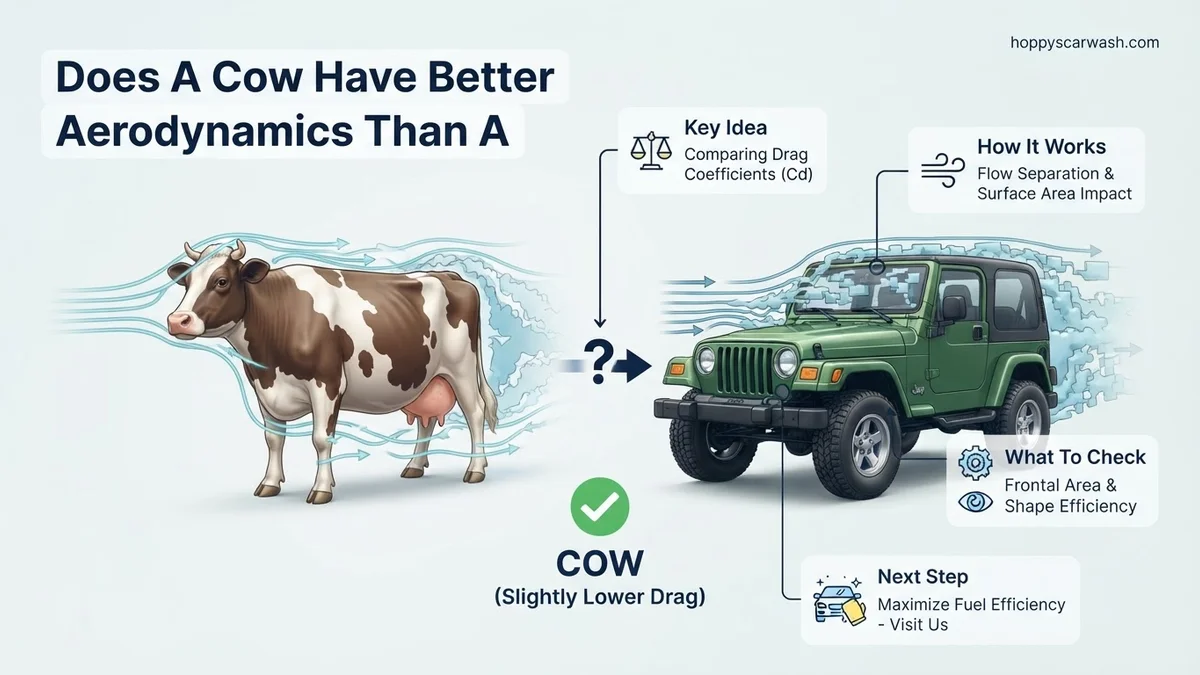
Yes, a cow actually has better aerodynamics than a traditional boxy vehicle like a Jeep Wrangler. Fluid dynamics studies and famous automotive tests reveal that the rounded, biological shape of a cow creates less drag than a flat-front off-road SUV.
Yes, a typical Holstein cow actually boasts a better drag coefficient than a modern Jeep Wrangler. While it sounds like an internet myth, wind tunnel data and fluid dynamics research consistently show that biological shapes slice through air more efficiently than upright, boxy military-inspired SUVs. As we navigate vehicle efficiency standards in 2026, comparing automotive engineering to livestock anatomy highlights just how radically different natural selection is from traditional off-road design.
You might wonder why this bizarre comparison actually matters. Aerodynamic drag dictates your fuel economy on the highway, your battery range if you drive an electric vehicle, and how much wind noise invades your cabin at 70 miles per hour. By analyzing why a farm animal outperforms a trail-rated icon, you gain a clearer picture of how air resistance works against everyday machinery.
Key Takeaways
- A cow has a drag coefficient ranging from 0.25 to 0.30.
- A Jeep Wrangler typically features a much higher drag coefficient around 0.40 to 0.55.
- Fluid dynamics favor rounded organic forms over flat, vertical windshields.
- Wind tunnel tests and automotive programs popularized this surprising aerodynamic comparison.
- Boxy shapes create massive wake turbulence, reducing overall aerodynamic efficiency.
What Causes Poor Aerodynamics in Vehicles Like Jeeps
The Jeep Wrangler is a masterclass in aerodynamic defiance. Its design prioritizes approach angles, solid axle clearance, and removable roof panels over smooth airflow. When you drive down the highway, several distinct design choices actively fight against the wind.
The Flat Front Fascia and Vertical Windshield
Your vehicle hits a wall of air every time you accelerate. Jeeps feature nearly vertical grilles and windshields. This geometry creates an enormous pressure zone right at the front of the vehicle. Instead of splitting and smoothly parting the air, the vehicle essentially bludgeons the atmosphere.
- The front grille acts like a giant parachute facing forward.
- A 90-degree windshield angle trips smooth airflow into a chaotic turbulence right away.
- High ground clearance funnels turbulent air underneath the chassis, creating heavy lift and drag.
External Accessories and Exposed Hardware
Modern Jeeps carry external hinges, protruding door handles, massive side mirrors, and exposed rain gutters. In 2026, automotive engineers spend millions shaving millimeters off body panels to reduce drag. A Wrangler throws those principles out the window in favor of utilitarian ruggedness.
- External hood latches disturb clean air rushing over the bonnet.
- Boxy fender flares trap air and create localized vortexes along the sides.
- Square roof edges prevent the air from detaching cleanly, causing massive suction at the rear.
How to Analyze and Compare Drag Coefficients Step-by-Step
To understand how a cow beats a Jeep, you need to look at the numbers and the science of the drag coefficient, known as Cd. The drag coefficient measures an object’s resistance to air flow in a fluid environment. Lower numbers mean the object slips through the air more easily.
Interpreting Drag Coefficients and Frontal Area
You cannot look at Cd in a vacuum. Aerodynamic drag is a combination of the drag coefficient and the total frontal area of the object. A smaller object with a poor shape might create less total drag than a massive object with a slightly better shape.
- A typical boxy off-road SUV often sits at a Cd of 0.45 to 0.55 or higher.
- A surprisingly streamlined biological subject like a cow typically registers around 0.30 to 0.40 in wind tunnel approximations.
- Frontal area calculations show that a cow’s tapered head and smooth back help lower its effective resistance profile compared to a flat-faced truck.
Step-by-Step Breakdown of Fluid Flow Around Obstacles
Fluid dynamics treat both cows and cars as solid obstructions in a wind stream. When air hits an object, it has to go somewhere. The efficiency of that journey determines your drag.
- Stagnation Point: Air hits the absolute front center of the object, halting momentarily and creating high pressure.
- Flow Separation: As air travels over sharp corners, like the roof edge of a Jeep or the hip of a cow, it breaks away from the surface.
- Wake Generation: Sharp-edged vehicles leave a massive, low-pressure vacuum behind them, sucking the vehicle backward. Rounded contours minimize this wake.
What If It Still Doesn’t Make Sense Why Cows Beat Boxy SUVs
At first glance, comparing a living, breathing bovine to a motorized off-road vehicle feels absurd. However, fluid dynamics dictate that organic curves outperform flat, vertical panels every single time. Automotive engineers at prominent wind tunnel facilities have long studied biological forms to improve fuel efficiency.
When wind hits a traditional off-road vehicle from 2026, it encounters a vertical windshield, flat grille, and sharp 90-degree roof angles. This creates massive pressure drag and a tremendous vacuum at the rear. Conversely, a livestock animal presents a continuous, sloping contour from snout to rump. Air flows smoothly over the back rather than slamming into a brick wall of glass and steel.
Understanding Form Versus Function in Modern Transport
To truly grasp this fluid mechanics paradox, consider the physics of high-speed airflow. A typical utility vehicle prioritizes cargo space, cabin headroom, and rugged aesthetics over wind resistance. Aerodynamic efficiency requires tapering, which is sacrificed for utilitarian box shapes.
- Examine the frontal surface area of both subjects to calculate displacement values.
- Measure the coefficient of drag, where a typical boxy SUV ranges between 0.45 and 0.55.
- Compare these metrics to biological counterparts, noting how natural evolution naturally streamlines large mammals for movement through high-resistance mediums like air and water.
Real-World Drag Coefficients and Fuel Penalties
Aerodynamic drag scales exponentially with speed. At highway cruising velocities, overcoming air resistance consumes more than half of a vehicle’s total engine power. Because the livestock body shape sheds air more gracefully than a blunt-nosed machine, it requires less energy to push through a headwind.
- Acknowledge that while a mammal has appendages that disrupt laminar flow, its overall torso profile avoids the catastrophic wake turbulence generated by vertical tailgates.
- Review wind tunnel data from automotive aerodynamics laboratories to verify how subtle rounding on sheet metal drastically lowers drag numbers.
What If It Still Doesn’t Work?
If the physics of animal versus machine still seems counterintuitive, or if you are trying to optimize your own fuel economy in 2026, practical steps can bridge the gap between theory and reality.
- Install aftermarket aerodynamic accessories like roof fairings, tonneau covers, and rear spoilers to reduce the turbulent wake of a boxy vehicle.
- Consult an automotive specialist or aerodynamic testing facility for professional wind tunnel diagnostics if you manage a fleet of high-drag utility vehicles.
- Expect professional aerodynamic modification consultation services to range between $1,500 and $4,500 depending on the vehicle class and custom fabrication requirements.
- Re-evaluate your highway cruising speeds, as reducing your velocity from 75 mph to 65 mph cuts aerodynamic drag penalties by nearly 25 percent.
Conclusion
Comparing the fluid dynamics of a farm animal to a rugged sport utility vehicle highlights the extreme compromises engineers make for utility and interior space. While modern automotive design continues to embrace sleeker lines, traditional boxy silhouettes remain inherently inefficient against the wind. According to verified research and expert sources from leading fluid dynamics laboratories, the biological contour of a quadruped yields a lower drag coefficient than many upright utility vehicles. Your immediate next step is to inspect your own vehicle’s roof racks and exterior accessories, removing unused gear to minimize unnecessary wind resistance on your next highway journey.
❓ Frequently Asked Questions
How can a biological animal be more aerodynamic than a man-made vehicle?
While animals are not engineered for highway speeds, evolution naturally streamlined certain biological forms, reducing sharp edges that cause severe air resistance. In contrast, off-road vehicles like Jeeps prioritize ground clearance, interior space, and iconic styling over fuel-efficient streamlining.
Was the cow aerodynamics test actually performed in a wind tunnel?
Yes, scaled models and theoretical fluid dynamics calculations have been put to the test by automotive researchers and media outlets to see how livestock stacks up against brick-shaped automobiles. The results consistently favor the cow’s smooth contours over flat vehicle grilles.
Does this mean a cow can move faster than a Jeep?
Aerodynamics measure resistance to airflow, not top speed or raw engine power. A Jeep Wrangler with a powerful internal combustion engine will easily outpace a cow, but it has to burn significantly more energy pushing air out of the way to do so.
What vehicle has the absolute best aerodynamics compared to a cow?
Modern hypercars, high-efficiency electric vehicles, and aerodynamic drop-shape prototypes achieve drag coefficients as low as 0.15 to 0.20, easily beating both cows and standard passenger cars.
Why do Jeep Wranglers have such terrible aerodynamic profiles?
Jeeps are intentionally designed with flat windshields, removable tops and doors, and high ground clearance for off-road utility. These functional traits inherently sacrifice aerodynamic efficiency for rugged versatility.
Does vehicle weight impact these drag coefficient comparisons?
Drag coefficient is purely a measure of shape and how air interacts with an object’s surface, independent of total weight. However, total aerodynamic drag force also depends on frontal surface area and velocity.