
What’s the Difference Between 245 and 265 Tires 2026 Guide
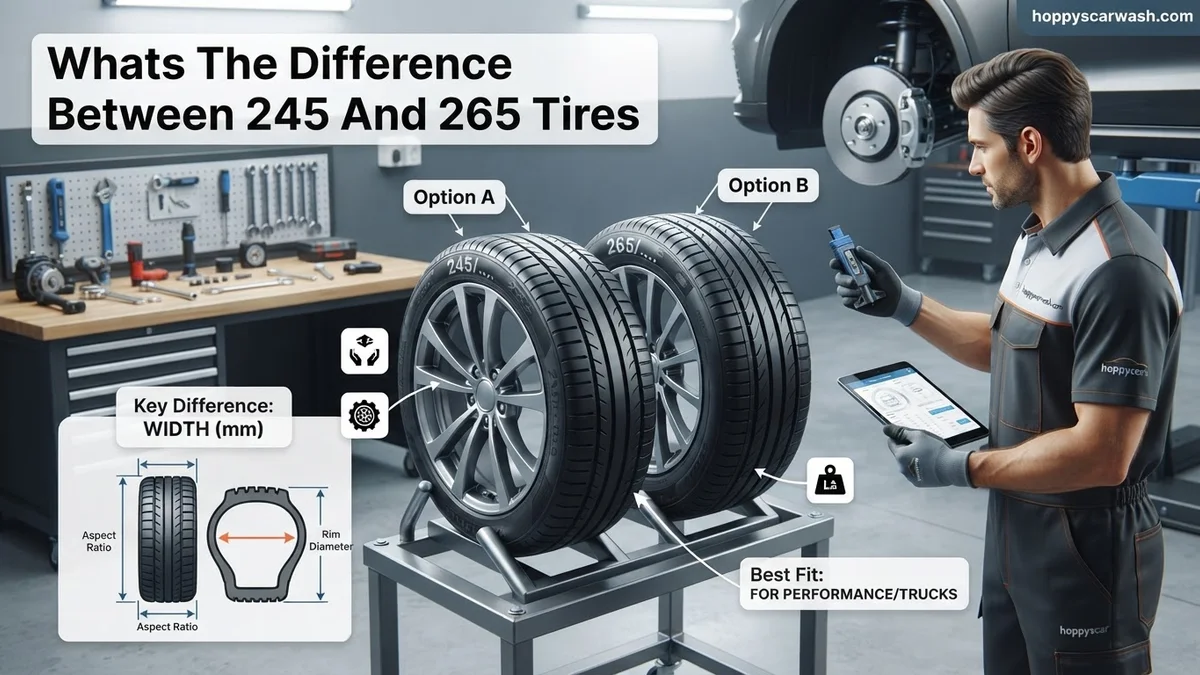
The main difference between 245 and 265 tires is the tread width, with 265 tires measuring 20 millimeters wider than 245 tires. This dimensional change impacts your vehicle’s handling grip, fuel economy, and clearance against suspension components.
The core difference between 245 and 265 tires comes down to a 20-millimeter increase in section width. A 245 tire measures 245 millimeters across at its widest point, while a 265 tire measures 265 millimeters, giving you roughly 0.8 inches of extra rubber on the ground. That extra width changes your contact patch, steering response, and how the tire fits inside your wheel wells.
Choosing between these two sizes in 2026 isn’t just about buying a replacement. Moving from a 245 to a 265 affects your vehicle’s stance, fuel economy, and clearance, especially if you drive a modern sport sedan, crossover, or performance truck. Let’s break down the exact physical and dynamic differences you need to know before swapping your rubber.
Key Takeaways
- 265 tires are 20mm wider across the tread than 245 tires.
- Sidewall height changes unless you adjust the aspect ratio accordingly.
- Wider 265 tires increase dry grip but can reduce hydroplaning resistance.
- Check wheel rim width compatibility before upgrading to wider tires.
- Ensure proper clearance to prevent rubbing against fenders and suspension.
What Causes Size Variations Between 245 and 265 Tires
The Raw Width and Footprint Difference
The first three digits in your tire size represent the nominal section width in millimeters, measured from sidewall to sidewall. When you jump from a 245 to a 265, you are adding 20 millimeters of total width. However, how that translates to the road depends heavily on your wheel rim width. Key physical factors include:
- Tread Width: Actual rubber touching the pavement usually increases by 15 to 20 millimeters, depending on the specific tire manufacturer’s tread design.
- Contact Patch Shape: The 265 tire yields a wider, slightly shorter contact patch, which alters lateral grip under hard cornering.
- Rim Constraints: A 265 tire requires a wider recommended rim width than a 245 to prevent the tread from crowning.
Aspect Ratio and Sidewall Implications
Width does not live in a vacuum. Tire sizes always pair width with an aspect ratio, such as 245/40R19 versus 265/35R19. Because the aspect ratio is a percentage of the section width, keeping the exact same profile number means a 265 tire will actually have a taller sidewall than a 245 tire. To maintain a comparable overall rolling diameter during a swap, you typically drop the aspect ratio by one increment when moving to the wider 265 size.
How to Calculate Fitment and Performance Impact for Swaps
Calculating Overall Diameter and Clearance
Before installing 265 tires on a vehicle factory-equipped with 245s, you must calculate the change in overall diameter to avoid rubbing your suspension struts or inner fender liners. A math check helps you prevent expensive clearance mistakes:
- Diameter Formula: Multiply the section width by the aspect ratio percentage, multiply by two for both sidewalls, convert millimeters to inches, and add the wheel diameter.
- The Plus-Size Rule: If you step up to a 265 width, dropping your aspect ratio from 45 to 40 keeps your speedometer accurate and prevents electronic traction control errors.
- Clearance Margins: Measure your current inner clearance. A 265 tire extends inward by about 10 millimeters and outward by 10 millimeters compared to a 245.
Drivetrain, Fuel Economy, and Rolling Resistance
Swapping to a wider tire introduces trade-offs in day-to-day driving dynamics. That extra 20 millimeters of rubber creates more mechanical drag. Expect a minor drop in fuel economy—often around 1 to 2 percent—due to increased rolling resistance. On the performance side, the 265 tire delivers superior braking distances in dry conditions and heavier steering feedback, though it can increase your vehicle’s tendency to hydroplane in heavy standing water compared to the narrower 245 option.
Step-by-Step Guide to Safely Upgrading from 245 to 265
Switching from a 245mm tread width to a 265mm width requires careful planning to prevent mechanical interference and speedometer errors. Industry standards from the Tire and Rim Association outline strict tolerances that drivers must follow during any tire size modification.
1. Verify Wheel Rim Width Compatibility
Before purchasing 265mm tires, inspect your current wheel’s width specification. A 245mm tire typically fits on an 8.0 to 9.5-inch wide rim, whereas a 265mm tire often demands a minimum rim width of 8.5 to 10.0 inches. Installing a wider tire on a narrow rim compromises sidewall integrity and handling stability.
2. Calculate Overall Diameter Variance
Maintaining the correct overall diameter is critical for modern electronic stability control systems in 2026 vehicles. If you retain the same aspect ratio (for example, moving from a 245/45R18 to a 265/45R18), the overall diameter increases by roughly 0.7 inches. This creates a 2.5% speedometer error that requires professional recalibration.
3. Test Clearance at Full Lock
Once the 265mm tires are mounted, inspect the inner wheel wells and suspension components. Turn the steering wheel completely to the left and right locks while the vehicle is parked on level ground. Ensure there is at least a half-inch of clearance between the tire tread and any structural components, brake lines, or plastic fender liners.
What If Your New Tires Rub or Affect Fuel Economy
Upgrading to a wider contact patch inevitably alters vehicle dynamics and physical clearances. If your newly installed 265mm tires make contact with the inner fender liner during sharp turns, or if your fuel economy drops noticeably, immediate corrective action is required to prevent premature tire wear and safety hazards.
Fuel economy typically decreases by 1% to 3% due to the increased rolling resistance and aerodynamic drag of a wider profile. Furthermore, the added unsprung weight can negatively impact acceleration response and braking distances if the wheels are significantly heavier than the factory units.
What If It Still Doesn’t Work?
If initial clearance adjustments fail to eliminate rubbing or if stability control warnings persist, execute these sequential troubleshooting steps:
- Install Hub-Centric Wheel Spacers: If the 265mm tires rub against internal suspension struts or sway bars, high-quality aluminum spacers ranging from 5mm to 15mm will push the wheel assembly outward. Expect to spend $100 to $250 for a professional-grade set of hub-centric spacers with extended lug studs.
- Modify Fender Liners or Trim Plastic: Minor rubbing against plastic inner liners can often be resolved by reshaping the plastic with a heat gun or trimming the offending lip. Professional body shops typically charge $150 to $300 for this specialized clearance work.
- Reprogram the Powertrain Control Module: If larger overall diameters trigger transmission shifting issues or anti-lock brake faults, take the vehicle to a certified dealership or specialty tuning shop. Software recalibration generally costs between $150 and $250 depending on the vehicle make and model.
- Consult a Professional Suspension Specialist: When clearance issues persist despite spacers and trimming, consult an alignment technician. Professional diagnostic labor rates average $120 to $180 per hour to evaluate custom suspension geometry.
Conclusion
Choosing between 245 and 265 tires comes down to balancing fuel efficiency and factory comfort with enhanced grip and an aggressive stance. While 245mm tires maximize daily commuting economy and maintain original engineering margins, upgrading to 265mm tires delivers superior traction and braking performance at the cost of slight fuel efficiency reductions and clearance checks. According to verified research and automotive engineering standards from the Tire and Rim Association, always confirm that your wheel rim width matches the broader tire specification before installation. Take the next step today by checking your current wheel width stamp and consulting your vehicle manufacturer’s approved sizing chart.
❓ Frequently Asked Questions
What do the numbers 245 and 265 actually mean in tire sizing?
The numbers 245 and 265 represent the nominal section width of the tire measured in millimeters from sidewall to sidewall. A 265 tire provides roughly 0.8 inches of additional width compared to a 245 tire.
Will switching from 245 to 265 tires improve my vehicle’s handling?
The wider contact patch of a 265 tire typically improves cornering grip and braking performance on dry pavement. However, it can also make the vehicle more susceptible to tramlining on uneven roads.
How does the swap affect speedometer accuracy?
If you only change the width number while keeping the aspect ratio the same, the sidewall will grow taller, increasing overall tire diameter. This causes your speedometer to read slower than your actual vehicle speed.
Are 265 tires worse in snow and rain than 245 tires?
Wider tires like the 265 distribute vehicle weight over a larger surface area, which reduces the pressure pushing through standing water or snow. This can increase the risk of hydroplaning compared to the narrower 245 tire.
What minimum rim width is required for a 265 tire?
Most 265-width passenger and light truck tires require a rim width between 7.5 and 9.5 inches, whereas 245 tires often fit slightly narrower wheels. Always check the specific tire manufacturer’s rim width range chart.
Will wider tires cause clearance issues with braking components?
While tread width primarily affects outer fender and inner suspension clearance, extreme changes can occasionally pose tight clearances near steering knuckles or brake assemblies depending on the vehicle geometry.