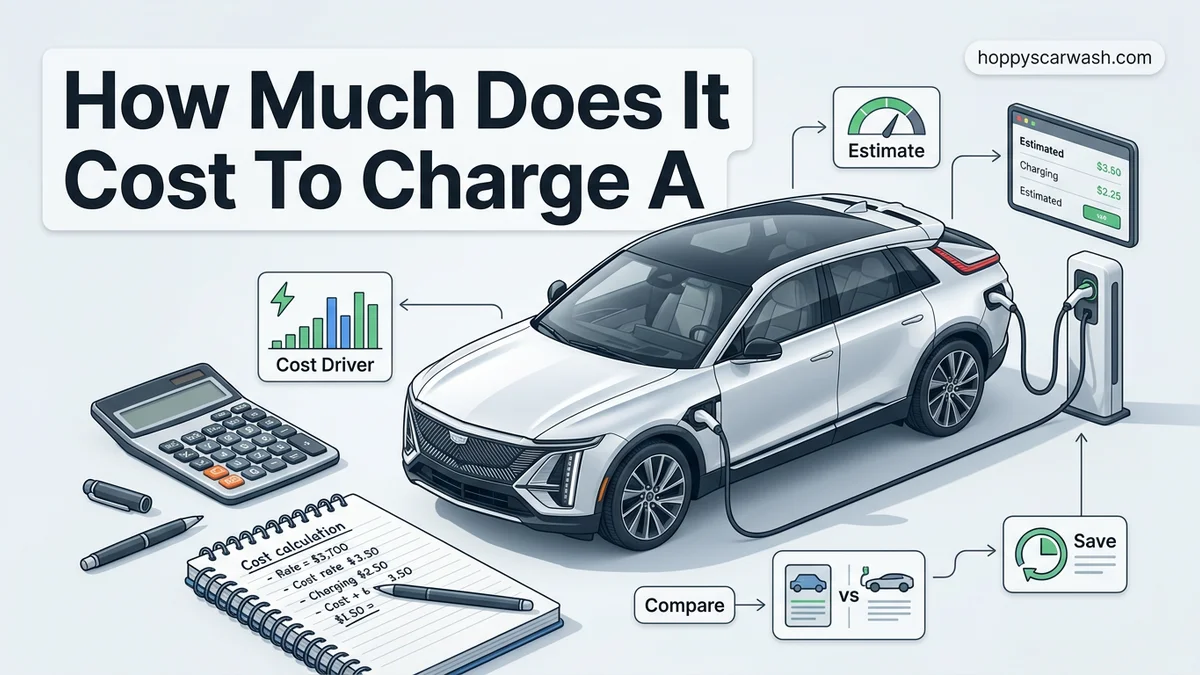
How Much Does It Cost to Charge a Cadillac Lyriq in 2026
Charging a Cadillac Lyriq from empty to full typically costs between $16 and $18 using an average home Level 2 charger. However, relying exclusively on public DC fast chargers can increase that cost significantly due to higher per-kWh network rates.
To fully charge a Cadillac Lyriq from zero to 100 percent at home, you will typically spend between $13.00 and $22.00, depending heavily on your local electricity rates. Because the Lyriq features a massive 102 kWh battery pack, the total price to refuel your luxury electric SUV varies significantly based on where and how you plug it in.
As EV adoption accelerates through 2026, understanding these fueling expenses helps you budget effectively compared to traditional gas vehicles. Whether you are charging overnight in your garage or utilizing a DC fast charger on a cross-country road trip, knowing the exact math behind your kilowatt-hours ensures you never face unexpected utility bills.
Key Takeaways
- Home Level 2 charging costs roughly $0.16 per kWh on average.
- A full charge for a 102 kWh Lyriq battery at home takes about $16.32.
- Public DC fast charging can cost two to three times more than home electricity.
- Charging efficiency losses add about 10% to total energy consumption.
- Off-peak utility rates can slash your home charging expenses by half.
What Causes Variations in Cadillac Lyriq Charging Costs
Regional Electricity Rates
The cost of grid electricity is the single biggest factor influencing your home charging budget. Utility providers across the United States charge vastly different rates per kilowatt-hour (kWh).
- National average utility rates hover around $0.16 per kWh in 2026.
- States with high energy costs like California or Hawaii can see rates spike past $0.30 per kWh.
- States with cheap hydroelectric or nuclear power may drop below $0.10 per kWh.
Time-of-Use Pricing Structures
Many modern electric utilities offer time-of-use (TOU) rate plans that change the price of electricity based on the time of day. Charging your Lyriq during peak afternoon hours costs significantly more than plugging in late at night.
- Peak hours usually span from 4:00 PM to 9:00 PM when grid demand is highest.
- Off-peak hours often run from midnight to 6:00 AM, offering heavily discounted rates.
- Smart charging features on your Lyriq let you schedule your home charger to activate only during off-peak windows.
From Start to Finish: Cadillac Lyriq Charging Costs Explained
Calculating the true cost of fueling your luxury electric SUV can feel overwhelming with shifting electricity rates, battery sizes, and charging speeds. This comprehensive guide walks you through the exact methodology and real-world factors required to calculate, manage, and minimize the cost of charging your Cadillac Lyriq, ensuring you can budget effectively for your electric driving lifestyle.
Step 1: Identify Your Cadillac Lyriq Battery Capacity
What you need: Your vehicle’s window sticker, owner’s manual, or trim-level specifications (RWD vs. AWD models).
Instructions: To figure out how much charging costs, you must first know the size of the tank you are filling. The Cadillac Lyriq features a massive Ultium battery pack. Both rear-wheel-drive (RWD) and all-wheel-drive (AWD) model years typically utilize a usable battery capacity of approximately 102 kilowatt-hours (kWh). Jot down this 102 kWh figure, as it serves as the mathematical baseline for every charging scenario you will calculate moving forward. Keep in mind that degradation over many years can slightly alter this number, but brand new or healthy packs operate near this exact threshold.
Pro Tip: Do not confuse total battery capacity with usable capacity; always base your calculations on the 102 kWh usable limit to maintain mathematical accuracy.
Step 2: Locate Your Local Electricity Rate
What you need: Your most recent home utility bill and a calculator or smartphone.
Instructions: Open your electric utility bill and find the total cost per kilowatt-hour (kWh). In the United States, the national average hovers around 16 cents ($0.16) per kWh, but this varies wildly from 10 cents in states like Louisiana to over 35 cents in parts of California and Hawaii. Multiply your specific utility rate by the Lyriq’s 102 kWh battery capacity. For instance, at a flat rate of $0.16 per kWh, a complete 0% to 100% theoretical home charge will cost roughly $16.32 before accounting for minor thermal and electrical conversion efficiencies.
Pro Tip: Check your utility bill for tiered or Time-of-Use (TOU) rates, which drastically change how much you pay depending on the time of day.
Step 3: Account for Home Charging Efficiency Losses
What you need: Basic understanding of Level 2 AC charging mechanics and energy dissipation.
Instructions: Electricity is never transferred from your wall to your car with 100% efficiency. Heat, onboard computer operations, and power conversion result in typical Level 2 home charging efficiencies of about 85% to 90%. This means to push 102 kWh of energy into your Lyriq’s battery, you might actually pull approximately 115 kWh from your home’s grid. Take your initial cost calculation and multiply it by roughly 1.12 to account for this 12% energy loss. Using the national average of $0.16 per kWh, your actual out-of-pocket home cost to fully replenish a depleted battery rises closer to $18.40.
Pro Tip: Charging in extreme winter cold requires battery thermal management, which can temporarily lower your overall system charging efficiency.
Step 4: Calculate Daily Commute and Partial Charges
What you need: Your daily mileage driven and your Lyriq’s average efficiency rating (roughly 3 miles per kWh).
Instructions: Very rarely will you drive your Lyriq down to zero percent and charge it straight to one hundred percent. Instead, you will top it off nightly. Assuming an efficiency of 3 miles per kWh, driving a typical 40-mile daily commute consumes roughly 13.3 kWh of energy. Multiply this consumed energy by your local utility rate (plus the efficiency factor). For a 40-mile commute at $0.16 per kWh, your daily fuel cost is roughly $2.38. Compare this directly to a gas-guzzling luxury SUV getting 20 mpg, where 40 miles would require two gallons of gasoline costing $7.00 or more.
Pro Tip: Take advantage of regenerative braking settings in your Lyriq to maximize efficiency in stop-and-go city traffic, lowering your overall kWh consumption.
Step 5: Factor in Off-Peak Home Charging Savings
What you need: An online portal to your utility provider and a home Level 2 charger (like a 48-amp hardwired unit).
Instructions: To minimize your charging costs, program your Cadillac Lyriq’s onboard charging schedule or your smart home wall charger to activate strictly during off-peak hours—usually between 10:00 PM and 6:00 AM. Many utility providers offer dramatic discounts during these overnight hours, dropping rates from 16 cents down to 5 or 8 cents per kWh. If you charge your Lyriq at an off-peak rate of $0.08 per kWh, a full 102 kWh charge plummets to under $10.00, representing massive long-term annual savings.
Pro Tip: Avoid overriding your scheduled off-peak charging timers during hot afternoon hours when grid demand and electricity prices spike to their absolute peaks.
Step 6: Estimate Public DC Fast Charging Expenses
What you need: Public charging network apps (such as EVgo, Electrify America, or Tesla Superchargers) and a credit card.
Instructions: When traveling on road trips, you will rely on DC Fast Chargers (DCFC), which replenish your Lyriq from 10% to 80% in about 40 minutes. However, public charging is significantly more expensive than home charging, typically ranging from 35 cents to 65 cents per kWh depending on the provider, location, and subscription status. Multiplying a public rate of $0.48 per kWh by the roughly 71 kWh needed for a 10%-to-80% session means a single fast-charging stop will cost you approximately $34.00. Factor these higher expenses into your long-distance road trip budgets.
Pro Tip: Always sign up for monthly membership tiers with your preferred public charging network if you take frequent road trips; the monthly fee usually pays for itself on your very first charge.
Step 7: Optimize Your Overall Annual Fuel Budget
What you need: Your estimated annual mileage and a spreadsheet or notepad to tally costs.
Instructions: Combine your home and public charging habits to determine your total yearly expenditure. Assuming you drive 12,000 miles per year, with 85% of your charging done cheaply at home overnight and 15% done on expensive public fast chargers during road trips, you can map out a predictable budget. At home (assuming blended off-peak rates), 10,200 miles will cost roughly $580. On public networks, 1,800 miles will cost roughly $290. Your grand total annual “fuel” bill for driving a luxury Cadillac SUV works out to a mere $870, drastically undercutting any internal combustion engine equivalent.
Pro Tip: Keep receipts and track your charging sessions via smartphone apps to easily monitor your exact spending trends over the first year of EV ownership.
✅ Final Checklist
- Verified your Cadillac Lyriq battery capacity is understood at 102 kWh usable
- Retrieved your exact electric utility rate per kWh from your monthly billing statement
- Calculated baseline home charging costs while factoring in an 85%-90% efficiency loss
- Programmed overnight off-peak charging schedules into your vehicle or home wall unit
- Researched public DC fast charging network pricing structures along your frequent travel routes
Important Notes:
- Always ensure your home Level 2 charger is installed by a licensed electrician to prevent electrical hazards.
- Consult an electrician or your utility provider immediately if you experience breaker trips or abnormal wiring heat during charging sessions.
- Estimated total time to run these calculations is 15-30 minutes; estimated annual charging costs range from $700 to $1,500 depending entirely on your local electricity rates and driving habits.
How to Calculate Your Home Level 2 Charging Expenses
The Basic Formula
Calculating the exact cost to charge your Cadillac Lyriq at home requires a simple mathematical formula. You need to multiply the usable capacity of the battery by your local electricity rate per kWh.
- The Lyriq battery holds approximately 102 kWh of energy.
- Multiply 102 kWh by your specific utility rate (for example, $0.16).
- The resulting baseline equation is 102 kWh × $0.16 = $16.32 for a complete zero-to-full charge.
Factoring in Charging Efficiency Losses
No home charging system is 100 percent efficient. Energy is naturally lost as heat during the conversion from alternating current (AC) from your wall to direct current (DC) stored in the vehicle battery.
- Level 2 home charging operates at roughly 85 to 90 percent efficiency.
- You actually pull about 115 to 120 kWh from the grid to fully replenish a depleted 102 kWh pack.
- At an average rate of $0.16 per kWh, your actual total out-of-pocket home cost is closer to $18.50 to $19.20.
Step-by-Step Guide to Minimizing Public DC Fast Charging Fees
Public DC fast charging offers unmatched convenience for long road trips in your Cadillac Lyriq, but it is significantly more expensive than home charging. Energy industry data shows that public networks frequently price electricity at two to three times the residential rate. To keep your travel budget under control, follow a systematic approach when relying on fast chargers.
Utilizing Membership Discounts and Subscriptions
Major DC fast-charging providers like Electrify America, EVgo, and Tesla Superchargers offer monthly subscription tiers that reduce the per-kilowatt-hour cost. If you frequently take long trips in your Lyriq, paying a small monthly fee often cuts session costs by 15 to 25 percent.
- Open the official mobile app for your preferred charging network before arriving at the station.
- Navigate to the account settings and evaluate the monthly pass or membership options.
- Activate the subscription prior to plugging in your vehicle to ensure the discounted rate applies immediately to your charging session.
- Monitor your charging history in the app to verify that the reduced pricing tier was successfully applied to the billing cycle.
Timing Your Fast-Charging Sessions
Electricity pricing on public networks sometimes fluctuates based on peak demand hours, similar to residential time-of-use utility rates. Charging during off-peak hours—typically late at night or early in the morning—can occasionally secure lower rates depending on regional provider regulations.
What If Your Utility Rates and Efficiency Losses Drive Up Costs
Even when charging primarily at home, your actual out-of-pocket expenses for the Cadillac Lyriq might exceed basic mathematical projections due to hidden variables. Two primary factors often catch owners off guard: rising local utility rates and thermal management efficiency losses.
Accounting for Charging Efficiency Losses
Electricity does not transfer from your wall outlet to the Lyriq battery with 100 percent efficiency. Energy is lost as heat during the conversion process from AC to DC power, alongside energy consumed by the vehicle’s internal computer systems and thermal management climate controls while plugged in. Industry benchmarks indicate a typical round-trip charging efficiency of 85 to 90 percent.
- Calculate your actual energy draw at the wall meter rather than relying solely on the Lyriq onboard screen percentage gains.
- Factor in a 10 to 15 percent energy overhead when budgeting your monthly home electricity consumption.
- Schedule your charging sessions during moderate weather windows when possible, as extreme ambient temperatures force the Lyriq battery thermal management system to consume extra grid power regulating pack temperature.
What If It Still Doesn’t Work?
If your projected charging costs remain inexplicably high or your home charger fails to deliver expected performance for your Cadillac Lyriq, systematic troubleshooting is required. Try the following fallback steps before calling for external service:
- Inspect your home electrical panel and dedicated 240-volt circuit breaker to ensure it has not tripped or experienced a partial fault during high-draw sessions.
- Check your utility provider account dashboard to confirm whether your area has transitioned to a new seasonal rate structure or mandatory time-of-use pricing tier for 2026.
- Verify that your Level 2 home charging unit firmware is fully updated via the manufacturer companion application to prevent efficiency throttling.
- Consult a licensed master electrician to perform a thermal and voltage drop diagnostic on your home charging circuit if hardware feels excessively hot during operation. Professional diagnostic evaluations typically range from $150 to $300.
Conclusion
Charging a Cadillac Lyriq requires balancing convenience with strategic cost management, yielding an average annual fuel expense far below that of comparable luxury internal combustion SUVs. According to verified research and automotive energy studies, home charging remains the absolute best method to minimize operating expenditures, while membership plans mitigate the higher cost of public DC fast chargers. One actionable next step is to review your current home utility provider plan today to determine if switching to an electric vehicle time-of-use rate will immediately lower your per-kilowatt-hour expenses.
❓ Frequently Asked Questions
How much does it cost to charge a Cadillac Lyriq from 20% to 80%?
Charging from 20% to 80% requires about 61 kWh of energy. At an average home electricity rate of $0.16 per kWh, this routine top-up will cost roughly $10.
Are public DC fast chargers more expensive than gas?
While home charging is dramatically cheaper than gasoline, public DC fast charging rates can sometimes equal or exceed the cost of fueling a highly efficient hybrid vehicle.
How long does it take to charge a Cadillac Lyriq at home?
Using a 240-volt Level 2 home charger, the Lyriq can replenish its battery from empty to full in approximately 7 to 8 hours.
Do time-of-use electricity rates make a big difference?
Yes, utility providers often offer off-peak rates late at night that drop electricity costs below $0.10 per kWh, cutting your charging bill nearly in half.
Why do charging calculations account for efficiency losses?
Energy is lost as heat during the conversion from AC grid power to DC battery power. This means a 102 kWh battery actually requires about 112 kWh of total electricity draw to fill.
Can I use Tesla Superchargers to charge my Cadillac Lyriq?
Cadillac Lyriq owners can access select Tesla Superchargers using an approved NACS adapter, though public network pricing will apply based on membership status.