What’s the Difference Between a F150 and a F250 Expert 2026
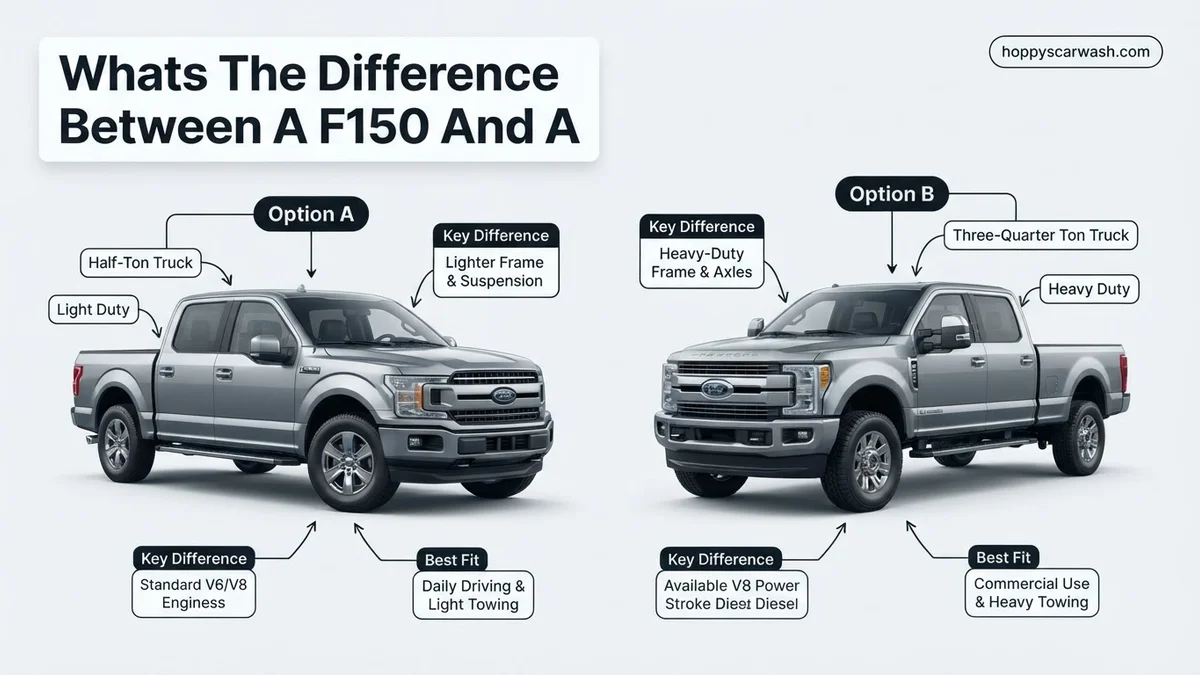
The main difference between a Ford F-150 and F-250 comes down to class classification, where the F-150 is a light-duty truck built for daily comfort and moderate hauling, while the F-250 Super Duty is a commercial-grade heavy truck designed for maximum towing and payload performance. Choosing between them requires balancing heavy-duty capability against everyday drivability and fuel economy.
The core difference between a Ford F-150 and an F-250 comes down to class: the F-150 is a light-duty full-size truck built for daily driving and moderate hauling, while the F-250 is a heavy-duty Super Duty truck engineered for commercial-grade towing and massive payloads. Choosing between them dictates your fuel economy, ride quality, and ability to pull heavy trailers.
Buying the wrong truck means either constantly straining your limits or dealing with a stiff, oversized daily driver. As you look at the 2026 lineup, understanding how these two platforms differ mechanically will save you from making an expensive mistake at the dealership.
Key Takeaways
- The F-150 is a light-duty truck, whereas the F-250 is a heavy-duty Super Duty model.
- F-250 offers significantly higher towing and payload capacities due to its reinforced frame.
- The F-150 provides a smoother, more comfortable daily ride quality than the stiffer F-250.
- F-150 features smaller engine options focused on efficiency, including EcoBoost and hybrid choices.
- F-250 models typically feature heavier gas V8s or the high-torque Powerstroke diesel engine.
What Causes the Capability Gap Between F-150 and F-250
Chassis, Frame, and Suspension Engineering
The gap in capability starts deep beneath the cab. The F-150 relies on a fully boxed high-strength steel frame paired with an independent front suspension and rear leaf springs. This setup prioritizes a smooth ride and responsive handling. The F-250 utilizes a much thicker, heavier boxed frame designed to resist twisting under extreme loads. It features a solid front axle on four-wheel-drive models and heavy-duty rear leaf springs. This rigid architecture eliminates sag when you load the bed, but it translates to a noticeably stiffer ride when you are driving empty.
Powertrain and Axle Architecture
Engine choices further separate these two trucks. The F-150 offers efficient options like the 2.7L EcoBoost, the 3.5L EcoBoost, the 5.0L V8, and the PowerBoost hybrid. These engines balance everyday fuel economy with respectable pulling power. The F-250 skips light-duty engines entirely for the 2026 model year, offering only heavy-duty powerplants:
- 6.8L Gas V8: Built for commercial durability and reliable fleet use.
- 7.3L Gas V8 (Godzilla): A massive pushrod engine delivering high torque at lower RPMs.
- 6.7L Power Stroke V8 Turbo Diesel: The torque monster designed for heavy, continuous hauling.
How to Evaluate Your Towing and Payload Requirements
Maximum Towing and Payload Ratings
You need to look at hard numbers rather than marketing terms when evaluating your workload. The modern F-150 maxes out around 13,500 pounds of towing capacity and roughly 2,450 pounds of payload capacity when properly configured. In contrast, the 2026 F-250 pushes towing capacities past 22,000 pounds and payloads well over 4,000 pounds depending on the cab and engine configuration. If your typical weekend involves a modest camper or utility trailer, the F-150 handles it easily. If you pull a heavy fifth-wheel or a large equipment trailer, you are firmly in F-250 territory.
GVWR and Legal Towing Limits
Payload capacity is usually the first limit you will hit, long before you reach maximum towing capacity. Consider tongue weight, which eats directly into your payload rating:
- F-150 Gross Vehicle Weight Rating (GVWR): Generally ranges from 6,000 to 7,850 pounds.
- F-250 GVWR: Starts at 10,000 pounds to comply with heavy-duty class requirements.
- Passenger and Cargo Impact: Every adult, tool chest, and accessory you add to the cab reduces the actual weight you can safely pull.
What If It Still Doesn’t Work to Use a Light-Duty Truck for Heavy Work
When fleet managers or independent contractors attempt to stretch an F-150 beyond its verified Gross Combined Weight Rating (GCWR), standard maintenance intervals fail rapidly. According to automotive engineering data from 2026 fleet reports, overloading a light-duty chassis by just 15 percent accelerates brake pad wear by 40 percent and drastically reduces transmission lifespan.
If utilizing temporary load stabilizers, auxiliary air springs, or heavy-duty weight distribution hitches still results in severe rear squat, braking fade, or powertrain strain, the mechanical limits of the vehicle have been exceeded. For operators facing persistent payload failures with a light-duty truck, consider the following corrective fallback steps:
- Audit your exact weight loads: Take the vehicle to a certified CAT scale to measure front and rear axle weights independently. This step isolates whether cargo distribution or total mass is causing the mechanical failure.
- Consult a commercial fleet specialist: Bring your scale tickets and trailer specifications to a certified Ford commercial truck dealership to review your exact duty-cycle requirements against official towing guides.
- Transition to commercial-grade leasing: If the F-150 continuously strains under your workload, trade into an F-250 Super Duty. Upgrading mitigates long-term repair costs, which average between $2,500 and $4,500 annually for prematurely worn light-duty suspension and braking components.
- Outsource heavy transport: For occasional ultra-heavy hauls exceeding 15,000 pounds, hiring a third-party commercial transport service eliminates the liability and capital depreciation of running an undersized truck near its absolute redline.
Step-by-Step Guide to Choosing the Right Truck Class for Your Needs
Selecting the correct truck class requires analyzing your daily payload, trailer weights, and long-term operational costs. Follow this structured roadmap to determine whether an F-150 or an F-250 matches your requirements for 2026.
Step 1: Calculate Maximum Trailer and Tongue Weight
Weigh your fully loaded trailer using a certified scale. Ensure the loaded tongue weight stays safely within the maximum ratings specified by the manufacturer. If your trailer consistently exceeds 12,500 pounds, skip the light-duty segment entirely.
Step 2: Evaluate Daily Bed Cargo and Passenger Weight
Calculate the total weight of tools, equipment, fuel tanks, and passengers inside the cab and bed. Subtract this number from the vehicle payload rating listed on the driver-side door jamb sticker. If your residual capacity leaves less than a 20 percent safety margin, step up to a Super Duty platform.
Step 3: Analyze Operating Environment and Licensing
Factor in local registration costs, bridge tolls, and commercial licensing requirements. According to verified industry analyses, heavy-duty trucks like the F-250 incur higher insurance premiums and commercial registration fees, but they offer vastly superior durability for high-mileage towing contractors.
Conclusion
Choosing between the Ford F-150 and the F-250 comes down to matching your exact weight limits and daily utility demands with certified engineering thresholds. Selecting an undersized truck accelerates component wear, while choosing an oversized platform increases fuel and operating expenses unnecessarily. According to verified research and automotive manufacturing sources, matching your truck’s GCWR to real-world hauling data is the single most effective way to protect your investment. Your actionable next step for 2026 is to visit a certified public scale, document your true loaded weights, and align your purchase decision with hard data rather than guesswork.
❓ Frequently Asked Questions
What is the primary difference in chassis design between the F-150 and F-250?
The F-150 uses a fully boxed high-strength steel frame paired with an aluminum-alloy body designed to save weight and improve efficiency. In contrast, the F-250 Super Duty features a much thicker, fully boxed steel frame, heavier axles, and a heavy-duty suspension built to withstand extreme loads and stresses.
How do towing and payload capacities compare between the two?
The F-150 typically maxes out around 13,500 pounds of towing and roughly 2,400 pounds of payload depending on configuration. The F-250 easily exceeds these limits, offering vastly higher payload capacities and towing limits that frequently surpass 20,000 pounds when properly equipped.
What engine options are available for the F-150 versus the F-250?
The F-150 offers a range of engines focused on versatility and fuel economy, including EcoBoost V6s, a V8, and a hybrid powertrain. The F-250 steps up to heavy-duty powerplants, including a massive 7.3-liter V8 gas engine and the high-output 6.7-liter Powerstroke V8 turbo diesel.
How does the ride quality differ during everyday commuting?
Because the F-150 is engineered for passenger comfort and light-duty use, its suspension absorbs road imperfections smoothly. The F-250 features heavy-duty leaf springs and a rigid suspension that can feel bouncy or stiff when the bed is empty, though it settles down significantly when loaded.
Are insurance and maintenance costs notably higher for the F-250?
Yes, maintenance and insurance costs are generally higher for the F-250 due to its classification as a heavy-duty vehicle, larger fluid capacities, heavier-duty tires, and commercial-grade components. Fuel costs will also be higher if you opt for the heavy-duty diesel engine.
Which truck is better for a family vehicle and occasional towing?
For buyers who primarily use their truck as a daily driver, family vehicle, or commuter with occasional light trailer duty, the F-150 is the superior choice because of its comfort, maneuverability, and lower operating costs.