How Fast Can You Drive in Four Wheel Drive High Best 2026
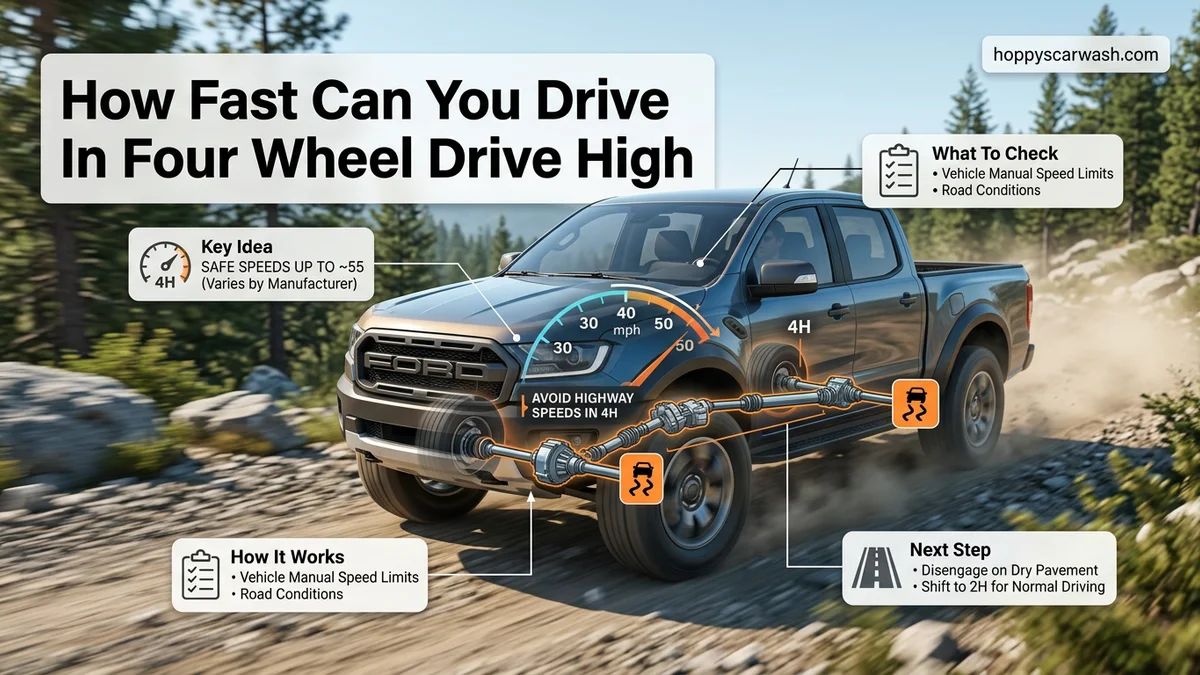
In most vehicles, the maximum safe speed for driving in Four-Wheel Drive High (4H) is 50 to 55 miles per hour, though you should always consult your specific vehicle owner’s manual. Exceeding this limit on high-traction surfaces can cause severe drivetrain binding and mechanical damage due to locked front and rear axles. Actual speeds should always be adjusted downward based on slippery road conditions like snow, ice, or deep mud.
The general maximum safe speed for driving in Four-Wheel Drive High (4H) is 55 to 60 miles per hour, though you should always verify the exact limit in your specific vehicle owner’s manual. Operating at highway speeds in 4H is generally acceptable for modern 2026 trucks and SUVs, provided you are driving on low-traction surfaces like snow, ice, or loose gravel.
Knowing this speed threshold prevents catastrophic drivetrain failure and keeps your vehicle controllable during winter storms or off-road excursions. Pushing past these recommended limits on dry pavement creates immense mechanical stress that can permanently damage your transfer case and axles.
Key Takeaways
- Never exceed 50 to 55 mph in 4H to prevent severe drivetrain and transfer case damage.
- Always consult your vehicle’s owner’s manual for manufacturer-specific speed limits.
- Avoid using 4H on dry pavement to prevent dangerous axle bind during turns.
- Match your actual speed to road conditions, slowing down significantly on ice and heavy snow.
- Shift back into 2WD immediately once you encounter clear, dry roads.
What Causes Drivetrain Damage When Speeding in 4H
To understand why speed matters in 4H, you have to look at how the transfer case locks your front and rear driveshafts together. This mechanical lock forces both axles to spin at the exact same speed, which is great for traction but terrible for cornering on dry roads.
Driveline Bind and Axle Stress
When you take a corner, your front wheels travel a wider arc and need to rotate faster than your rear wheels. Because 4H locks the front and rear output shafts together, the tires cannot differentiate their speeds. This mismatch causes a phenomenon called driveline bind. As you drive faster on high-traction surfaces, the resulting friction and mechanical resistance escalate rapidly, threatening to snap components or strip gears.
- Internal Component Heat: Excessive friction builds intense heat within the transfer case differential and gears.
- Component Wear: U-joints, CV joints, and the chain inside the transfer case experience abnormal stress loads.
- Tire Scrubbing: You will often feel the vehicle hop, stutter, or resist turning as the tires fight for individual rotation on dry asphalt.
The Physics of High-Speed Traction Loss
Many drivers assume that locking all four wheels gives them superior high-speed grip in any condition. In reality, 4H locks your power distribution 50/50, which reduces your tires’ ability to handle steering inputs dynamically at high speeds. If you hit a dry patch of road while traveling 70 mph in 4H, your vehicle’s steering response becomes unpredictable. Modern 2026 driver-assistance systems and stability controls can fight against the locked drivetrain, leading to sudden loss of control.
How to Safely Operate and Speed Test Your 4H Drivetrain
Operating 4H safely requires matching your speed to the road conditions rather than pushing your vehicle to its mechanical limit. Even if a road is partially clear, keeping your speeds moderate ensures your drivetrain can handle minor surface friction changes without binding.
Recommended Speed Guidelines by Surface Condition
Your absolute maximum speed in 4H changes dramatically depending on what is underneath your tires. Modern 2026 vehicle displays often give you drivetrain temperature and status warnings, but you must still use proper judgment based on the weather.
- Deep Snow or Ice: Cap your speed around 45 to 55 mph, focusing on smooth steering and gentle braking inputs.
- Heavy Rain or Standing Water: Limit speeds to 50 mph to prevent hydroplaning, as locked axles react aggressively to sudden loss of traction.
- Dry Pavement or Hard-Packed Dirt: Disengage 4H immediately. If you must use it briefly to clear an obstacle, keep speeds under 15 mph.
Shifting and Monitoring Best Practices
Most modern 4×4 systems feature shift-on-the-fly capability, allowing you to engage 4H at speeds up to 55 mph. However, always ease off the gas pedal slightly when shifting to let the synchronizers match shaft speeds smoothly. If your 2026 truck features an auto-4WD mode, rely on that for mixed highway conditions rather than locking it manually into 4H.
What If It Still Doesn’t Work and Your Vehicle Binds on Turns
Sometimes adhering to speed limits and shifting protocols is not enough. You might experience drivetrain bind, which manifests as hopping, skipping, or a tight feeling in the steering wheel when executing low-speed turns on surfaces with decent traction. According to automotive engineering data from the Society of Automotive Engineers (SAE), part-time four-wheel drive systems lock the front and rear driveshafts together. This lack of a center differential prevents the front and rear wheels from rotating at different speeds during a turn.
Recognizing Drivetrain Bind Symptoms
Drivetrain bind puts immense stress on your vehicle’s transfer case, U-joints, and axle shafts. If you feel your vehicle resisting turns or hearing loud popping noises from underneath, you are operating 4HI on a surface that is too dry or sticky. The immediate remedy is to straighten your steering wheel and shift back into two-wheel drive to relieve accumulated torsional stress.
What If It Still Doesn’t Work?
If shifting back to 2WD does not relieve the binding sensation, or if your 4HI indicator light begins flashing persistently, you need a systematic troubleshooting approach. Follow these steps to diagnose and resolve persistent four-wheel drive system failures in 2026:
- Reverse the vehicle: Stop completely, shift into reverse, and back up in a straight line for ten to fifteen feet. This helps disengage stubborn automatic locking hubs or mechanical shift collars.
- Check tire pressure imbalances: Measure the air pressure in all four tires. Uneven tire wear or differing pressures force wheels to rotate at mismatched speeds, exacerbating bind in 4HI.
- Inspect the transfer case actuator: Listen for the electric shift motor when toggling the switch. A clicking sound often indicates a failing electronic actuator motor that requires replacement.
- Consult a professional drivetrain specialist: If mechanical linkages are jammed or internal gears fail to release, professional diagnosis is mandatory. Drivetrain repairs typically range from $300 to $1,200 depending on whether the issue stems from an electronic sensor, actuator motor, or internal transfer case damage.
Best Practices for Shifting and Driving in Winter Conditions
Mastering winter driving requires disciplined adherence to mechanical limitations. Modern 2026 vehicle manuals universally emphasize that 4HI is designed to enhance straight-line traction during heavy snow or ice storms, not to improve cornering grip or decrease stopping distances. Four-wheel drive helps you accelerate and maintain momentum through deep snow, but it does not alter the fundamental laws of physics when you press the brake pedal.
Safe Transition Protocols
Whenever road conditions deteriorate, anticipate the need for 4HI before you lose traction. Most modern part-time and shift-on-the-fly systems allow you to engage 4HI at speeds up to 50 or 55 mph, provided your front wheels are pointed straight and you are not actively slipping. However, seasoned automotive technicians recommend slowing down to a crawl or stopping completely when shifting older manual-hub or lever-actuated systems to prevent premature gear wear.
Maintaining Situational Awareness
Always disengage 4HI the moment you encounter clear pavement, dry patches, or treated highways. Leaving the vehicle engaged in four-wheel high on dry asphalt guarantees accelerated tire wear and risks catastrophic transfer case failure. According to verified research and expert sources from major automotive safety organizations, driver overconfidence in four-wheel drive capabilities remains a leading cause of winter weather single-vehicle accidents. Maintain a safe following distance, reduce your cruising speed well below statutory limits, and treat 4HI strictly as a low-traction assistance tool rather than an invincibility switch.
❓ Frequently Asked Questions
What happens mechanically if you drive too fast in 4H?
Driving too fast in 4H forces the front and rear driveshafts to rotate at the exact same speed, preventing necessary wheel speed differentiation during turns. This results in excessive heat, drivetrain wind-up, and potential failure of the transfer case gears.
Does four-wheel drive help you stop faster at high speeds?
No, 4WD only improves traction and acceleration in slippery conditions, not braking ability. All vehicles require the same stopping distance regardless of whether they are in 2WD, 4H, or 4L.
What is the difference between 4H and 4L speed limits?
While 4H limits you to around 50-55 mph, Four-Wheel Drive Low (4L) drastically reduces your top speed to typically under 15 or 25 mph. 4L engages a gear reduction multiplier intended strictly for crawling over obstacles or pulling heavy loads at low speeds.
Can I use 4H in heavy rain on the highway?
Generally, 4H should not be used in heavy rain unless standing water poses a severe hydroplaning risk on unpaved roads. On standard paved highways, the risk of tire traction dropping enough to prevent drivetrain bind is low, meaning wet pavement can still cause binding.
How do I know if my vehicle is stuck in 4H?
If your vehicle feels stiff, resists turning, or makes a loud binding noise when navigating tight corners on dry surfaces, it is likely still engaged in 4H. Check your dashboard indicator light and shift back into 2WD while driving straight or reversing slightly.
Should I use 4H for driving through deep snow on the interstate?
Yes, 4H is ideal for unplowed interstates covered in snow or slush, provided you keep your speed safely under 55 mph. Once the highway department plows the road down to bare asphalt, you must shift back into 2WD.