Is All Wheel Drive Safer Than Front Wheel Drive 2026 Guide
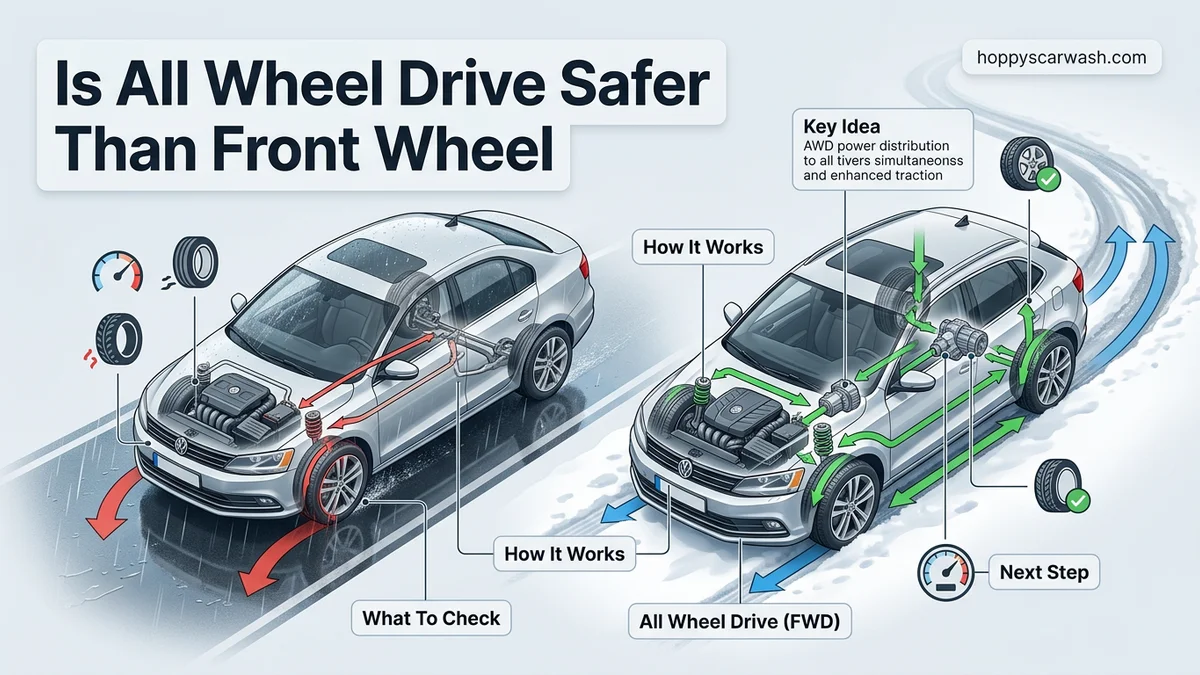
All-wheel drive (AWD) is not inherently safer than front-wheel drive (FWD) for everyday stopping and steering. While AWD excels at getting your vehicle moving in snow and rain by distributing power to all four wheels, both systems brake and turn identically when equipped with the same tires.
All-wheel drive (AWD) is not inherently safer than front-wheel drive (FWD) when it comes to everyday driving, emergency maneuvering, or stopping distances. While AWD significantly improves your ability to accelerate and maintain forward momentum in snow, deep mud, and heavy rain, it provides zero advantage once you need to brake or turn on slippery surfaces.
As you evaluate vehicle options for 2026, understanding this distinction is critical for your safety on the road. Many drivers mistakenly believe that sending power to all four wheels makes a car immune to winter hazards, leading to a false sense of security that frequently results in winter collisions.
Key Takeaways
- AWD dramatically improves acceleration traction in deep snow and slick road conditions.
- FWD and AWD vehicles stop in the exact same distance given identical tires.
- AWD creates a false sense of security, leading drivers to drive too fast for conditions.
- Tires matter far more for winter safety than choosing AWD over FWD.
- FWD offers better fuel economy and lower long-term maintenance costs.
What Causes the Safety Confusion Between AWD and FWD
The primary confusion between AWD and FWD stems from how a vehicle behaves when you press the gas pedal versus the brake pedal. Marketing campaigns heavily emphasize the launch capabilities of AWD systems, cementing the idea that power at all four corners equals total control.
The Acceleration Versus Braking Fallacy
When you start from a dead stop at a snowy 2026 intersection, an AWD system distributes power to the wheels with the most grip, allowing you to pull away smoothly. A FWD vehicle, relying solely on the weight of the engine over the front axle, may struggle with wheel spin.
- AWD Advantage: Distributes engine torque to all four tires to prevent localized wheel slip during acceleration.
- FWD Limitation: Concentrates 100 percent of drive force into two wheels, making it easier to lose traction when starting on ice.
- The Equalizer: Once your vehicle is moving at 45 mph, the method of acceleration matters very little compared to tire chemistry and braking physics.
The Physics of Stopping Distance
You might assume that a heavier, more complex drivetrain helps a vehicle stop faster. In reality, stopping distance is determined exclusively by tire traction, road conditions, and your braking system. An AWD vehicle and a FWD vehicle equipped with the exact same all-season tires will require the exact same distance to brake from 60 mph to zero. In some cases, the heavier weight of an AWD system actually increases momentum, requiring slightly more distance to stop.
How to Test and Compare AWD Versus FWD Traction Limits
Understanding where these drivetrains reach their limits requires looking at how they handle adverse weather dynamics. You can evaluate their real-world performance by analyzing how they manage traction loss in severe conditions.
Deep Snow and Heavy Rain Performance
In unplowed 2026 winter streets or during torrential downpours, AWD systems shine by continuously shifting power to prevent getting stuck. If you live in a region with heavy snowfall, an AWD crossover or sedan will pull through drifts where a FWD vehicle would high-center or spin its front tires.
- Hydroplaning Resistance: FWD and AWD perform similarly; hydroplaning is a function of tire tread depth and speed, not which wheels receive engine power.
- Cornering Under Power: AWD can pull a vehicle through a snowy turn more neutrally, whereas FWD tends to understeer (plow straight) if you apply too much throttle.
The Danger of Overconfidence
The biggest safety hazard associated with AWD is psychological rather than mechanical. Because AWD masks slippery conditions during acceleration, you tend to drive faster than conditions warrant. When you eventually need to brake hard or steer around an obstacle, the AWD system offers no extra grip, often resulting in a slide that catches unprepared drivers by surprise.
Step-by-Step Guide to Choosing the Right Drivetrain for Your Climate
Selecting between all-wheel drive and front-wheel drive depends heavily on your local weather patterns and driving habits. Analyzing your regional climate helps prevent overpaying for capability you rarely need while ensuring safety when conditions deteriorate.
1. Assess Your Regional Snowfall and Winter Severity
Review historical local snowfall data for your primary driving routes. If your municipality regularly experiences over six inches of snow accumulation before roads are cleared, AWD provides a tangible traction advantage. For regions with mild winters, heavy rain, or occasional light dusting, FWD paired with dedicated winter tires offers more than enough security.
2. Evaluate Your Daily Commute Topography
Analyze the geography of your standard routes. Steep inclines, unpaved mountain passes, and rural roads that lack prompt snowplow service favor the deployment of an AWD system. Conversely, flat urban and suburban commutes rarely justify the mechanical complexity and fuel economy penalty associated with four-driven wheels.
3. Factor in Your Budget and Long-Term Ownership Costs
Calculate the total cost of ownership beyond the initial dealership sticker price. AWD systems typically add $1,500 to $3,000 to purchase prices and reduce fuel economy by one to two miles per gallon. Furthermore, AWD components require specialized fluid changes and identical tire wear tolerances, increasing maintenance expenses through 2026 and beyond.
What If Your AWD Vehicle Still Slides on Ice
Even the most advanced all-wheel-drive systems cannot repeal the laws of physics when encountering sheet ice or driving on worn-out tread. If your AWD vehicle loses grip and begins to slide, immediate corrective action is required to regain control.
- Ease off the accelerator immediately: Avoid sudden braking or abrupt steering inputs that can upset the vehicle’s remaining balance on slick surfaces.
- Steer smoothly into the slide: Point your front wheels in the exact direction you want the front of the vehicle to travel until traction recovers.
- Check your tire compound and tread depth: If sliding persists across multiple winter storms, your tires may be hardened by age or lack adequate siping. Replacing a set of four all-season tires with dedicated winter tires typically costs between $600 and $1,200 installed.
- Inspect the AWD mechanical system: If power is visibly failing to transfer to the rear wheels during slip conditions, visit a certified mechanic for a diagnostic scan. Electronic differential actuator repairs generally range from $350 to $900 depending on the vehicle make and model.
Conclusion
Ultimately, all-wheel drive improves acceleration and traction in deep snow, but it does not shorten stopping distances or improve high-speed cornering on slippery surfaces compared to front-wheel drive. According to verified research from the Insurance Institute for Highway Safety and automotive engineering experts, proper tire selection remains far more critical for overall winter driving safety than the number of driven wheels. Your immediate next step should be checking your current tire tread depth with a gauge to ensure you are ready for the 2026 winter season.
❓ Frequently Asked Questions
Does all-wheel drive help you turn more safely on slippery roads?
No, AWD primarily provides power to the wheels to keep the car moving forward. Once you begin cornering on ice or snow, steering control relies entirely on your tires and vehicle speed.
Why do people think AWD is safer in all winter conditions?
Drivers often confuse the ability to accelerate easily in deep snow with overall vehicle safety. Because an AWD car pulls away from a stoplight without slipping, drivers assume it will stop and turn just as easily.
Are winter tires more important than having all-wheel drive?
Yes, dedicated winter tires provide significantly more safety for stopping, turning, and accelerating on ice and snow than any drivetrain system combined with all-season tires.
What are the main downsides of choosing AWD over FWD?
AWD vehicles are heavier, more expensive to purchase, consume more fuel, and feature more mechanical components that can require costly repairs over time.
Does front-wheel drive struggle on steep hills in winter?
FWD can struggle to maintain traction on steep, unplowed snowy hills because weight transfers backward away from the front driving wheels during acceleration.
Can I switch a front-wheel drive car into all-wheel drive?
No, drivetrains are built directly into the vehicle’s manufacturing architecture, meaning you cannot convert a standard FWD vehicle into an AWD system.