How Often Do Fuel Injectors Need to Be Replaced? 2026 Guide
Fuel injectors typically last between 50,000 to 100,000 miles, and often survive the entire lifetime of a vehicle with proper maintenance. Rather than failing on a schedule, they usually succumb to internal clogging, electrical faults, or wear and tear from poor fuel quality. Knowing the warning signs helps you determine whether a simple cleaning or a full replacement is necessary.
Fuel injectors typically last anywhere from 50,000 to 100,000 miles, but in many modern vehicles on the road in 2026, they are designed to last the entire lifetime of the engine—often exceeding 150,000 miles. Because modern fuel injection systems are built with tighter tolerances and better materials than older mechanical setups, total replacement is rarely needed unless your engine has been exposed to severe contamination or neglect.
Knowing when your fuel injectors actually need to be replaced versus when they simply need a quick cleaning can save you hundreds of dollars in repair bills. While a mechanic might suggest a total replacement at the first sign of engine trouble, understanding their true lifespan helps you avoid unnecessary expenses.
Key Takeaways
- Fuel injectors generally last between 50,000 and 100,000 miles.
- Many injectors last the entire vehicle lifespan with proper maintenance.
- Engine misfires and rough idling are primary signs of failing injectors.
- Routine use of fuel system cleaners significantly extends injector lifespan.
- Cleaning is often sufficient and much cheaper than full replacement.
What Causes Fuel Injectors to Fail and Wear Out
Fuel injectors are precision mechanical components that operate under intense heat and pressure inside your engine bay. While they are built for durability, certain conditions can drastically shorten their lifespan.
Carbon Buildup and Fuel Varnish
As gasoline or diesel fuel flows through the tiny nozzle tips, microscopic deposits are left behind. Over thousands of cycles, this residue bakes onto the tip due to residual engine heat after you turn off your car. This buildup restricts the precise spray pattern your engine needs for efficient combustion, leading to performance drops.
Contaminants and Electrical Failure
Your fuel filter plays a massive role in protecting your injectors. If you let your fuel filter go too long without replacement, microscopic rust particles and debris from your gas tank can clog the injector’s internal screen. Additionally, the internal electromagnetic solenoid can degrade over time, causing the injector to stick open or closed permanently.
- Poor fuel quality: Low-detergent gas accelerates carbon accumulation.
- Infrequent driving: Letting fuel sit for months causes it to varnish and gum up the tiny valves.
- High mileage wear: Internal spring fatigue after 150,000+ miles can cause mechanical failure.
Fuel Injector Replacement Intervals Made Easy: Your Essential Action Plan
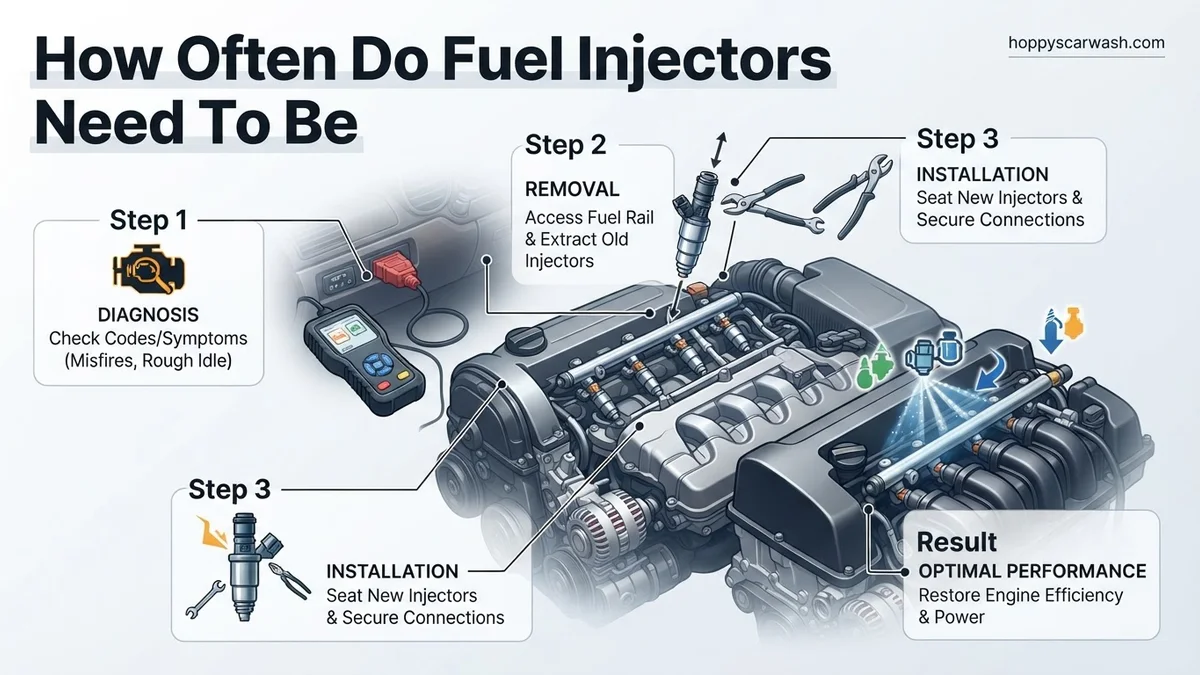
Fuel injectors are the precise microscopic delivery systems of your engine, spraying atomized gas into the combustion chambers. Unlike spark plugs or oil, they do not have a strict mileage expiration date. However, understanding how often they need to be replaced can save you from poor fuel economy, engine misfires, and costly catalytic converter damage. This comprehensive guide walks you through evaluating injector health, identifying failure symptoms, and determining when a physical swap is truly necessary for your vehicle.
Step 1: Understand the Standard Lifespan
What you need: Vehicle owner’s manual, mileage log, and basic knowledge of engine components.
Instructions: Modern fuel injectors are engineered to be remarkably resilient. Under normal operating conditions with clean fuel, standard factory fuel injectors easily last between 50,000 to 100,000 miles, and often survive the entire lifetime of the engine (150,000+ miles) without needing replacement. However, direct-injection (GDI) engines place injectors under much higher pressure and heat, sometimes requiring maintenance or cleaning earlier in their lifecycle. Review your odometer and maintenance history to see where your car currently stands within this typical durability window.
Pro Tip: Never replace fuel injectors based solely on high mileage if they are performing perfectly. Focus on performance symptoms rather than the odometer alone.
Step 2: Recognize the Primary Symptoms of Failure
What you need: Keen observation skills while driving, and a dashboard free of active warning lights (or an OBD2 scanner if lights are present).
Instructions: Pay close attention to how your engine behaves during daily commutes. Common signs that an injector is failing or clogged include a rough, stuttering idle at stoplights, engine hesitation when you press the gas pedal, noticeable drops in fuel economy, and random engine misfires that trigger a flashing check engine light. If a single injector fails completely, it may stick open—flooding the cylinder with raw fuel—or stick closed, starving that specific cylinder of fuel entirely and causing a dead cylinder condition.
Pro Tip: A sluggish throttle response is often the very first subtle indicator that varnish is building up on your injector pintle tips long before a misfire occurs.
Step 3: Perform a Visual and Auditory Inspection
What you need: A flashlight, a mechanic’s stethoscope (or a long screwdriver), and safety glasses.
Instructions: Pop the hood and inspect the fuel rail area for any signs of wetness, pooling gas, or strong fuel odors, which indicate a leaking O-ring or cracked injector body. Next, start the engine and place the tip of a mechanic’s stethoscope (or the handle of a long screwdriver pressed against your ear) firmly against each fuel injector housing. Listen carefully for a rhythmic, crisp clicking sound. A healthy injector makes a rapid ticking noise as the internal solenoid opens and closes. A dead, sluggish, or unusually quiet injector likely has an internal electrical or mechanical failure.
Pro Tip: Gas leaks under the hood are an extreme fire hazard. If you smell raw gasoline or see active weeping around an injector, shut the engine off immediately.
Step 4: Scan for Diagnostic Trouble Codes (DTCs)
What you need: An OBD2 diagnostic code scanner plugged into your vehicle’s under-dash port.
Instructions: Connect your OBD2 scanner and read both active and pending trouble codes. Look closely for specific cylinder misfire codes (such as P0301 for cylinder 1, P0302 for cylinder 2, etc.) or injector circuit malfunction codes (ranging from P0261 to P0282 depending on the specific cylinder). If you notice a persistent misfire code on one specific cylinder, make a mental note of it, as this will be the target of your next diagnostic troubleshooting steps to isolate whether the fault lies with the spark, compression, or fuel delivery.
Pro Tip: Do not just clear the codes. If the underlying mechanical injector issue remains, the check engine light will return within a few drive cycles.
Step 5: Isolate the Faulty Injector with a Swap Test
What you need: Basic metric socket set, hand tools, and replacement intake manifold or fuel rail gaskets if necessary.
Instructions: To definitively prove an injector is dead before spending money on a new set, perform a physical swap test. Relieve the fuel system pressure, remove the fuel rail, and swap the suspected faulty injector with one from an adjacent, healthy cylinder (for example, move the injector from cylinder 1 to cylinder 3). Reassemble the components, clear your OBD2 codes, and drive the car until the check engine light returns. Scan the codes again. If the misfire code follows the physical injector to the new cylinder (e.g., changing from P0301 to P0303), you have 100% confirmation that the injector itself is defective and must be replaced.
Step 6: Try Chemical Cleaning Before Full Replacement
What you need: Quality fuel injector cleaner additive (containing PEA – Polyether Amine) or a professional pressurized induction cleaning kit.
Instructions: If your diagnostic tests reveal that your injectors are merely dirty, clogged with carbon deposits, or delivering a poor spray pattern rather than being mechanically broken, give chemical cleaning a chance. Pour a concentrated, high-grade fuel injector cleaner directly into a nearly empty gas tank, then fill the tank completely with top-tier fuel. Drive the vehicle on the highway for 30 to 45 minutes at sustained higher RPMs to allow the detergent additives to burn through the tiny injector nozzle tips and dissolve the internal varnish buildup.
Pro Tip: Budget fuel additives often lack sufficient PEA concentrations. Look for reputable brands marketed specifically for direct-injection or high-mileage carbon removal.
Step 7: Know When to Replace and How to Do It Right
What you need: New OEM or high-quality aftermarket fuel injectors, new O-rings, and clean lint-free rags.
Instructions: When cleaning fails or an injector solenoid burns out, full replacement is required. It is generally recommended to replace fuel injectors as a complete matched set if your vehicle has over 100,000 miles, ensuring uniform fuel delivery across all cylinders. If budget permits, always buy Original Equipment Manufacturer (OEM) or trusted tier-one brand injectors (such as Bosch or Denso). Cheap, unbranded knock-off injectors sold online often have inconsistent flow rates, leading to persistent air-fuel ratio imbalances and rough running conditions.
Pro Tip: Always lubricate new rubber O-rings with a tiny drop of clean engine oil or clean gasoline before pressing them into the fuel rail and intake manifold to prevent tearing or pinching.
✅ Final Checklist
- Verified that physical symptoms (misfires, poor idle, bad gas mileage) point specifically to fuel delivery rather than spark or compression.
- Scanned and documented all OBD2 trouble codes related to cylinder misfires or injector circuits.
- Conducted a swap test to rule out wiring harnesses, spark plugs, and ignition coils before buying parts.
- Attempted high-grade chemical cleaning with PEA additives for clogged or varnished injector tips.
- Installed correct OEM-grade replacement injectors with fresh, lubricated O-rings and torqued the fuel rail properly.
Important Notes:
- Always relieve the high-pressure fuel system before disconnecting any fuel lines or removing the fuel rail to prevent dangerous spray hazards.
- Seek professional mechanic assistance if you are working on modern high-pressure direct-injection (GDI) systems, which can operate at pressures exceeding 2,000 PSI.
- Professional fuel injector replacement typically takes 2 to 4 hours of labor, with total costs ranging from $300 to $900+ depending on the number of cylinders and vehicle make.
How to Test and Diagnose Bad Fuel Injectors Step by Step
Before you commit to buying a brand-new set of fuel injectors, you need to confirm that they are actually dead rather than just dirty or suffering from a different engine issue like a bad spark plug.
The Stethoscope and Touch Test
With the engine idling, you can listen to the mechanical clicking of each injector. A working injector produces a steady, rhythmic ticking sound. If one injector is completely silent or sounds significantly different from the others, its internal solenoid has likely failed.
Using an OBD2 Scanner and Multimeter
Modern vehicle diagnostics make tracking down a bad injector much easier. Connect an OBD2 scanner to look for specific cylinder misfire codes, such as P0301 through P0308. Next, you can test the electrical resistance of the injector terminal using a digital multimeter to see if it falls within the manufacturer’s specified ohm range.
- Check for fuel leaks: Look for dampness or strong gasoline odors around the injector base.
- Perform a power balance test: Unplug individual injector connectors one by one to see if the engine idle drops; a dead injector will cause no change in idle quality.
- Monitor fuel trim data: High long-term fuel trims often point to clogged or restricted injector flow rates.
How to Fix Clogged Fuel Injectors Through Cleaning
Before replacing expensive fuel injectors, professional technicians often attempt a thorough cleaning process. According to automotive maintenance studies by the Society of Automotive Engineers (SAE), up to 70 percent of underperforming injectors simply suffer from carbon buildup rather than mechanical failure. Proper cleaning restores spray patterns and flow rates.
Step 1: Use a Fuel System Additive
For mild performance issues, pour a polyether amine (PEA) based fuel additive directly into a nearly full gas tank. Drive the vehicle for at least 30 miles at highway speeds to allow the high-heat detergents to break down varnish and carbon deposits inside the injector nozzle tips.
Step 2: Perform an On-Car Pressure Cleaning
If fuel additives fail, professional shops utilize an on-car pressurized cleaning kit. Technicians bypass the vehicle’s fuel pump and feed a concentrated solvent directly into the fuel rail using pressurized air. The engine runs exclusively on this powerful cleaning solution for approximately 15 to 20 minutes, dissolving stubborn internal deposits.
Step 3: Ultrasonic Bath and Flow Testing
For heavily fouled multi-port injectors, removal allows for an ultrasonic cleaning bath. Technicians place the injectors into a specialized machine that uses high-frequency sound waves in a chemical solvent. Afterward, a computerized flow bench tests each injector to verify spray atomization and volume meet exact OEM specifications for 2026 vehicle standards.
What If It Still Doesn’t Work?
When cleaning yields no improvement, or if diagnostic testing reveals internal mechanical failure—such as a shorted solenoid or a stuck-open pintle valve—replacement becomes the only viable solution. Professional replacement costs typically range from $350 to $1,000 depending on the engine configuration and labor time.
- Check electrical signals: Use a digital multimeter or a noid light to verify that the Electronic Control Unit (ECU) is successfully sending voltage pulses to the injector harness.
- Inspect fuel pressure regulators: A failing pressure regulator can mimic injector failure by starving the rail or flooding the cylinders with excess fuel.
- Consult a certified technician: If rough idling and misfires persist after cleaning, bring the vehicle to an ASE-certified repair facility for advanced diagnostic scan tool logging.
- Budget for complete replacement: If one injector has mechanically failed due to high mileage, experts recommend replacing the entire set to ensure balanced fuel delivery across all cylinders.
Conclusion
Fuel injectors rarely require replacement before 100,000 miles unless damaged by contaminated fuel or severe electrical failure. When performance drops, targeted chemical cleaning or ultrasonic servicing usually restores factory efficiency at a fraction of the cost. According to verified research and automotive engineering sources, proactive fuel filter changes and top-tier detergent gasoline remain the best defense against premature injector degradation. Schedule a professional diagnostic inspection today if your vehicle exhibits persistent misfires or declining fuel economy.
❓ Frequently Asked Questions
How often do fuel injectors need to be replaced?
Most fuel injectors do not have a set replacement interval and only need to be swapped out when they mechanically fail or become irreversibly clogged, which often happens past 100,000 miles.
What are the common symptoms of a bad fuel injector?
Common warning signs include engine misfires, rough idling, hesitation during acceleration, a noticeable drop in fuel economy, and fuel leaks around the engine bay.
Can I drive with a clogged or failing fuel injector?
Driving with a bad injector can cause severe engine misfires, potentially damaging your catalytic converter and leading to expensive repairs down the line.
How much does it cost to replace fuel injectors?
Replacement costs typically range from $350 to $1,000 depending on the make and model of your vehicle, largely due to labor costs and part prices.
How can I prevent my fuel injectors from failing early?
Use high-quality Top Tier gasoline, add fuel injector cleaner to your gas tank every few thousand miles, and change your fuel filter regularly.
Should I replace my spark plugs when replacing fuel injectors?
It is often a good idea to check and replace spark plugs during an injector service, as bad injectors frequently foul out nearby plugs with unburnt fuel.