How Much Transmission Fluid for Chevy Silverado 2026 Guide
Finding out how much transmission fluid for a Chevy Silverado is required depends heavily on your specific model year, transmission type, and whether you are performing a standard filter change or a dry fill. A standard pan drop and filter change typically requires 5 to 7 quarts, while a complete dry fill can demand anywhere from 11 to 14+ quarts.
Finding the exact amount of transmission fluid your Chevy Silverado needs depends heavily on your specific model year and transmission type. If you are servicing a modern 2026 Silverado or an older generation, capacities range anywhere from 5 quarts for a simple pan drop up to 13 quarts for a complete dry fill on heavy-duty models.
Getting this measurement right is critical for maintaining shifting performance and preventing premature clutch wear. Putting in too little fluid causes slipping and overheating, while overfilling creates foaming that starves the system of hydraulic pressure.
Key Takeaways
- Standard fluid and filter changes require significantly less fluid than total dry system rebuilds.
- Verify your exact transmission model, such as the 4L60E, 6L80, 8L90, or 10L80.
- Always use the specific fluid type recommended for your year, like Dexron VI or ULV.
- Check fluid levels at normal operating temperature on a completely level surface.
- Consult your specific owner’s manual to prevent costly underfilling or overfilling mistakes.
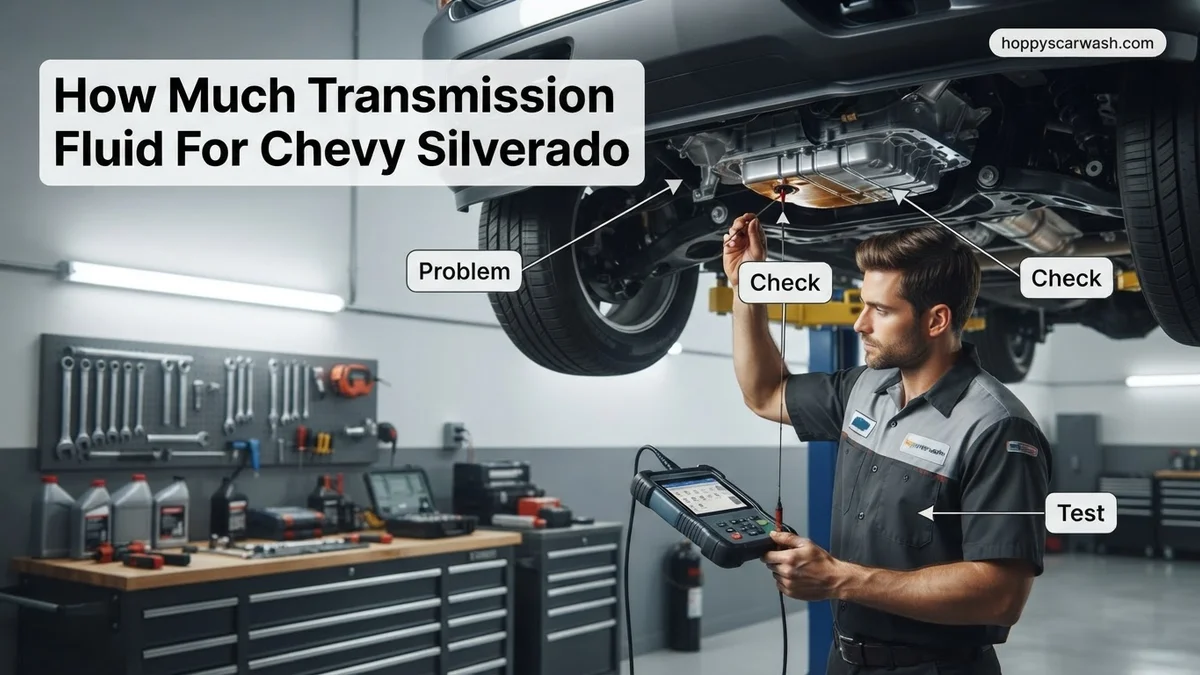
What Causes Incorrect Transmission Fluid Levels in a Chevy Silverado
Leaking Seals, Gaskets, and Cooler Lines
Physical leaks are the most common reason your Silverado ends up running low on transmission fluid. Over time, factory pan gaskets degrade, output shaft seals dry out, and the quick-disconnect fittings on transmission cooler lines begin to seep. If you spot red puddles under your truck, you are steadily losing capacity.
Inaccurate Refill After a Service
Many DIY mechanics underfill their transmissions during routine maintenance by failing to distinguish between a standard filter change and a total dry rebuild. When you simply drop the pan, you only drain a fraction of the total fluid. Pumping in a full dry-fill amount will severely overfill the transmission.
- Failing to account for fluid trapped in the torque converter
- Not checking fluid temperature during the dipstick or plug verification process
- Using an uneven surface when measuring fluid levels
Master Determining Chevy Silverado Transmission Fluid Capacity in 6 Simple Steps
Figuring out exactly how much transmission fluid your Chevy Silverado needs can feel like guessing in the dark, especially given the dozens of engine, year, and transmission combinations out there. Putting the wrong amount in can cause slipping, overheating, or catastrophic internal damage. This comprehensive guide walks you through the exact process of identifying your specific truck’s transmission configuration, calculating the correct fluid volume for both standard changes and total rebuilds, and verifying the level safely so your Silverado shifts smoothly for years to come.
Step 1: Identify Your Exact Silverado Year, Engine, and Transmission Code
What you need: Your vehicle’s Owner’s Manual, registration card, or the Service Parts Identification (SPID) sticker usually located inside the glove box or driver’s door jamb.
Instructions: Start by writing down the exact model year and engine size of your Chevy Silverado (for example, a 2018 5.3L V8). Next, you must identify which transmission is bolted to that engine, as GM paired Silverados with several options over the years, including the 4L60E/4L80E, the 6L80/6L90, the 8L90, and the heavy-duty 10L1000. Look at the three-letter or alpha-numeric codes on your glove box door sticker (such as MYC, M5T, MHW, or MQB) and cross-reference them with your owner’s manual to pinpoint your exact transmission model.
Pro Tip: Never rely solely on the truck’s model year when buying fluid or filters. Mid-year production changes are extremely common in Chevy trucks, meaning a late-year build might utilize a completely different transmission pan design and fluid volume than an early-year build of the exact same trim.
Step 2: Determine Fluid Capacity Based on Service Type (Pan Drop vs. Dry Fill)
What you need: A notepad, internet access or your service manual, and an understanding of the maintenance job you are performing.
Instructions: Once you know your transmission model, look up the fluid capacity for your specific service scenario. A standard fluid change and filter replacement (dropping the pan) typically requires between 5 to 7 quarts for light-duty 6-speed and 8-speed transmissions, because a significant amount of old fluid remains trapped inside the torque converter and cooler lines. Conversely, a completely dry transmission—common after a total rebuild, torque converter replacement, or complete system flush—will require anywhere from 11 to 14+ quarts, particularly for heavy-duty 10-speed variants or trucks equipped with auxiliary transmission coolers.
Pro Tip: Always buy at least 1 or 2 extra quarts more than the technical specification sheet calls for. It is better to have unopened bottles left over to return than to run out of fluid halfway through a Sunday afternoon garage project.
Step 3: Match the Correct Fluid Specification to Your Transmission
What you need: Your vehicle manual, pen, and a list of approved GM fluid certifications.
Instructions: Quantity means nothing if you pour the wrong chemical formulation into your transmission. Older Silverados (pre-2006 typically) generally use standard DEXRON III or VI. Modern Silverados with 6-speed and 8-speed transmissions strictly require DEXRON VI. Furthermore, newer 8-speed and 10-speed transmissions (like the 8L90 and 10L80) often require specialized formulations such as Mobil 1 Synthetic LV ATF HP or specific GM Blue Label standards to prevent shuddering and clutch damage. Check the back of the fluid bottle to ensure it explicitly lists compatibility with your specific GM transmission specification number.
Pro Tip: Avoid cheap, universal “multi-vehicle” transmission fluids unless they explicitly list the exact GM specification code on the label. Modern Silverado transmissions have extremely tight tolerances and electronic clutch controls that demand exact fluid viscosities.
Step 4: Prepare Your Silverado and Get Accurate Operating Temperatures
What you need: A flat, level surface, wheel chocks, a floor jack, heavy-duty jack stands, and an OBD2 scanner or an infrared thermometer.
Instructions: Park your Silverado on a completely flat, level surface and apply the emergency brake securely. Chock the rear wheels if you are only lifting the front, or lift the entire vehicle evenly on four jack stands if you need maximum working clearance. To check or fill most modern Silverado transmissions accurately, the transmission fluid must be at a specific operating temperature—usually between 85°F and 122°F for 6L80/8L90 units, or up to 180°F for older dipstick models. Start the engine, run through all the gear selections (P-R-N-D-L) pausing for 3 seconds on each, and let the transmission reach the required temperature window.
Pro Tip: Never attempt to check fluid levels on a stone-cold modern Silverado transmission. Thermal expansion causes transmission fluid to occupy significantly more volume at operating temperature, leading to severe under-filling if checked cold.
Step 5: Safely Drain, Replace the Filter, and Pump in the Correct Amount
What you need: Drain pan, socket set, new transmission filter, pan gasket, clean rags, and a fluid transfer pump or turkey baster style syringe.
Instructions: Place your drain pan underneath the transmission pan and remove the drain plug (if equipped) or slowly loosen the pan bolts to let the fluid spill out. Once drained, remove the pan completely, clean the magnetic debris off the bottom of the pan, and replace the old filter. Reinstall the pan with a fresh gasket and torque the bolts to factory specifications (usually around 90-100 inch-pounds). Remove the fill plug (located on the side of the transmission housing for dipstick-less models) and use your fluid transfer pump to inject the exact amount of fresh fluid you calculated in Step 2 until it begins to trickle out of the fill hole.
Pro Tip: Be careful not to overtighten transmission pan bolts. Overtightening can warp the metal pan lip or crush the rubber gasket, creating persistent, hard-to-diagnose leaks underneath your truck.
Step 6: Perform the Final Level Check and Test Drive
What you need: Safety glasses, shop towels, gloves, and your OBD2 scanner to monitor live transmission fluid temperature.
Instructions: With the vehicle running, the engine at idle, and the transmission fluid sitting within the prescribed temperature range (verify via OBD2 live data), remove the side level check plug. A small steady stream or heavy drip of fluid should emerge; if nothing comes out, pump additional fluid in until it reaches a slow, consistent overflow. Reinstall the plug securely. Clean up any spilled fluid on the exhaust or frame. Lower the vehicle safely off the jack stands, take your Silverado out for a 10-minute test drive through town and highway speeds, and cycle through all the gears to ensure smooth shifting without hesitation or error codes.
Pro Tip: Keep an eye on your driveway or parking spot over the next 48 hours. Check underneath your Silverado daily to ensure there are no slow drips coming from the transmission pan gasket, cooling lines, or fill plugs.
✅ Final Checklist
- Verified the exact transmission model code using the vehicle’s SPID label and owner’s manual.
- Calculated the precise fluid volume required for your specific service (pan drop vs. dry system).
- Purchased the correct certified fluid type (such as DEXRON VI or specialized synthetic LV).
- Ensured the vehicle was completely level and raised safely on secure support stands.
- Checked fluid levels while the transmission was at the proper manufacturer-specified operating temperature.
Important Notes:
- Always wear safety glasses and heat-resistant gloves; transmission fluid and exhaust components can be dangerously hot during checking and filling procedures.
- Seek professional mechanic assistance immediately if you notice severe metal shavings in your old transmission pan, persistent slipping after a fluid change, or if your transmission throws stored diagnostic trouble codes (DTCs).
- Estimated time for a standard fluid and filter change is 1.5 to 3 hours. Estimated DIY cost ranges between $60 to $150 depending on fluid quality and filter kits, whereas professional shop services typically cost between $250 and $450.
How to Fix and Refill Your Silverado Transmission Fluid Properly
Draining, Flushing, and Measuring
To fix an incorrect fluid level, you must first establish a clean baseline. Drain the existing fluid completely into a marked bucket so you can measure exactly what came out. For standard 2026 Silverado models utilizing the 8-speed or 10-speed automatic transmissions, always replace the filter and clean the pan magnets before buttoning everything back up.
Refilling with the Correct Spec and Amount
Once your pan is reinstalled, pump in the initial recommended fluid capacity based on your transmission type. Modern Silverados require specific fluid formulations, typically Dexron ULV for newer 10-speed units or Dexron VI for older variants. Never guess the final level; bring the transmission up to operating temperature and check the dipstick or level check plug on a perfectly flat surface.
- Pump fresh fluid into the fill port or dipstick tube slowly
- Cycle through the gears (Park to Reverse to Drive) with the engine running
- Remove the level plug to let excess fluid escape until it reaches a steady trickle
Step-by-Step Guide to Checking Your Transmission Fluid Level
Accurately checking the transmission fluid on your 2026 Chevy Silverado prevents costly mechanical failures. Modern Silverado models with sealed 8-speed or 10-speed transmissions require precise temperature checks during the evaluation process.
Preparation and Temperature Requirements
Park your truck on a completely flat surface and set the parking brake firmly. Start the engine and let it idle until the transmission fluid reaches operating temperature, typically between 180°F and 200°F. Automotive service standards require monitoring this temperature via the digital driver information center or an OBD-II scanner before proceeding.
Procedure for Checking Fluid
Depending on whether your 2026 Silverado features a traditional dipstick or a sealed transmission plug, follow the correct procedure below:
- Shift through all gear selections slowly, pausing for three seconds on each gear, before returning the gear selector to Park.
- Leave the engine running while you work underneath or under the hood, ensuring safety glasses and heat-resistant gloves are worn.
- For models with a dipstick, pull it out, wipe it clean with a lint-free rag, reinsert it fully, and pull it out again to read the fluid level against the hot markings.
- For sealed transmissions, locate the check plug on the transmission pan, remove it, and verify that fluid is just beginning to trickle out of the fill hole.
- If the fluid level is low, use a fluid pump to add fluid incrementally until the correct level is achieved, then reinstall and torque all plugs to factory specifications.
What If It Still Doesn’t Work?
If you have topped off your transmission fluid to the correct specification for your 2026 Chevy Silverado and still experience shifting delays, slipping gears, or warning lights, deeper mechanical intervention is required. Transmission fluid solves low-level issues, but it cannot repair internal component failure.
Consider these fallback steps if the issue persists:
- Scan the vehicle computer for diagnostic trouble codes using an advanced OBD-II scanner to identify specific solenoid or pressure switch failures.
- Check the transmission control module (TCM) software for pending factory updates or calibration bulletins specific to the 2026 model year.
- Inspect external cooler lines and gaskets for hairline cracks that cause rapid pressure loss despite a full fluid capacity.
- Seek professional diagnostic assistance from a certified Chevrolet dealership or a specialized transmission repair facility.
- Prepare for potential internal repairs, noting that professional diagnostic labor typically ranges from $150 to $250, while major internal component overhauls can cost between $2,500 and $4,500 depending on the specific transmission variant.
Conclusion
Maintaining the correct transmission fluid capacity is vital for the longevity and performance of your 2026 Chevy Silverado. Whether you are performing a simple drain and fill requiring roughly 6 to 8 quarts or a complete system overhaul utilizing up to 13 quarts, precision matters. According to verified research and automotive service standards from GM, using the exact Dexron specification prevents premature wear and protects internal components. Your actionable next step is to check your transmission fluid temperature and inspect the pan for leaks today.
❓ Frequently Asked Questions
How much transmission fluid does a 2014-2018 Chevy Silverado 6L80 require?
For a standard filter change, a 6L80 transmission generally takes between 5 to 6 quarts of Dexron VI. A complete dry fill or total system flush can require up to 12 quarts.
What is the difference between fluid change capacity and total dry capacity?
Fluid change capacity only accounts for what drains out during a pan drop and filter change, leaving fluid inside the torque converter and cooler lines. Total dry capacity accounts for an entirely empty system.
How much fluid does the 8L90 transmission take in a Silverado?
The 8-speed 8L90 transmission typically requires about 6 to 7 quarts during a standard pan and filter service, and roughly 10 to 11 quarts for a completely dry system.
How do I check transmission fluid on a Silverado without a dipstick?
Many newer Silverados feature sealed transmissions. You must safely lift the vehicle, remove the check plug on the transmission pan while the fluid is at operating temperature, and verify fluid reaches the plug level.
What happens if I overfill my Chevy Silverado transmission?
Overfilling can cause the fluid to churn into foam from the rotating components inside the transmission, leading to erratic shifting, pressure loss, overheating, and potential seal damage.
Which transmission fluid specification is required for the 10L80 transmission?
The 10L80 transmission used in recent Silverado models typically requires Mobil 1 LV ATF HP or an equivalent fluid meeting GM’s specific ULV standards.