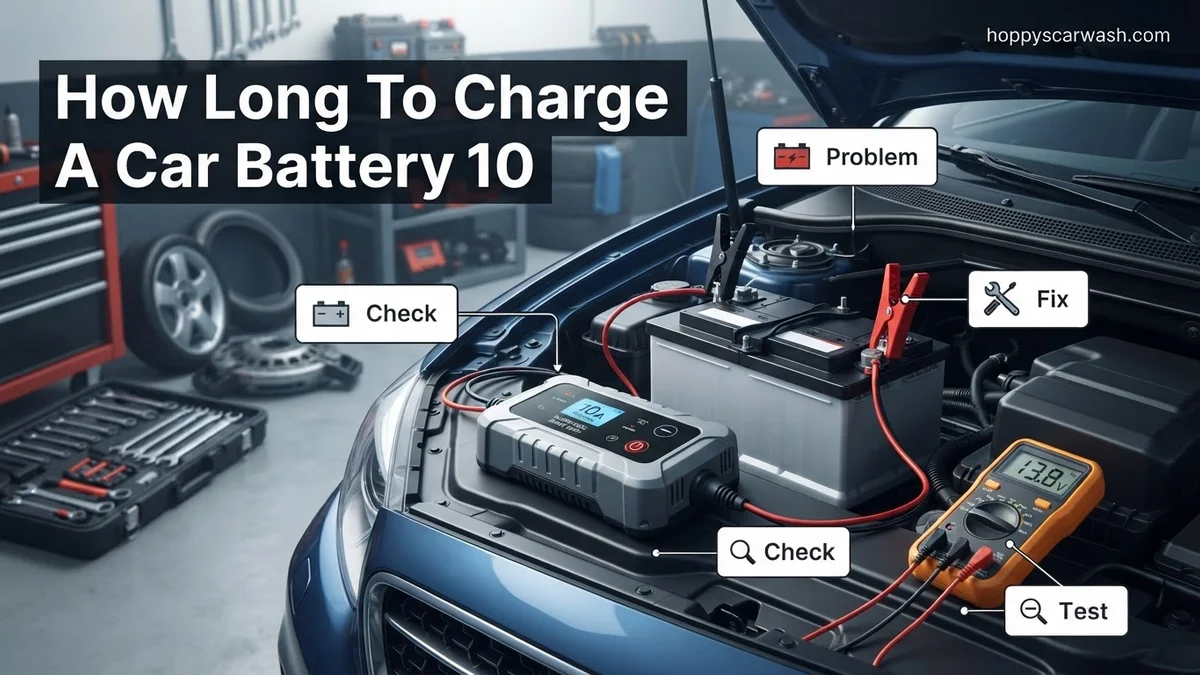
How Long to Charge a Car Battery 10 Amp Charger 2026 Guide
A standard car battery typically takes between 5 to 10 hours to fully charge using a 10-amp charger, depending on how depleted the battery is and its total capacity in Ah. Because charging efficiency is not 100%, actual times may vary slightly based on temperature and battery health.
Charging a standard car battery from completely dead using a 10-amp charger typically takes between 5 to 12 hours, depending heavily on your battery’s total capacity (Amp-hours) and its current depletion level. If your battery is only half-discharged, you can safely cut those estimated times in half.
By 2026, modern vehicle electrical demands mean that portable smart chargers have become essential garage tools. Knowing exact charging timeframes helps you plan your day, prevents overcharging, and ensures your vehicle is ready to hit the road without unnecessary waiting around.
Key Takeaways
- Divide the battery’s remaining Amp-hour (Ah) deficit by 10 to estimate base charging hours.
- A completely dead standard 50Ah battery takes roughly 6 to 8 hours at 10 amps.
- Modern smart 10-amp chargers automatically reduce amperage and shut off when full.
- Factor in roughly 10% to 20% extra time for heat loss and charging inefficiency.
- Always connect the red positive clamp first, followed by the black negative clamp.
What Causes Slow or Dead Car Batteries Requiring a 10 Amp Charge
Parasitic Drains and Accessory Overload
Modern vehicles feature dozens of computers, security systems, and infotainment modules that never truly shut down. These systems create a continuous low-level parasitic draw. If you leave your car parked for extended periods in 2026 without driving it, this background drain slowly depletes the battery. When voltage drops too low, a 10-amp charger provides the ideal steady current to revive the cells without generating the excessive heat of a rapid 50-amp shop boost.
Extreme Temperatures and Battery Aging
Both freezing winter cold and blistering summer heat accelerate internal battery degradation. Cold weather thickens engine oil and saps battery power, requiring maximum effort from the starter. If your battery is past its prime, the cold pushes it over the edge into a no-start condition. A 10-amp charger acts as a reliable medium-speed remedy, gently restoring chemical balance to sulfated lead plates inside standard flooded or AGM batteries.
How to Calculate Charging Time for a 10 Amp Charger
The Core Formula: Ah Capacity Divided by 10
To figure out exactly how long your specific battery will take to charge, you need to know its Amp-hour (Ah) rating, usually printed on the battery label. Divide that Ah number by the 10-amp output of your charger. For example, a standard 50 Ah battery divided by 10 amps equals 5 hours of theoretical charging time from zero percent.
Accounting for Charging Efficiency Losses
Physics dictates that no charging system is 100 percent efficient. Energy is lost primarily through internal resistance and heat generation during the electrochemical conversion process. You must factor in a roughly 15 to 20 percent efficiency loss for standard lead-acid batteries:
- Multiply your base calculation by 1.20 to find the realistic timeline.
- A theoretical 5-hour charge actually takes closer to 6 hours in real-world conditions.
- Smart chargers in 2026 will automatically taper current down to prevent overheating near the end of the cycle, which can add a bit more time to the final 10 percent of the charge.
Step-by-Step Guide on How to Safely Charge a Car Battery
Charging a car battery with a 10 amp charger requires careful adherence to safety protocols to prevent electrical shock, acid spills, or potential explosions from hydrogen gas buildup. Modern smart chargers simplify the process, but foundational safety steps remain non-negotiable for 2026 DIY mechanics.
Preparation and Setup
Before plugging in your charger, prepare the workspace and inspect the equipment for damage.
- Park the vehicle in a well-ventilated area, preferably outdoors or in an open garage, to dissipate any toxic or flammable gases safely.
- Turn off the vehicle ignition, all accessories, headlights, and the heating or air conditioning system.
- Inspect the 10 amp charger cables, clamps, and power cord for fraying, cracks, or exposed copper wiring.
- Put on safety glasses and chemical-resistant gloves to protect against residual battery acid and corrosion.
Connecting and Operating the Charger
Proper connection sequence prevents dangerous electrical sparks near the battery posts.
- Connect the positive (red) charger clamp to the positive terminal of the car battery, marked with a plus sign or “POS”.
- Connect the negative (black) charger clamp to a solid, unpainted metal grounding point on the engine block or vehicle chassis, away from the battery.
- Plug the 10 amp charger into a grounded 120V electrical outlet equipped with a GFCI circuit breaker.
- Select the correct battery chemistry setting on your charger, such as AGM, Gel, or standard flooded lead-acid, to match your specific battery.
- Power on the charger and monitor the initial current draw to ensure the unit operates normally without overheating.
- Once the charging cycle finishes and the unit indicates 100 percent capacity, unplug the charger from the wall outlet before disconnecting the cables in reverse order.
What If It Still Doesn’t Work?
If your 10 amp charger completes a full cycle and your vehicle still fails to start or the battery voltage reads below 12.4 volts, the battery may be permanently degraded. Automotive electrical experts note that sulfated plates or internal short circuits often prevent older batteries from accepting a charge.
- Perform a load test using a digital battery analyzer or visit a local auto parts store for complimentary diagnostic testing.
- Check the battery age printed on the case; standard lead-acid batteries rarely exceed a reliable operational lifespan of 3 to 5 years.
- Inspect battery terminals and cable ends for heavy corrosion, cleaning them thoroughly with a wire brush and a baking soda-water solution if necessary.
- Inspect the alternator output with a multimeter once the car is running to ensure the charging system is not the underlying cause of your power loss.
- Consult a certified professional mechanic if the electrical draw persists, which may indicate a parasitic drain in your vehicle wiring harness.
Replacement costs for a standard automotive battery typically range from $90 to $250, while professional diagnostic services usually cost between $50 and $150 depending on labor rates.
Conclusion
Using a 10 amp charger provides a reliable, balanced method to restore a depleted car battery over a predictable timeframe of 4 to 12 hours. By following correct safety procedures and matching the charger settings to your specific battery chemistry, you extend the overall operational life of your electrical system. According to verified research and expert automotive sources, routine preventive maintenance and timely recharging prevent unexpected roadside breakdowns. Take the next step today by testing your battery voltage with a digital multimeter to verify its current health status.
❓ Frequently Asked Questions
How many hours does it take to charge a 50Ah car battery at 10 amps?
A 50Ah battery at zero percent charge will take roughly 5 to 6 hours of continuous charging, factoring in standard thermal loss and resistance.
Does temperature affect 10-amp car battery charging times?
Yes, cold temperatures slow down the chemical reaction inside lead-acid batteries, which can increase overall charging times by a couple of hours.
Can a 10 amp charger damage my car battery if left too long?
Traditional manual 10-amp chargers can overboil and ruin a battery if left connected past full capacity. However, modern automatic smart chargers prevent this by switching to a trickle mode.
Should I disconnect the battery terminals from the car while charging?
It is generally safer to disconnect the negative terminal to protect sensitive onboard vehicle electronics from voltage spikes, though many modern smart chargers allow in-vehicle charging.
What is the difference between a 2-amp, 10-amp, and 50-amp charger?
A 2-amp charger is a slow trickle charger meant for maintenance, a 10-amp charger is a medium-speed charger ideal for standard recharges, and a 50-amp charger is typically used for rapid engine starting.
Why is my 10-amp charger taking longer than expected to finish?
Older batteries with degraded internal cells or high internal resistance draw less current and take significantly longer to absorb a full charge.