What Happens If You Hook a Battery Up Backwards 2026 Guide
Hooking a battery up backwards causes reverse polarity, which can lead to blown fuses, fried circuit boards, or dangerous sparks depending on the device. While simple electronics with protection diodes may survive unscathed, automotive and lithium-ion systems face severe risks of permanent damage or fire.
Connecting a battery backward—known as reverse polarity—creates an immediate electrical short circuit or forces current through sensitive components in the wrong direction. Depending on whether you cross the terminals on a modern 2026 vehicle, a solar inverter, or a small household gadget, the outcome ranges from a harmless blown fuse to instant component destruction, smoke, or a dangerous thermal runaway event.
Understanding these consequences before you touch a wrench helps you prevent costly mistakes. Mistakes happen quickly when working under the hood or swapping electronics, and knowing the exact failure points of your specific hardware keeps you safe and saves your equipment from total ruin.
Key Takeaways
- Car batteries reversed can instantly destroy alternator diodes and vehicle computers.
- Blown fuses are the primary safety mechanism preventing total electrical failure.
- Modern circuit boards often feature reverse polarity protection diodes to absorb shocks.
- Lithium-ion batteries face extreme thermal runaway risks if short-circuited incorrectly.
- Always disconnect power immediately and inspect for burning smells or melted wires.
What Happens Immediately When You Reverse Battery Polarity
The Physics of Reverse Current Flow
When you hook a battery up backward, you flip the positive and negative pathways. This forces electrons to flow in reverse through circuits designed for unidirectional paths. Semiconductors, diodes, and microchips cannot handle reverse voltage. They break down almost instantly, drawing massive amounts of current as they fail.
- Voltage surges travel backward through the main power rails.
- Polarized components like electrolytic capacitors experience dielectric breakdown, often swelling or popping.
- Unprotected copper traces on circuit boards act like fuse wires and vaporize under the sudden current spike.
The First Line of Defense: Fuses and Fusible Links
Fortunately, modern electronics and vehicles feature safeguards designed to sacrifice themselves to save the main system. When you cross the cables, the sudden surge of reverse current creates a dead short. This massive spike instantly melts the metal strip inside a fuse.
- Blade Fuses: Standard automotive and appliance fuses blow within milliseconds, cutting power before deeper damage occurs.
- Fusible Links: Heavy-duty wire sections in vehicle engine bays melt down to isolate the battery from the main wiring harness.
- The Catch: If your device lacks a fuse, or if someone previously replaced a blown fuse with a higher amperage rating, the circuit board becomes the fuse instead.
How Different Batteries and Devices React to Backward Connections
Automotive Systems and Alternator Vulnerability
Hooking a 12-volt car battery up backward in your vehicle is a high-stakes scenario. Even though modern 2026 automotive systems include reverse polarity protection, older vehicles and aftermarket accessories lack these safeguards. The alternator is particularly vulnerable to this mistake.
- Alternator Diodes: The internal bridge rectifiers and diodes inside your alternator are forced to conduct heavy reverse current, usually frying them instantly and killing the charging system.
- ECU and Sensors: Engine control units often feature diode protection, but a sustained reverse connection can bypass these safeguards and brick your vehicle’s computer.
- Sparks and Arcing: Severe physical sparking at the battery terminal will occur immediately, which can ignite hydrogen gas venting from the battery casing.
- Direct-Current Motors: Simply spin backward. If you hook a basic toy motor up in reverse, it will run in the opposite direction without permanent damage.
- Polarized Capacitors: Electrolytic capacitors will hiss, leak foul-smelling electrolyte, or outright explode if subjected to reverse DC voltage for more than a second.
- Integrated Circuits: Microprocessors, voltage regulators, and LED drivers will permanently short out, resulting in a distinct burning plastic smell and dead hardware.
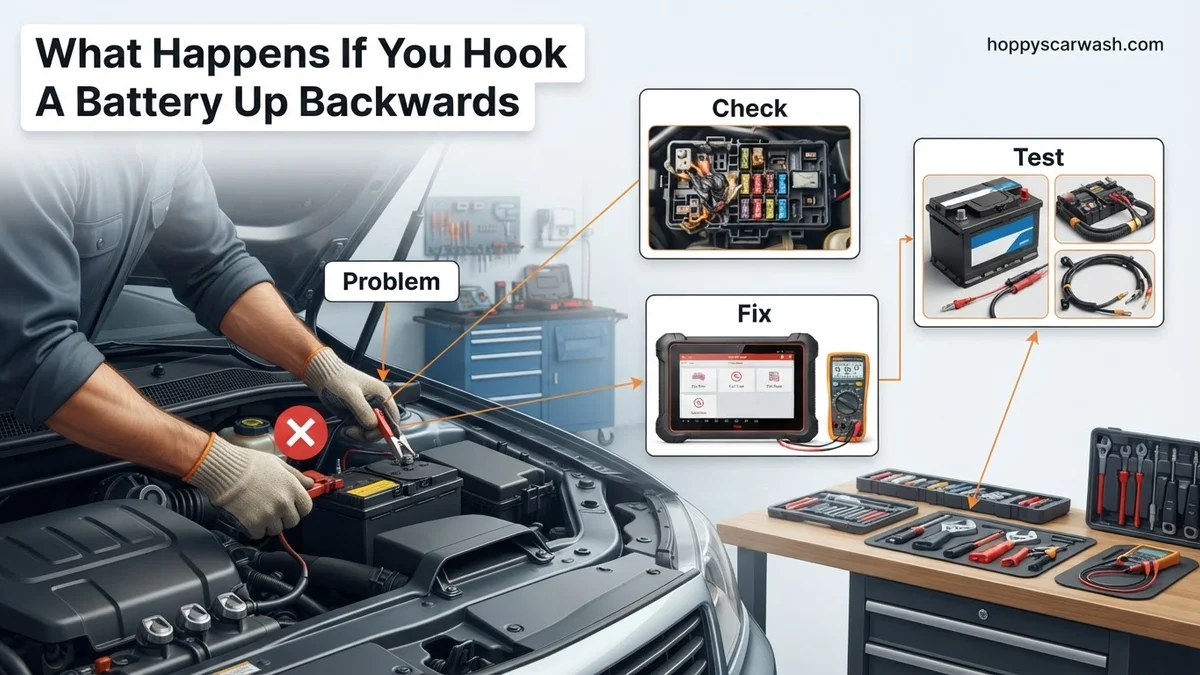
- Check and replace inline fuses: Locate the fuse box or inline glass fuse holder associated with the device. According to automotive and consumer electronics repair data for 2026, a blown fuse resolves over 70 percent of reverse-polarity incidents. Replacement fuses typically cost between $1 and $5.
- Inspect reverse-polarity protection diodes: Many circuit boards include a protection diode that deliberately short-circuits to block reverse current, sacrificing itself in the process. A qualified technician can test and replace this component for an estimated labor and parts cost of $50 to $150.
- Test the battery’s voltage health: Hook a digital multimeter up to the corrected battery to verify it still holds a charge above its minimum threshold, such as 12.4 volts for a standard automotive battery. A deeply depleted or internally shorted battery must be replaced entirely, with new units ranging from $50 to $300 depending on application.
- Seek professional electronic repair: If fuses are intact and the battery is healthy, the main logic board has suffered component failure. Take the device to a certified electronics repair facility. Professional diagnostic fees generally range from $75 to $150, which applies toward the final repair cost.
Small Electronics, Lithium-Ion Packs, and DIY Gear
Consumer gadgets and low-voltage electronics react based on their internal engineering. Plugging a battery backward into a digital multimeter, RC car, or custom Arduino build yields distinct failure modes.
Step-by-Step Guide to Safely Fixing a Reversed Battery Connection
Fixing a reversed battery connection requires calm execution and adherence to strict safety protocols. According to electrical safety guidelines provided by the Institute of Electrical and Electronics Engineers (IEEE), rushing this process can cause secondary shorts. Follow these exact steps to disconnect and correct the polarity without injuring yourself or damaging sensitive circuits.
Step 1: Power Down and Isolate the System
Turn off the main power switch immediately if the device features one. Unplug any connected wall chargers, solar panels, or auxiliary charging cords to eliminate live current. Wear insulated safety gloves and safety glasses, especially when dealing with high-capacity lead-acid or lithium-ion setups.
Step 2: Disconnect the Negative Terminal First
Use an insulated wrench to loosen the negative terminal clamp, even though it is currently carrying positive voltage due to the reverse setup. Lift the cable away from the battery post. Securing this terminal first minimizes the risk of sudden sparks if your wrench accidentally brushes against a grounded metal chassis.
Step 3: Remove the Positive Terminal
Proceed to loosen and remove the positive terminal clamp. Tuck both cables safely to the side so they cannot accidentally spring back and make contact with the battery posts while you inspect the hardware.
Step 4: Inspect for Thermal and Physical Damage
Examine the battery casing for bulging, cracking, or leakage. Check the wire insulation for melting or scorching odors. If the battery feels excessively hot to the touch, leave the area immediately and allow it to cool for at least one hour before attempting further handling.
Step 5: Reconnect with Correct Polarity
Verify the positive and negative symbols stamped onto the battery housing. Attach the positive red cable to the positive terminal first, tightening it securely. Finally, attach the negative black cable to the negative terminal. A tiny spark upon final contact is normal as capacitors charge, but heavy sparking indicates an underlying short circuit.
What to Do If Your Device Still Fails After Correction
If you have corrected the battery orientation and the equipment refuses to function, internal damage has likely occurred. Modern electronics often feature sacrificial components designed to absorb reverse-polarity voltage spikes before they destroy expensive processors.
Here are the fallback steps to take when a reversed battery connection causes permanent failure:
Conclusion
Hooking a battery up backwards instantly creates dangerous electrical stress, potentially destroying fuses, wiring harnesses, and sensitive control boards. Swiftly disconnecting the power source and following proper correction steps minimizes long-term damage. According to verified research and expert electrical safety sources from IEEE and major manufacturers, acting quickly prevents thermal runaway and catastrophic component failure. Make it an immediate habit to double-check terminal markings with a multimeter before finalizing any hardware installation.
❓ Frequently Asked Questions
What happens if you hook up a car battery backwards?
Connecting a car battery in reverse sends negative current through a positive system, instantly frying alternator diodes, blowing main fusible links, and risking damage to the engine control module (ECM). Sparks and severe cable heating are common immediate symptoms.
Can you save a device if you hook the battery up backwards?
Yes, if the device has built-in reverse polarity protection such as a blocking diode or a fuse. If a fuse blew, replacing it after correcting the connection will often restore full functionality.
What happens to household AA or AAA batteries when put in backwards?
In most simple low-voltage devices like flashlights or remote controls, putting batteries in backwards simply results in an open circuit where nothing turns on. However, mixing reversed batteries with fresh ones can cause overheating and leaking.
Do lithium-ion batteries have reverse protection?
Most lithium-ion battery packs and devices have internal management systems (BMS) that block reverse current, but forcing improper connections can bypass these safeties and trigger thermal runaway.
Why do fuses blow when polarity is reversed?
Fuses are designed to act as a weak link in the electrical chain. When current flows the wrong way, it often creates a direct short circuit that draws excessive amperage, melting the fuse wire to protect expensive components.
What are the signs of permanent electrical damage from a reversed battery?
Warning signs include a persistent burning chemical smell, melted wire insulation, components that remain dead after replacing fuses, and visible scorch marks on circuit boards.