How Do You Determine Tongue Weight of a Trailer 2026
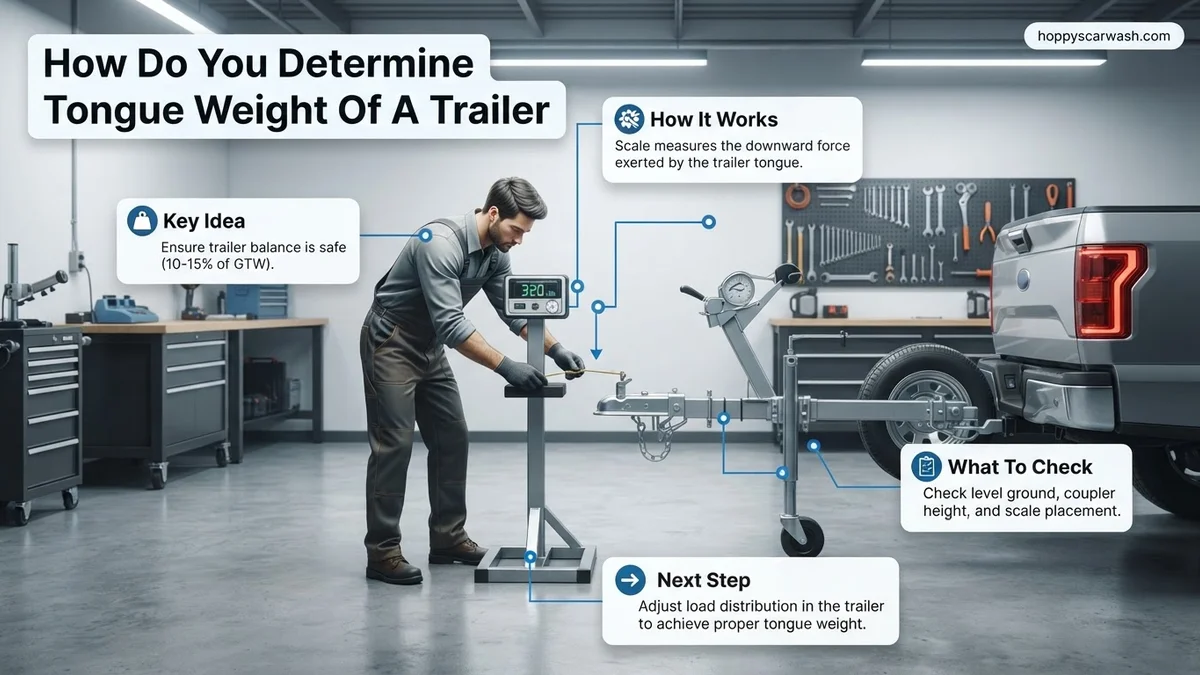
Proper tongue weight is essential for safe towing, ideally falling between 10% to 15% of your total trailer weight. Failing to measure tongue weight correctly can lead to dangerous trailer sway, loss of steering control, and uneven tire wear. You can easily determine this metric using standard bathroom scales, commercial scales, or specialized tongue weight devices.
Determining your trailer tongue weight requires measuring the downward force that the loaded trailer coupler exerts on your vehicle’s hitch ball. For most standard bumper-pull setups in 2026, this ideal downward force should fall between 10 to 15 percent of your total loaded trailer weight. If your trailer weighs 5,000 pounds, your target tongue weight is 500 to 750 pounds.
Getting this measurement right prevents dangerous trailer sway, reduces strain on your tow vehicle’s suspension, and keeps your steering and braking predictable. Whether you are hauling a lightweight utility trailer or a heavy-duty camper, taking a few minutes to measure your tongue weight before hitting the road is essential for safe towing.
Key Takeaways
- Ideal tongue weight is 10% to 15% of your total trailer weight.
- Use a standard bathroom scale for lighter utility and cargo trailers.
- Commercial truck scales provide accurate measurements for heavy travel trailers.
- Always measure while the trailer is completely loaded and parked on level ground.
- Adjust cargo placement forward or backward to correct improper tongue weight measurements.
What Causes Incorrect Tongue Weight and Why It Matters
The Physics of Improper Cargo Distribution
Incorrect tongue weight almost always stems from how you pack your gear. If you load too much weight behind the trailer axle, it acts like a seesaw, lifting the tongue and creating a dangerously low or even negative tongue weight. Conversely, piling all your heavy items right up against the front wall overloads the tongue. Both scenarios compromise your vehicle’s stability.
Safety Risks on the Road in 2026
Modern towing safety standards emphasize that improper tongue weight ruins your driving experience. Key issues include:
- Trailer Sway: Too little tongue weight causes the trailer to fishtail violently at highway speeds.
- Steering Loss: Too much tongue weight lifts the front tires of your tow vehicle, reducing traction and steering control.
- Component Failure: Overloading the hitch receiver or rear axle causes premature wear and potential mechanical failure.
Trailer Tongue Weight Made Easy: Your Essential Action Plan
Determining your trailer’s tongue weight is one of the most critical aspects of safe towing. Tongue weight is the downward force that the trailer tongue exerts on the hitch ball of your tow vehicle. If the tongue weight is too light, your trailer can sway dangerously at highway speeds; if it is too heavy, it can overload your vehicle’s rear suspension and compromise steering control. This guide walks you through the exact process of measuring tongue weight accurately, ensuring your next road trip is safe, stable, and stress-free.
Step 1: Understand Your Target Weight Range
What you need: Your trailer’s Gross Vehicle Weight Rating (GVWR) or current loaded weight, and a calculator.
Instructions: Before you lift a finger to measure, you need to know your target numbers. As a general industry standard, tongue weight should fall between 10% and 15% of your fully loaded trailer’s total weight. For example, if your loaded utility or travel trailer weighs 4,000 pounds, your ideal tongue weight should be between 400 and 600 pounds. Locate your trailer’s VIN plate to check its maximum capacity ratings, and estimate or weigh your cargo so you know what total loaded weight you are working with.
Pro Tip: Never guess your total trailer weight. Visit a certified public scale (like a CAT scale at a truck stop) to get an accurate baseline of your fully loaded trailer before calculating your target percentage.
Step 2: Park on a Level, Hard Surface
What you need: Your trailer, tow vehicle, and a flat concrete or asphalt parking area.
Instructions: Drive your trailer and tow vehicle to a completely flat, level surface, such as a large empty parking lot or a smooth driveway. Avoid sloped surfaces, gravel, or soft dirt, as these terrain variations will skew your measurements significantly. Chock the trailer wheels securely on both sides to prevent any unexpected rolling. Disconnect the trailer electrical plug, safety chains, and breakaway cable from the tow vehicle, and prepare to unlatch the coupler.
Pro Tip: Even a slight incline of just a few degrees can transfer weight off or onto the trailer axle, ruining the accuracy of your tongue weight calculation.
Step 3: Choose Your Measuring Equipment
What you need: A commercial tongue weight scale, a bathroom scale (for lighter trailers), or a commercial vehicle scale.
Instructions: Select the method that fits your trailer’s weight class. For lightweight utility, boat, or small pop-up camping trailers (under 300-500 pounds tongue weight), a standard digital bathroom scale or specialized mechanical tongue weight scale works well. For heavier travel trailers, horse trailers, or large cargo haulers, you will need a heavy-duty commercial hydraulic tongue weight scale or a specialized hitch-integrated scale that can safely support up to 1,500 pounds or more.
Pro Tip: If using a standard bathroom scale for a heavier trailer, never place the tongue directly on the glass surface; use a sturdy wooden beam setup to distribute the weight safely.
Step 4: Position the Scale at Hitch Height
What you need: Your chosen scale, wooden blocks, and a tape measure.
Instructions: Measure the height of the trailer coupler from the ground while the trailer is hitched to your level tow vehicle. Now, place your tongue weight scale directly beneath the trailer coupler. It is vital that the scale is positioned at the exact same height as your tow vehicle’s receiver hitch. If the scale sits too low or too high, the angle will cause inaccurate weight distribution readings. Use wooden blocks under the scale if necessary to achieve the correct elevation.
Pro Tip: Many commercial tongue weight scales come with an adjustable height post or stinger designed to match standard receiver heights perfectly.
Step 5: Lower the Trailer Coupler onto the Scale
What you need: A working trailer tongue jack and your tongue weight scale.
Instructions: Slowly and carefully operate your trailer tongue jack to lower the coupler down onto the center of the scale platform or specialized measuring post. Continue cranking the jack down until the trailer’s tongue weight is resting entirely on the scale, and the tongue jack foot is completely lifted off the ground. Step back and ensure the trailer is stable and the scale is bearing the full downward load safely without shifting or tipping over.
Pro Tip: Keep your hands and feet clear of the pinch points around the coupler and jack while lowering the trailer to avoid injury.
Step 6: Read and Record the Measurement
What you need: Your scale’s digital or analog readout and a notepad.
Instructions: Observe the weight displayed on the scale once the needle settles or the digital readout stabilizes. If you are using a bathroom scale with a wooden lever multiplier setup (where the scale supports half the distance), remember to multiply your final scale reading by two. Write down this exact measurement. Compare your recorded tongue weight against the 10% to 15% target range you calculated in Step 1 to see how your loaded trailer measures up.
Pro Tip: Take two or three separate measurements by raising and lowering the jack again to ensure consistency and eliminate mechanical error from the scale.
Step 7: Adjust Cargo If Necessary
What you need: Your cargo, moving muscle, and your recorded weight data.
Instructions: If your tongue weight is too heavy (above 15%), you need to shift heavy cargo items toward the rear of the trailer, closer to the axle. If your tongue weight is too light (below 10%), you must move heavy items forward toward the tongue. Once you shift your cargo, repeat Steps 5 and 6 to re-measure the tongue weight. Continue making minor cargo adjustments until your tongue weight falls squarely within the safe 10% to 15% window.
Pro Tip: Secure all shifted cargo tightly with heavy-duty ratchet straps before hitting the road, as shifting cargo changes your tongue weight while driving.
✅ Final Checklist
- Trailer is parked on a completely flat, level surface with wheels chocked
- Tongue weight scale is rated for your trailer’s capacity
- Scale is positioned at the exact height of the tow vehicle’s hitch receiver
- Final measured tongue weight falls between 10% and 15% of total trailer weight
- All cargo inside the trailer is securely tied down and locked in place
Important Notes:
- Never exceed the maximum tongue weight rating specified by your vehicle’s hitch receiver or your vehicle manufacturer.
- If you cannot safely measure a heavy trailer at home, visit a local RV service center or commercial scale for professional assistance.
- Estimated time to complete: 20 to 30 minutes. Cost range: Free (if using existing equipment) to $50–$150 for a dedicated commercial tongue weight scale.
How to Measure Trailer Tongue Weight Step-by-Step
Using a Bathroom Scale for Light Trailers
If your trailer has a tongue weight under 300 or 400 pounds, a standard household bathroom scale often does the trick. Park your trailer on level ground, chock the wheels, and set up your measuring tools:
- Place a sturdy household scale on a flat piece of wood to distribute the weight evenly.
- Use a section of 4×4 lumber between the trailer coupler and the scale to reach the correct height if needed.
- Lower the trailer tongue jack until the coupler rests directly on the scale.
- Read the weight on the dial or digital display. If using a wooden lever setup, multiply the reading by two or three depending on your fulcrum placement.
Using a Dedicated Tongue Weight Scale or Commercial Scale
For heavier utility, boat, or travel trailers common on the road today, standard bathroom scales will not suffice. Instead, rely on heavy-duty equipment:
- Specialized Mechanical Scales: Purchase a direct-reading hydraulic tongue weight scale designed to handle up to 1,000 pounds or more. Place it under the coupler and lower the jack.
- Truck Stop Certified Scales: Weigh your tow vehicle with the trailer attached on the scale platform, then weigh just the tow vehicle alone. Subtract the second number from the first to find your exact tongue weight.
How to Fix Improper Tongue Weight Through Better Cargo Loading
Once you calculate your trailer’s tongue weight, you may discover it falls outside the recommended 10 to 15 percent window for conventional travel trailers. According to towing safety guidelines published by the National Highway Traffic Safety Administration (NHTSA), correcting an unbalanced setup requires strategic cargo redistribution rather than guesswork. Shifting weight changes the center of gravity and immediately alters vertical hitch load.
Step-by-Step Cargo Redistribution
Follow these numbered steps to adjust your tongue weight safely and effectively before your 2026 trip:
- Unload heavy items: Remove dense cargo, generators, and full water tanks from the front or rear storage compartments to establish a baseline.
- Shift weight forward for low tongue weight: If your percentage drops below 10 percent, move heavy gear—such as toolboxes, spare tires, and heavy coolers—toward the front storage compartments ahead of the axle.
- Shift weight backward for high tongue weight: If your percentage exceeds 15 percent, relocate heavy items toward the rear, ensuring you maintain at least 10 percent on the tongue to prevent dangerous trailer sway.
- Secure all cargo: Tie down relocated gear using heavy-duty ratchet straps rated for your cargo weight to prevent shifting during transit.
- Re-measure the tongue weight: Place your scale back under the coupler to verify that your adjustments brought the measurement within the ideal 10 to 15 percent range.
Industry standards from the Society of Automotive Engineers (SAE) emphasize that lateral balance matters just as much as longitudinal balance. Distribute heavy items evenly across the left and right sides of the centerline to prevent uneven tire wear and erratic handling on the highway.
What If Your Trailer Still Sways After Adjusting Tongue Weight?
If you have successfully dialed in your tongue weight to 12 percent but your trailer still exhibits dangerous oscillation at highway speeds in 2026, underlying mechanical or aerodynamic issues are likely the culprit. When standard weight adjustments fail to solve stability problems, use these advanced troubleshooting steps:
- Inspect tire pressures: Check that all tow vehicle and trailer tires match the maximum cold PSI ratings listed on their sidewalls, as underinflated tires severely compromise lateral stability.
- Install a weight-distribution hitch: If your tow vehicle sags more than two inches at the rear, invest in a weight-distribution system to transfer load back to the front axle. Professional installation typically costs between $400 and $900 including hardware.
- Upgrade to a sway control device: Add a friction-bar sway control unit or a dual-cam integrated system to dampen lateral forces caused by crosswinds and passing semi-trucks. Quality sway control units range from $150 to $600.
- Consult a certified RV technician: If handling issues persist, visit a professional chassis and suspension shop for alignment checks and axle inspections. Diagnostic labor rates average $120 to $180 per hour.
Conclusion
Determining and maintaining proper trailer tongue weight—ideally between 10 and 15 percent of total gross trailer weight—remains essential for safe, controlled towing. When your measurements fall outside this safety window, strategic cargo redistribution quickly restores vehicle stability and protects your steering control. According to verified research and expert sources from the towing and automotive safety industries, proactive weight management prevents catastrophic sway accidents. Your actionable next step for 2026 is to weigh your fully loaded trailer setup this weekend using a certified commercial scale to confirm your hitch loads meet manufacturer specifications.
❓ Frequently Asked Questions
How do you determine tongue weight of a trailer using a bathroom scale?
Place a bathroom scale on level ground, set a sturdy wooden post on top of it, and lower the trailer coupler onto the post using the trailer jack. Ensure you subtract the weight of the wood to get an accurate reading, and use a lever-beam setup if the tongue weight exceeds the scale’s maximum capacity.
What tools do I need to measure trailer tongue weight?
Depending on your trailer size, you will need a commercial truck scale, a specialized mechanical or digital tongue weight scale, or a standard household bathroom scale paired with wooden blocks and a support beam.
How do I calculate the 10% to 15% rule for my trailer?
First, weigh your fully loaded trailer on a certified commercial scale to find its total Gross Trailer Weight (GTW). Multiply that total weight by 0.10 and 0.15 to find the acceptable minimum and maximum tongue weight range in pounds.
Why is my trailer tongue weight too heavy?
A heavy tongue weight usually results from loading too much heavy gear near the front of the trailer or ahead of the axle. To fix this, redistribute your heavier items directly over or slightly behind the trailer axles.
Can a weight-distribution hitch fix bad tongue weight?
A weight-distribution hitch helps distribute tongue weight across all axles of the tow vehicle and trailer, but it does not correct fundamental loading errors. You should still ensure your actual static tongue weight falls within safe manufacturer limits before towing.
Where should I park my trailer when measuring tongue weight?
Always park your trailer on completely flat, level pavement when taking measurements. Measuring on a slope or incline will drastically skew the scale readings and give you inaccurate data.