How to Put Jeep Grand Cherokee in 4 Wheel Drive 2026 Guide
Putting a Jeep Grand Cherokee into 4-wheel drive depends on your specific model year and transfer case system. 4WD Auto and 4WD High can typically be engaged on the fly at normal speeds, while 4WD Low requires a specific procedure involving a neutral transmission gear and slow rolling speeds.
Engaging the four-wheel-drive system in your Jeep Grand Cherokee depends entirely on your specific model year, trim level, and transfer case type. Most modern Grand Cherokees utilize either a center console rotary dial or a set of buttons to shift between drive modes, while older generations rely on a physical floor lever. To shift safely without damaging your drivetrain, you generally need to match specific vehicle speeds and put your transmission into the correct gear.
Getting this process right protects your transfer case and ensures you have maximum traction when road conditions deteriorate in 2026. Whether you are navigating heavy snow or tackling a muddy trail, following the exact manufacturer shifting procedures prevents costly mechanical failures.
Key Takeaways
- Use the center console dial or buttons to switch between different 4WD modes.
- Shift into 4WD Low only while the transmission is in Neutral and the vehicle is rolling under 3 mph.
- 4WD Auto actively monitors slip and engages the front axle automatically when needed.
- Never drive on dry, high-traction pavement while locked in 4WD Low to prevent drivetrain binding.
- Check your dashboard indicator lights to confirm the 4WD system has fully engaged.
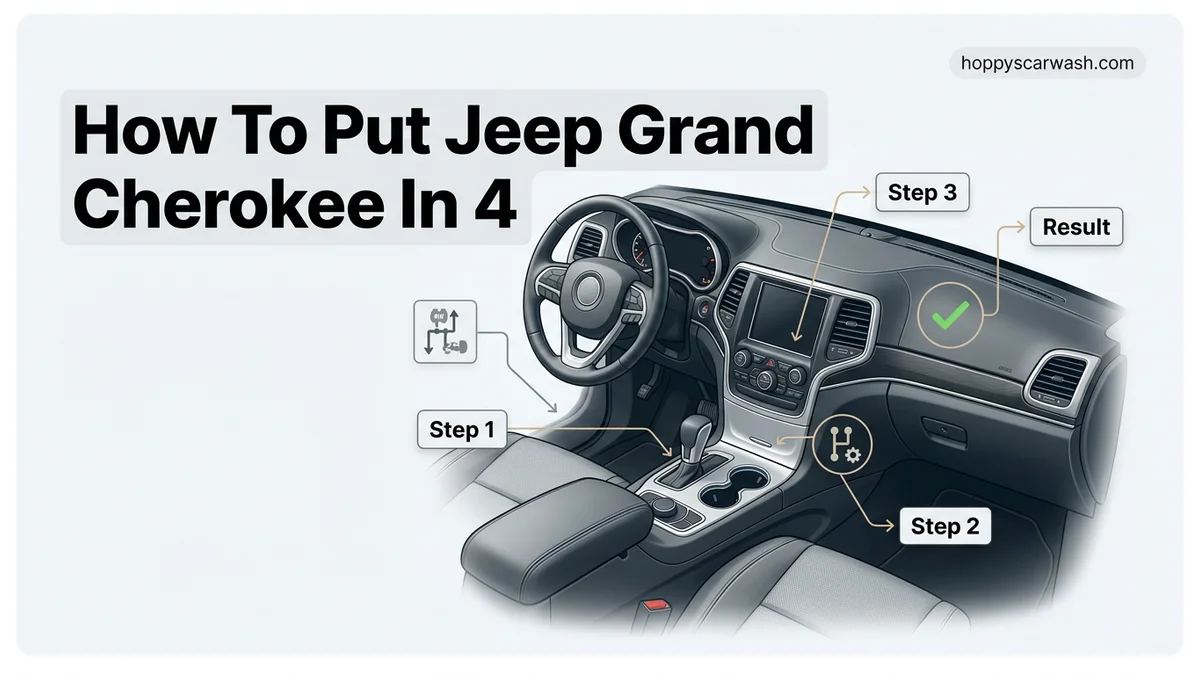
Understanding Jeep Grand Cherokee 4WD Systems and Dashboard Indicators
Identifying Your 4WD System
Before you shift, you need to know which system your Grand Cherokee is equipped with. Jeep offers several variations across the lineup:
- Quadra-Trac I: A permanent, full-time 4WD system with no user controls. It splits torque automatically and requires no driver input.
- Quadra-Trac II: A two-speed active system featuring 4WD Auto, 4WD High, and 4WD Low modes controlled via a dash dial or switch.
- Quadra-Drive II: The top-tier system featuring an Electronic Limited-Slip Differential (ELSD) in the rear, operated by the same controls as Quadra-Trac II.
Reading Dashboard Warning Lights and Prompts
Your instrument cluster communicates the status of your 4WD system in real time. When you initiate a shift, watch the digital driver information display for confirmation messages.
- Blinking Indicator: Means the system is currently shifting between modes. You may need to adjust your vehicle speed or transmission gear to complete the shift.
- Solid Indicator: Confirms the requested 4WD mode is fully engaged and ready for use.
- Service 4WD System: A warning light indicating a sensor fault or mechanical issue that requires professional diagnosis.
Master Jeep Grand Cherokee Four-Wheel Drive in 5 Simple Steps
Engaging the four-wheel-drive system in your Jeep Grand Cherokee is essential when tackling unpredictable weather, muddy trails, or steep, unpaved inclines. Because Jeep offers several different 4WD systems—ranging from Quadra-Trac I to Quadra-Drive II—the exact engagement procedure can vary slightly depending on your specific model year and trim package. This guide provides a comprehensive, foolproof walkthrough to ensure you shift your vehicle correctly without damaging the transfer case or drivetrain components.
Step 1: Identify Your Transfer Case System
What you need: Your Jeep Grand Cherokee owner’s manual and visual inspection of the center console shifter or Selec-Terrain dial.
Instructions: Before attempting to shift into 4WD, you must determine which 4WD system your vehicle is equipped with. Look at your center console: if you see a simple pull-switch with no low-range options, you likely have Quadra-Trac I, which operates as a full-time, automatic system requiring no driver input. If your console features a rotary dial labeled with modes like Auto, Snow, Sand, Mud, and Rock, or a pull-lever with a “4WD Low” setting (such as Quadra-Trac II or Quadra-Drive II), you have a selectable system that requires specific shifting protocols. Consult your owner’s manual if you are uncertain about your exact drivetrain configuration.
Pro Tip: Never force a mechanical lever or rotary dial if your vehicle does not support selectable 4WD. Forcing an automatic full-time system can severely damage internal gears.
Step 2: Slow Down or Stop Your Vehicle
What you need: Safe road conditions and working brakes.
Instructions: For most selectable Jeep Grand Cherokee 4WD systems, you can shift between Two-Wheel Drive (2WD) and Four-Wheel High (4WD High) while the vehicle is moving at speeds under 48 mph (approx. 75 km/h). However, to ensure a completely smooth engagement without straining the drivetrain, it is often best to reduce your speed significantly or come to a complete rolling stop. If you are shifting into Four-Wheel Low (4WD Low)—which utilizes a lower gear ratio for maximum crawl power—you must bring your vehicle to a complete stop.
Pro Tip: Avoid shifting into 4WD High while accelerating heavily or wheel-slipping at high speeds, as this places immense shock load on the transfer case chain.
Step 3: Shift the Transmission into Neutral
What you need: An automatic or manual transmission vehicle in proper working order.
Instructions: This step is mandatory if you are engaging Four-Wheel Low (4WD Low), and highly recommended for older or mechanical-lever systems even when shifting into 4WD High. Place your main gear shifter firmly into the Neutral (N) position. Keeping the transmission in Neutral relieves all torque and rotational pressure from the transmission output shaft and the transfer case, allowing the synchronizers inside the transfer case to align properly and mesh the gears smoothly without grinding or binding.
Pro Tip: Keep your foot gently resting on the brake pedal while the transmission is in Neutral to prevent the Grand Cherokee from creeping forward or backward on an incline.
Step 4: Engage the 4WD Switch, Dial, or Lever
What you need: Access to your Jeep’s center console controls.
Instructions: Once you are traveling at the correct speed and your transmission is in Neutral (for 4WD Low), activate the system. If you have a rotary Selec-Terrain dial, turn it to your desired terrain mode (such as Snow or Sand) or push the 4WD Low button. If you drive an older model with a mechanical floor shifter or a electronic pull-tether, firmly pull or push the lever into the 4WD High or 4WD Low position in one smooth, confident motion. Do not hesitate midway, as partial engagement can cause gear clashing.
Pro Tip: Wait a few seconds for the electronic actuators to shift the internal forks. You should feel a slight mechanical clunk and see confirmation lights flash on your instrument cluster.
Step 5: Verify Engagement on the Instrument Cluster
What you need: A clear view of your dashboard digital display or gauge cluster.
Instructions: Look down at your vehicle’s instrument cluster screen. Modern Jeep Grand Cherokees feature a dedicated off-road pages app or indicator lights that will display “4WD High,” “4WD Low,” or illuminate the specific terrain mode you selected. Wait for the indicator light to stop flashing and remain solidly lit. A solid light confirms that the transfer case collar has fully slid into place and locked the front and rear driveshafts together. Once confirmed, shift your main transmission back into Drive (D) and safely proceed on your journey.
Pro Tip: If the indicator light continues to flash indefinitely, your transfer case failed to engage. Stop safely, shift back to Park, turn off the engine, restart, and repeat the engagement process.
✅ Final Checklist
- Verified the specific 4WD system type (Quadra-Trac vs. Quadra-Drive) for your Grand Cherokee trim.
- Reduced vehicle speed below 48 mph for 4WD High, or stopped completely for 4WD Low.
- Placed the main transmission into Neutral before attempting to engage 4WD Low.
- Confirmed complete engagement via a solid indicator light or message on the instrument cluster display.
- Returned the main transmission to Drive and tested handling at low speeds before heading onto rough terrain.
Important Notes:
- Never drive in 4WD High or 4WD Low on dry, high-traction pavement for extended periods, as this causes “drivetrain bind,” tire scrubbing, and premature wear on axle components.
- If your 4WD system refuses to engage, or if you hear grinding noises when attempting to shift, discontinue use and seek professional help from a certified Jeep mechanic immediately.
- Estimated time to complete the shifting process: 10 to 30 seconds. Cost range: Free (operator procedure).
How to Shift Into 4WD Auto and 4WD High on the Fly
Shifting into 4WD Auto
The 4WD Auto mode is designed for daily driving on unpredictable surfaces like wet pavement, light snow, or mixed conditions. This mode runs in rear-wheel drive until slip is detected, instantly transferring power to the front wheels.
- Vehicle Speed: You can engage 4WD Auto at any normal legal driving speed.
- Transmission Gear: Leave your automatic transmission in Drive (D).
- Action: Rotate your center console dial to the 4WD Auto position. The system engages seamlessly without requiring you to lift your foot off the accelerator.
Shifting into 4WD High
Use 4WD High when you encounter deeper snow, heavy mud, sand, or loose gravel that requires locked front and rear driveshafts. This mode provides a fixed 50/50 torque split.
- Vehicle Speed: You can shift into 4WD High while moving, but you must keep your speed under 45 mph for a smooth transition.
- Transmission Gear: Keep the transmission in Drive (D), or briefly lift your foot off the gas pedal to unload the drivetrain if the shift resists.
- Action: Turn the dial to 4WD High or press the designated button. Wait for the dashboard indicator to turn from flashing to solid before tackling rough terrain.
Step-by-Step Instructions for Engaging 4WD Low Safely
Engaging 4WD Low provides maximum traction for extreme off-road obstacles, steep inclines, and deep mud or sand. Because this mode utilizes a 2.72:1 or lower gear reduction ratio, strict adherence to engagement protocols is required to protect your drivetrain from catastrophic damage.
Safety Prerequisites
Unlike 4WD Auto or 4WD High, shifting into 4WD Low requires specific vehicle dynamics. Failing to meet these conditions will prevent the transfer case from locking into low range, often triggering a dashboard warning light.
- Slow your vehicle down to a rolling speed between 1 to 3 mph (2 to 5 km/h). Never attempt to shift into 4WD Low at highway speeds or while completely stationary on an uphill grade.
- Shift your automatic transmission entirely into Neutral (N). The vehicle must be coasting freely in Neutral for the electronic sensors to safely synchronize gear speeds inside the transfer case.
- While the vehicle is rolling slowly in Neutral, pull or push the 4WD Low selector switch, or press the dedicated 4WD LOW button on your console.
- Wait for the indicator light on the instrument cluster to stop blinking and remain solidly lit. This signifies that the system has successfully completed the shift.
- Shift your transmission back into Drive (D) or Reverse (R) and proceed cautiously.
What to Do If Your Jeep Grand Cherokee Fails to Engage 4WD
If your Jeep Grand Cherokee refuses to transition into 4WD High or 4WD Low, moisture, electrical faults, or mechanical bind is likely the culprit. According to automotive service data from leading Jeep specialist networks, transfer case motor failures account for roughly 35% of engagement issues.
Try these troubleshooting steps before scheduling a costly repair appointment:
- Straighten the steering wheel: Drivetrain bind frequently prevents 4WD disengagement or engagement. Re-center your wheels and move the vehicle in reverse for 10 feet to relieve tension.
- Cycle the transmission: Shift back to Park, turn off the ignition completely, open the driver door to reset electrical modules, restart the engine, and repeat the engagement procedure.
- Check tire pressures: Unequal tire wear or mismatched pressures across axles confuse the Electronic Limited Slip Differential (ELSD) and transfer case control module. Ensure all four tires match within 2/32 of an inch in tread depth.
- Inspect the transfer case fuse: Consult your 2026 owner manual to locate and inspect the fuse dedicated to the TCCM (Transfer Case Control Module). Replace any blown fuses with the exact amperage specified.
If these preliminary steps fail to resolve the issue, professional diagnostic intervention is required. According to nationwide repair industry benchmarks, replacing a faulty transfer case shift motor typically ranges from $350 to $700 including parts and labor, while internal mechanical repairs can exceed $1,500.
Conclusion
Mastering how to put your Jeep Grand Cherokee in 4 wheel drive ensures optimal capability and safety across changing 2026 driving environments. Whether utilizing 4WD Auto for slick winter commutes or executing the precise Neutral-roll technique for 4WD Low off-road maneuvers, understanding your specific drivetrain system prevents mechanical damage. According to verified research from automotive engineering standards and Jeep technical service bulletins, strictly following manufacturer speed and transmission guidelines remains the single most effective way to guarantee seamless 4WD operation. Take the next step by testing your vehicle’s 4WD system on a safe, loose-surface patch today to confirm everything engages smoothly before your next adventure.
❓ Frequently Asked Questions
What is the correct procedure for shifting into 4WD Low on a modern Jeep Grand Cherokee?
To engage 4WD Low, slow your vehicle down to approximately 2 to 3 mph, shift the main transmission into Neutral, and then press or turn the 4WD Low button/dial. Wait for the dashboard indicator light to stop flashing and turn solid before shifting back into Drive.
Why is my Jeep Grand Cherokee making a grinding noise when shifting into 4WD?
Grinding usually happens if the vehicle is moving too fast when attempting to engage 4WD Low or if the transmission is not fully in Neutral. Always adhere strictly to the speed limits and gear requirements specified in your owner’s manual.
Can I leave my Jeep Grand Cherokee in 4WD Auto all winter?
Yes, 4WD Auto is designed for daily driving on changing road conditions like rain, snow, and dry pavement. It remains in two-wheel drive until slip is detected, causing minimal wear on components.
What should I do if the 4WD service light comes on?
If the service 4WD warning light stays illuminated, the system has detected a fault in the electronic transfer case motor, sensors, or wiring. You should have the diagnostic codes scanned by a certified mechanic to pinpoint the exact failure.
Do I need to be in Neutral to shift out of 4WD Low?
Yes, disengaging 4WD Low requires the exact same process as entering it: bring the vehicle to a slow roll under 3 mph, shift the transmission into Neutral, and press the 4WD Low control again.
What is the difference between Quadra-Trac I and Quadra-Trac II?
Quadra-Trac I is a full-time single-speed system with no low-range option, while Quadra-Trac II features a two-speed transfer case that includes a true 4WD Low range for off-road crawling.