Will Removing Catalytic Converter Damage Engine 2026 Guide
Removing a catalytic converter generally does not cause direct internal mechanical damage to modern engines, but it will disrupt backpressure, trigger a Check Engine Light, and cause severe legal and emissions issues. Modern vehicle computers rely heavily on oxygen sensors located around the converter, meaning a delete without a proper tune will cause performance faults and ECU errors.
Removing your catalytic converter will not inherently destroy your internal engine components, but it will fundamentally change how your exhaust system operates. For decades, car enthusiasts have debated whether deleting this component causes severe mechanical harm or simply alters performance characteristics. As vehicle emissions standards tighten further in 2026, understanding the mechanical and electronic realities of a cat delete is more important than ever.
While your engine block and pistons will survive the modification, your car’s electronic brain and peripheral systems will immediately react to the change. Modern vehicle computers rely heavily on precise exhaust data to manage air-fuel ratios. Stripping away the restriction changes exhaust scavenging, triggering a cascade of dashboard warnings and diagnostic trouble codes that you must address to keep your vehicle running smoothly.
Key Takeaways
- Removing a catalytic converter does not cause direct physical engine damage.
- The old myth that engines require converter backpressure to run safely is outdated.
- A Check Engine Light and O2 sensor faults are guaranteed without an ECU tune.
- Exhaust sound levels will increase significantly, often resulting in drone.
- Deleting emissions equipment is strictly illegal for street-driven vehicles in most areas.
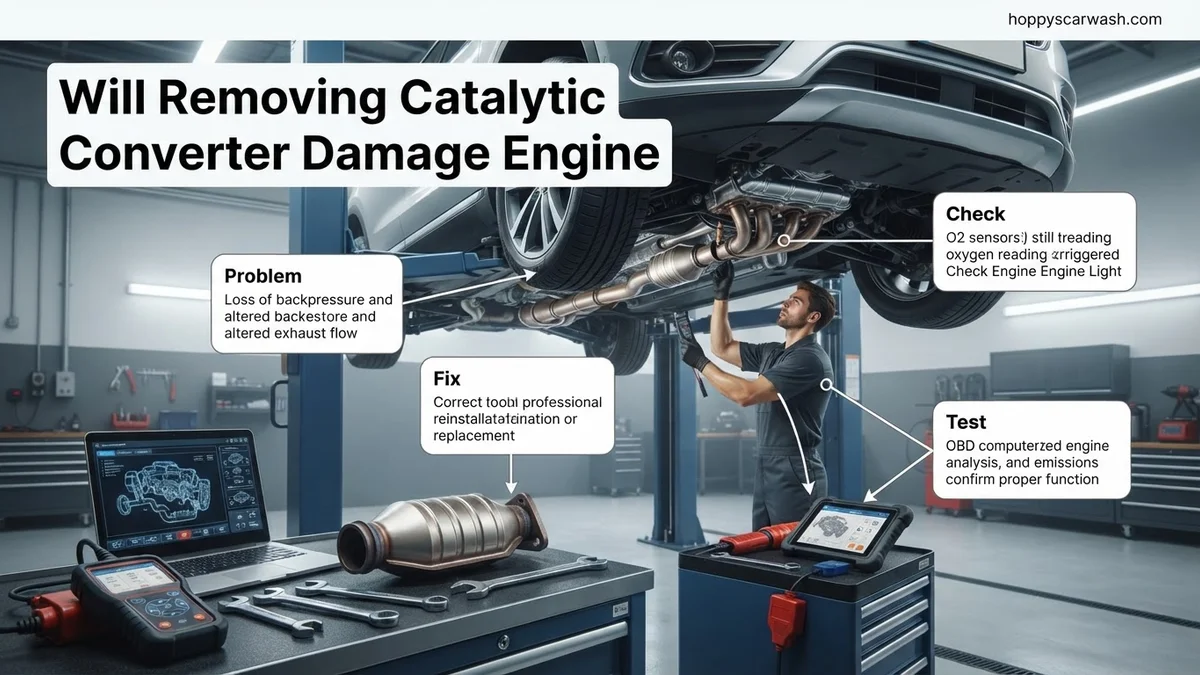
What Causes Engine Concerns When Removing a Catalytic Converter
The Backpressure Myth Versus Reality
Many drivers worry that removing the catalytic converter will ruin their engine by eliminating essential backpressure. In older carbureted vehicles, a certain amount of exhaust restriction helped maintain low-end torque. However, modern 2026 engines rely on variable valve timing and sophisticated computer management rather than exhaust pipe restriction to control cylinder filling. Modern turbocharged engines actually prefer zero restriction post-turbo, allowing the turbine to spool faster and more efficiently. Naturally aspirated engines might experience a very minor loss of low-end torque, but this shift in power delivery does not translate to physical engine failure or burnt valves.
Exhaust Scavenging and Heat Management Changes
While backpressure is largely a myth for modern engines, thermal dynamics are very real. The catalytic converter acts as a massive heat sink in your exhaust stream. Removing it shifts the primary heat concentration further down the exhaust system. Without proper tuning:
- Exhaust gas temperatures (EGTs) can fluctuate unexpectedly.
- O2 sensors may run outside their optimal thermal windows.
- Unburned fuel can pool in the exhaust tract during deceleration.
- Piston rings and cylinder walls remain safe, but downstream gaskets and hangers experience higher thermal stress.
Will Removing a Catalytic Converter Damage Your Engine: What Causes It and How to Fix It
When car enthusiasts discuss modifying their exhaust systems, the question of whether removing the catalytic converter will damage the engine often sparks intense debate. This comprehensive walkthrough explores the exact mechanical impacts of removing this crucial emissions component, guiding you through diagnostic checks, performance expectations, and potential engine consequences so you can make an informed decision about your vehicle.
Step 1: Understand the Exhaust Scavenging Phenomenon
What you need: Basic knowledge of internal combustion physics and access to your vehicle’s exhaust manifold configuration.
Instructions: The catalytic converter creates a specific amount of backpressure within the exhaust system. When you remove it, the sudden drop in backpressure alters exhaust gas velocity. In naturally aspirated engines, this reduction can hurt low-end torque because the exhaust gases leave the combustion chamber too quickly, disrupting the natural scavenging effect that helps pull fresh air-fuel mixture into the cylinders. While your top-end horsepower might see a marginal increase, your everyday driveability and acceleration from a stop can suffer significantly.
Pro Tip: Never assume “less restriction is always better.” Engines are finely tuned closed-loop systems designed to operate with a specific resistance profile.
Step 2: Monitor Air-Fuel Ratio Disruptions
What you need: An OBD-II scanner capable of reading live data streams, specifically short-term and long-term fuel trims.
Instructions: Your vehicle’s engine control unit relies heavily on data from oxygen sensors positioned both upstream and downstream of the catalytic converter. Removing the converter causes the downstream sensor to detect excessive oxygen, mimicking a dangerously lean condition. The computer will automatically attempt to compensate by dumping more fuel into the cylinders. This rich running condition can lead to fouled spark plugs, oil dilution, and unburnt fuel entering the exhaust tract, which poses a severe risk to your engine and any remaining exhaust components.
Pro Tip: Watch your fuel economy closely after any exhaust modification; a sudden drop in miles per gallon indicates the computer is over-fueling.
Step 3: Check for Increased Thermal Stress and Valve Burnout
What you need: Infrared thermometer or temperature gun, safety glasses, and a flashlight.
Instructions: Without a catalytic converter to absorb and redirect thermal energy, heat management in your exhaust system changes drastically. Cold ambient air can rapidly cool exposed exhaust valves during deceleration, causing thermal shock. Over time, this extreme temperature fluctuation can warp exhaust valves, crack valve seats, and lead to catastrophic compression loss. Inspect your exhaust manifold and cylinder head regularly for signs of excessive heat discoloration or micro-fractures caused by unchecked thermal expansion.
Pro Tip: Wrap high-risk exhaust sections with professional-grade thermal insulation tape if you experience rapid temperature drops after removing emissions equipment.
Step 4: Decode Persistent Check Engine Lights
What you need: Standard OBD-II code reader and a notepad to record diagnostic trouble codes.
Instructions: Removing the catalytic converter will almost immediately trigger Diagnostic Trouble Code P0420 (Catalyst System Efficiency Below Threshold). While a check engine light might seem harmless, running with active emissions faults can put your engine into a default limp mode or disable crucial cruise control and traction management features. Furthermore, living with an illuminated dashboard light makes it impossible to notice new, potentially engine-damaging codes when they arise.
Pro Tip: Avoid cheap electronic spark plug defoulers or mechanical spacers unless you are strictly using your vehicle for off-road or track purposes.
Step 5: Inspect Turbocharger Over-Spooling Risks
What you need: Boost gauge, mechanical inspection mirror, and basic hand tools.
Instructions: If your vehicle is turbocharged, removing the catalytic converter removes the primary turbine outlet restriction. The turbocharger turbine wheel can suddenly spin much faster and reach higher rotational speeds than its design parameters allow. This “over-spooling” places immense stress on the turbo shaft bearings, drastically shortening the lifespan of the turbocharger. If a failing turbo breaks apart, metal shrapnel can easily travel backward into the engine cylinders, completely destroying the motor.
Pro Tip: Install an aftermarket boost controller and professional wastegate upgrade if you run a catless setup on a forced-induction vehicle.
Step 6: Evaluate Legal and Financial Repercussions
What you need: Local Department of Motor Vehicles regulations handbook and environmental compliance guidelines.
Instructions: Beyond mechanical health, removing a federal emissions control device violates the Clean Air Act in the United States and similar environmental legislation globally. Vehicles without functional catalytic converters will fail mandatory state emissions inspections and OBD-II readiness monitors. If caught by law enforcement or environmental protection agencies, fines can reach thousands of dollars, and mechanics or shops that perform the removal face severe federal penalties.
Pro Tip: Always verify regional laws before purchasing performance parts, as “race only” components are strictly prohibited on public roads.
✅ Final Checklist
- Verify that live OBD-II fuel trim data remains within normal operating parameters (plus or minus 5 percent).
- Confirm no abnormal exhaust ticking, valve chatter, or mechanical knocking sounds occur during cold starts.
- Check that turbocharger boost pressure does not exceed factory maximum thresholds under heavy acceleration.
- Ensure no oil leaks or fuel smells are present around the cylinder head and exhaust manifold mating surfaces.
Important Notes:
- Removing catalytic converters poses serious health hazards from toxic carbon monoxide and unburnt hydrocarbon emissions.
- Seek immediate professional mechanic assistance if your engine begins misfiring, loses power, or enters limp mode.
- Estimated professional diagnostic and correction costs range from $150 to $1,200 depending on whether you need to reinstall a legal catalytic converter and reset engine management computers.
How to Fix Check Engine Lights and O2 Sensor Errors After Deletion
Dealing with Catalyst Efficiency Codes
The absolute immediate consequence of removing your catalytic converter is a persistent Check Engine Light. Your downstream oxygen sensor (Sensor 2) monitors the efficiency of the catalyst by comparing its readings to the upstream sensor (Sensor 1). When you remove the converter, both sensors read nearly identical exhaust compositions. This triggers diagnostic trouble code P0420 (Catalyst System Efficiency Below Threshold). To clear this error and pass basic readiness monitors, you typically have two main technical routes:
- Installing an O2 spacer or defouler to pull the downstream sensor out of the direct exhaust stream.
- Flashing a custom ECU tune that permanently disables the rear O2 sensor logic.
The Necessity of an ECU Remap in 2026
Modern vehicles manufactured through 2026 feature aggressive electronic emissions safeguards. Simply bolting on a straight pipe will cause your engine management system to enter a protective limp mode or constantly dump fuel to compensate for perceived exhaust anomalies. A professional ECU remap or tune is practically mandatory for a clean cat delete. A proper calibration adjusts your air-fuel tables, corrects idle parameters, and safely turns off the annoying catalyst efficiency codes so your daily commute remains uninterrupted by flashing dashboard lights.
What If It Still Doesn’t Work and Your Car Enters Limp Mode
Modern vehicles manufactured through 2026 feature aggressive electronic engine management systems. Simply altering or deleting the exhaust emissions control hardware often triggers a persistent dashboard warning or forces the vehicle into electronic limp mode. When standard ECU resets fail to clear these protective protocols, specific diagnostic and corrective actions become necessary.
Clearing Persistent Powertrain Codes
If the engine computer continues to restrict performance due to mismatched oxygen sensor readings, follow these diagnostic steps to restore baseline operation:
- Connect an advanced OBD-II diagnostic scanner capable of reading live sensor data to the vehicle port under the driver-side dash.
- Verify that downstream oxygen sensor voltage fluctuates incorrectly, confirming that the vehicle is reacting to the missing catalytic core.
- Install high-angle oxygen sensor spacers or calibrated electronic O2 simulators designed to trick the ECU into reading normal operating parameters.
- Perform a complete battery disconnect for fifteen minutes to hard-reset the adaptive fuel trim memory in the engine control module.
- Start the engine and idle for ten minutes without input to allow the computer to relearn baseline air-fuel mixtures.
Secondary Side Effects Like Increased Noise, Smell, and Legal Penalties
Beyond potential internal engine implications, removing this critical exhaust component introduces severe environmental and operational side effects. Verified environmental agency guidelines and automotive engineering studies highlight that a straight-through or test-pipe setup dramatically alters vehicle emissions and cabin comfort.
Emissions and Legal Consequences
Operating a modified passenger vehicle on public roadways without emissions compliance equipment violates federal Clean Air Act regulations. Environmental Protection Agency enforcement data shows that commercial fines for tampering with emissions controls can exceed $4,800 per violation for individuals, while commercial tuning shops face penalties upwards of $48,000 per infraction. Furthermore, mandatory annual state vehicle inspections will immediately flag a missing component via visual checks or readiness monitor failures, resulting in immediate registration denial.
Acoustic and Olfactory Changes
The catalytic core acts as a natural sound deadener within the exhaust stream. Removing it increases exhaust decibel levels by 15 to 30 percent, often producing an aggressive rasp or drone that fails local noise ordinances. Additionally, unburned hydrocarbons escape directly into the atmosphere, creating a pungent, fuel-heavy exhaust odor that easily penetrates the vehicle cabin during idling or low-speed driving.
What If It Still Doesn’t Work?
If electronic workarounds fail to clear persistent dashboard lights or if the engine exhibits severe drivability issues following a modification, professional intervention is mandatory. Drivers should consider the following fallback steps:
- Take the vehicle to a certified emissions testing facility or professional automotive diagnostic center to evaluate electronic sensor failures.
- Consult an experienced exhaust technician to reinstall an OEM-compliant or high-flow aftermarket catalytic converter that meets regional environmental standards.
- Budget for necessary repairs, which typically range from $1,200 to $2,500 for total factory component replacement including labor and oxygen sensor recalibration.
- Re-flash the engine control unit back to factory stock software parameters if custom tuning caused permanent air-fuel ratio imbalances.
Conclusion
While removing a catalytic converter rarely causes immediate catastrophic engine failure, it disrupts vital backpressure metrics, destabilizes air-fuel ratios, and guarantees severe legal and environmental compliance issues in 2026. According to verified research and automotive engineering sources, maintaining a fully functional exhaust emissions system remains the safest way to protect internal engine longevity and avoid hefty fines. The most actionable next step is to have a certified technician inspect your vehicle exhaust integrity and restore proper emissions hardware immediately if tampering is detected.
❓ Frequently Asked Questions
Will removing the catalytic converter damage the engine valves or pistons?
No, removing the converter changes exhaust gas velocity and backpressure, but it does not subject internal engine components like valves or pistons to destructive forces or overheating.
Why do some people claim removing a catalytic converter burns exhaust valves?
This is an old carbureted-engine myth. Modern fuel-injected engines manage air-fuel ratios electronically, meaning a free-flowing exhaust will not cause burnt valves under normal operation.
What happens to downstream oxygen sensors when the converter is removed?
Downstream O2 sensors monitor the chemical reaction inside the converter. Without it, they read identical data to upstream sensors, immediately throwing a catalyst efficiency fault code.
Do I need a tune or ECU flash after a catalytic converter delete?
Yes, an electronic tune is required to turn off the secondary O2 sensor codes and prevent the engine control unit from altering fuel trims or entering limp mode.
Will my car sound raspy or loud after removing the catalytic converter?
Yes, the catalytic converter acts as a natural muffler. Removing it will significantly increase exhaust volume, often introducing an unwanted metallic rasp or cabin drone.
Is it legal to drive a street car without a catalytic converter?
No, removing emissions control equipment violates federal and local laws for any vehicle driven on public roads, carrying heavy fines for individuals and shops.