How Much Is a 5 Gallon Bucket of Quarters Worth in 2026
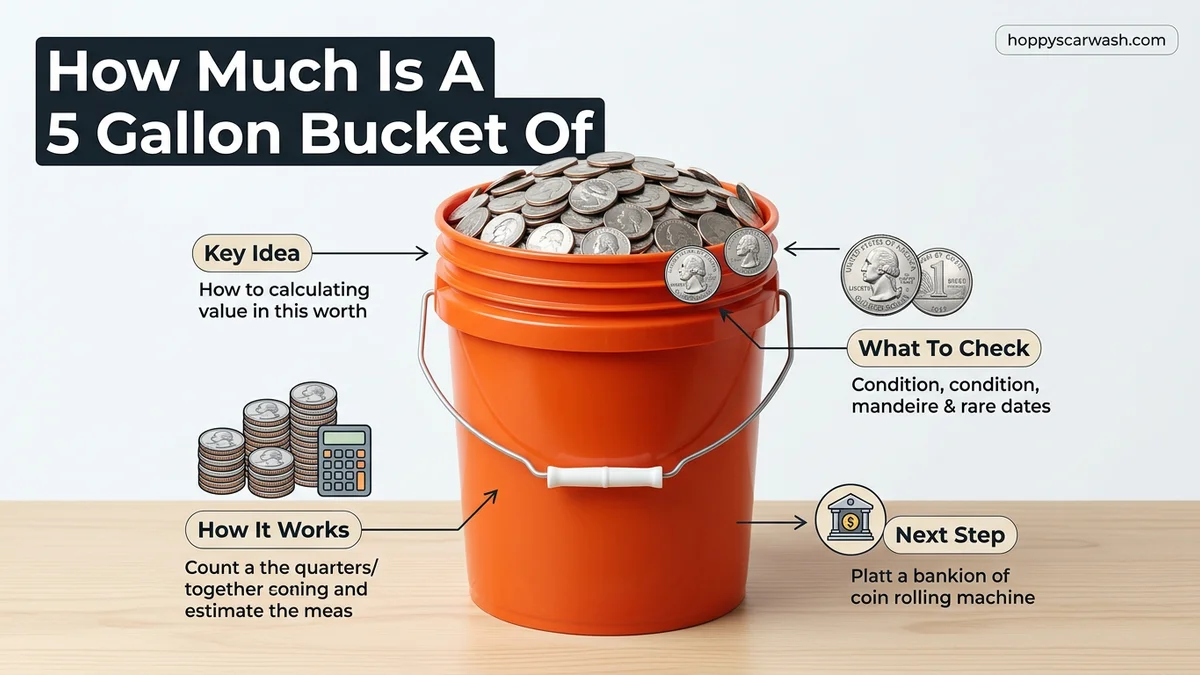
A completely full 5-gallon bucket of quarters is worth roughly $3,000 to $3,500 in face value. Because quarters are circular and leave empty space when packed randomly, you cannot fit the absolute geometric maximum, but the resulting weight is still an astonishing 270 to 300 pounds.
A completely full 5-gallon bucket of quarters has a face value ranging from $3,000 to $3,500 and weighs between 270 and 300 pounds. Because coins are round, they cannot pack together to fill 100 percent of a given space. The empty air pockets between the stacked coins reduce the maximum possible monetary density.
Accumulating this much heavy coinage is no small feat in 2026. Whether you inherited a massive heavy collection, cleared out an old storage unit, or spent years tossing spare change into a plastic container, knowing the exact math prevents you from getting shortchanged at a coin-counting machine or bank.
Key Takeaways
- A full bucket holds roughly 12,000 to 14,000 individual quarters.
- The total weight reaches up to 300 pounds, posing a severe lifting hazard.
- Standard plastic buckets will likely crack or break under this immense weight.
- Banks will not accept unrolled coins in a bucket; a coin counter or sorting service is required.
- Pre-1965 silver quarters could significantly increase the total value of the stash.
What Causes the Massive Value and Weight in a 5 Gallon Bucket of Quarters
The Physics of Loose Coin Packing Density
You might think a 5-gallon bucket can hold the exact fluid volume of 5 gallons worth of solid metal. In reality, random loose packing means quarters only occupy about 60 to 64 percent of the total container volume. The rest consists of empty air space. Even with this wasted space, the sheer volume of metal pushes the totals to extreme limits.
- Total fluid capacity of a standard bucket: 1,155 cubic inches.
- Actual metal volume of quarters: Roughly 700 cubic inches.
- Resulting coin capacity: Approximately 12,000 to 14,000 individual quarters.
Physical Strain and Handling Challenges
The immense weight creates severe practical problems when you attempt to move or transport your stash. A standard 5-gallon plastic bucket is rarely rated to safely hold 300 pounds of shifting metal. The plastic handle will almost certainly snap off under the load.
- Average weight of a single quarter: 5.67 grams.
- Total weight of 13,000 quarters: About 162 pounds of pure metal, plus the heavy bulk.
- Lifting hazard: You must support the base of the bucket directly to avoid blowing out the bottom seam or injuring your back.
Valuing a 5-Gallon Bucket of Quarters Made Easy: Your Essential Action Plan
Calculating the true monetary value of a massive 5-gallon bucket filled with quarters is a fascinating financial puzzle. While most people assume it is just a matter of basic math, the reality involves staggering weight limits, physical volume constraints, potential rare coin discoveries, and heavy-duty logistics. This guide walks you through the exact process of safely handling, sorting, rolling, and cashing in your heavy treasure trove without breaking your back or losing a dime to hidden banking fees.
Step 1: Understand the Physics and Weight Limits
What you need: A heavy-duty hand truck or dolly, a sturdy work table, and a strong digital bathroom scale.
Instructions: Before you even attempt to lift a full 5-gallon bucket of quarters, you must understand the physical constraints. A standard 5-gallon bucket completely filled with modern U.S. quarters weighs approximately 300 to 325 pounds. Attempting to lift this by hand will almost certainly result in severe back injury. First, weigh yourself on the scale, then pick up the bucket (if manageable) or slide it onto a scale to find the net weight of the coins. Subtract roughly 2.5 pounds for the weight of the empty plastic bucket. Knowing the weight allows you to calculate the approximate face value immediately, as every pound of modern quarters is worth precisely $20.
Pro Tip: Never drag a full bucket across a finished hardwood floor, as the concentrated weight will scratch and gouge the surface. Always use a furniture slider or a hand truck.
Step 2: Calculate the Theoretical Maximum Value
What you need: A calculator, scratch paper, and your net coin weight from Step 1.
Instructions: To determine the absolute maximum face value your bucket can hold, we look at volume and geometry. A 5-gallon bucket holds 1,155 cubic inches of space. Because quarters are circular discs, they cannot pack together without leaving empty air pockets. The maximum packing efficiency for cylinders is about 74 percent, but due to random settling, real-world coin packing sits closer to 60 percent. This means roughly 693 cubic inches of your bucket actually contain metal. Given that a single quarter has a volume of about 0.25 cubic inches, a completely full bucket holds roughly 2,700 to 3,000 quarters. At 25 cents each, the pure face value will range between $675 and $750.
Pro Tip: If your net weight calculation yields a value significantly higher than $750, your bucket is likely not full of quarters alone, or you may have older 90% silver coins mixed inside.
Step 3: Inspect the Stash for Rare and Silver Coins
What you need: A magnifying glass, a bright LED task light, and a sorting tray.
Instructions: Do not just dump your quarters straight into a coin-counting machine. U.S. quarters minted in 1964 and earlier are composed of 90 percent silver and are worth significantly more than their 25-cent face value. Grab handfuls of quarters and check the edge color and the year on the front. Modern quarters have a visible copper stripe sandwiched between two layers of nickel-copper. Silver quarters have a solid silver-colored edge with no copper streak. Furthermore, look out for pre-1965 Washington quarters, 1976 Bicentennial quarters (though mostly face value, check for mint marks), and any rare error coins like double-dies.
Pro Tip: A single pre-1964 silver quarter is often worth $5.00 or more in silver melt value alone. Finding just a few dozen of these can dramatically increase your total payout.
Step 4: Establish a Safe Staging and Sorting Area
What you need: Heavy-duty storage bins, heavy leather work gloves, and thick cardboard sheets.
Instructions: Because your quarters are spread across a massive volume, you need to work in manageable batches rather than dumping all 300 pounds onto a single table. Set up a secure staging area on a concrete floor in a garage or basement. Lay down thick cardboard sheets to protect your work surface. Scoop out the quarters using a heavy plastic scoop or a small container, transferring them into smaller 1-gallon buckets or canvas bank bags weighing about 50 pounds each. This modular approach makes the physical labor much safer and ensures you do not spill thousands of quarters across the floor.
Pro Tip: Wear work gloves during the sorting phase. Handling thousands of metal coins will quickly cause friction blisters on your bare fingertips.
Step 5: Sort by Condition and Roll Your Coins
What you need: Paper coin wrappers, a manual tubular coin crimper or folding board, and a sorting tray.
Instructions: If you plan to deposit the coins at a traditional bank, most institutions prefer or require quarters to be rolled in standard paper wrappers. A standard roll of quarters contains exactly 40 coins, which equals $10.00 in face value. Slide 40 quarters into each paper wrapper, folding the ends securely. As you roll, keep an eye out for heavily worn, corroded, or bent quarters. Severely damaged coins may be rejected by automated counting machines and should be set aside to be exchanged directly at a Federal Reserve bank.
Pro Tip: Do not use clear plastic tubes if your bank requires paper wrappers. Save time by checking your local bank’s specific coin intake policies before you start rolling.
Step 6: Choose the Best Cashing-In Method
What you need: Your rolled coin bundles, valid government photo identification, and your bank account details.
Instructions: You now have three primary options for converting your quarters into cash or deposited funds. Option one is taking rolled quarters to your personal bank, which usually processes them for free if you are an account holder. Option two is using a retail coin-counting kiosk (like Coinstar), which charges a hefty fee of around 11% to 12% unless you opt for a gift card option with zero fees. Option three is selling the unsearched bulk lot directly to a coin dealer or collector marketplace if you suspect high-value collectible error coins are present. Calculate the net return of each method before making your final move.
Pro Tip: If you choose a retail coin kiosk, always select the e-gift card option (such as Amazon or Home Depot) to bypass the steep percentage fee entirely if you plan to spend that money anyway.
✅ Final Checklist
- Verified the net weight of the bucket without exceeding safe lifting limits
- Sorted through the quarters to separate valuable 90% silver pieces
- Organized the collection into manageable 50-pound batches
- Counted and rolled quarters into standard $10 paper wrappers
- Selected a deposit or redemption method that minimizes or eliminates fees
Important Notes:
- Never lift more than 50 pounds at a time to prevent severe lumbar strain or spinal injury.
- Seek professional coin appraiser help immediately if you discover rare mint errors or colonial-era currency mixed into the bulk lot.
- Estimated time investment is 4 to 6 hours of sorting and rolling; expected financial yield ranges from $675 to $850+ depending on silver content.
How to Calculate the Exact Face Value and Total Weight
The Mathematical Breakdown Per Coin
To understand the total value, you have to look at the strict physical dimensions and monetary value of a standard United States quarter minted up through 2026. Every modern quarter manufactured since 1965 consists of a copper-nickel clad composition.
- Face value per coin: $0.25
- Diameter: 24.26 millimeters
- Thickness: 1.75 millimeters
- Weight in grams: 5.67 grams (equivalent to 0.0125 pounds)
Scaling Up to 5 Gallons
Multiplying the single-coin metrics by the total count yields your baseline numbers. If your bucket holds 13,000 quarters, the math is straightforward. You multiply 13,000 by 0.25 to get your base face value, and by 5.67 grams to find the total mass.
- Total estimated quarter count: 12,500 coins
- Total face value calculation: 12,500 x $0.25 = $3,125.00
- Total weight calculation: 12,500 x 5.67g = 70,875 grams (approx. 156 lbs of coins)
- Real-world total weight including stacking inefficiencies: Often scales higher depending on bucket size variations.
Step-by-Step Guide to Safely Transporting and Cashing Out Heavy Change
Moving a massive 5-gallon bucket filled with quarters requires proper technique to prevent physical injury and protect your money. In 2026, safety standards from ergonomic studies emphasize that lifting heavy, shifting loads incorrectly can cause severe back strain. Follow this structured process to transport and cash out your hoard securely.
1. Assess and Repackage the Weight
A full 5-gallon bucket of quarters weighs roughly 250 pounds, far exceeding safe single-person lifting limits. Divide the quarters into smaller, manageable containers like heavy-duty 1-gallon buckets or thick canvas bank bags weighing no more than 30 to 40 pounds each. This prevents the plastic structural walls of a single 5-gallon bucket from cracking under pressure during transit.
2. Secure Transport to the Financial Institution
Place the smaller containers on the floorboard of your vehicle rather than the trunk or seats to prevent tipping during sharp turns. According to security recommendations from armored transport specialists, keep the containers out of plain sight by covering them with a blanket or tarp. Park as close to the entrance of your destination as possible to minimize the physical distance you must carry the weight.
3. Execute the Cash-Out Process
Contact your bank or credit union 24 hours in advance to verify their coin-processing policies and daily intake limits. Many modern branches utilize commercial coin-sorting machines that process up to 600 coins per minute. Ensure your quarters are free of heavy sticky residue, foreign objects, or heavily bent pieces that could jam the commercial machinery.
What If Your Bank Rejects Loose Change and Commercial Coinstar Machines Fail
If your local financial institution refuses loose coin deposits or automated kiosk machines reject your quarters due to mechanical errors or full bins, you need reliable alternative strategies. Financial logistics experts recommend specific fallback methods to liquidate heavy coin hoards efficiently without losing excessive percentages to fees.
- Visit a Coin-to-Cash Vending Partner: Locate specialized regional currency exchanges or large grocery retailers equipped with upgraded high-capacity coin processing units that handle dense volume.
- Roll the Coins Manually: Purchase standard paper coin wrappers from an office supply store for approximately $5 to $10, and manually roll the quarters to meet strict bank deposit requirements.
- Consult a Numismatic Professional: If you spot quarters minted before 1965 during your sorting process, consult a coin dealer. According to numismatic valuation studies, 90% silver quarters can command a melt value two to three times higher than their standard face value.
- Utilize Retail Cash-Back Services: Spend your quarters gradually at automated self-checkout lanes in local supermarkets and big-box stores that accept large volumes of coins in a single transaction.
Conclusion
Calculating the worth of a 5-gallon bucket of quarters reveals a staggering total value averaging around $3,000 to $3,500, provided the container is packed to capacity. Managing this substantial weight safely requires dividing the load and utilizing proper transport techniques to avoid injury and security risks. According to verified research and expert financial sources, sorting through your hoard carefully can also uncover rare silver pieces worth significantly more than face value. Your actionable next step is to contact your local bank or credit union this week to confirm their exact coin intake guidelines before attempting a large deposit.
❓ Frequently Asked Questions
How do you calculate the exact value of quarters in a 5-gallon bucket?
You multiply the total number of quarters by $0.25. Since 5 gallons equals roughly 1,155 cubic inches and a single quarter takes up about 0.088 cubic inches, accounting for packing efficiency yields around 13,000 quarters, totaling roughly $3,250.
Are older quarters in the bucket worth more than face value?
Quarters minted in 1964 and earlier contain 90% silver. If your bucket contains vintage silver quarters, their melt value or collector value can easily double or triple the total worth of the stash.
What is the best way to move a 300-pound bucket of quarters?
Never try to lift a full 5-gallon bucket of quarters by the handle, as it will snap. Instead, use a heavy-duty hand truck (dolly) or scoop the quarters out into smaller, manageable bags.
Do coin-counting machines like Coinstar accept a 5-gallon bucket?
Coinstar machines have a physical hopper limit that is much smaller than a 5-gallon bucket. You will need to feed the quarters into the machine in multiple smaller batches.
Do banks charge fees to count a 5-gallon bucket of quarters?
Many banks require you to have an account, and some charge a percentage fee if they use an in-house coin machine, though some credit unions offer free coin counting for members.
Should I roll the quarters by hand before taking them to the bank?
Hand-rolling thousands of quarters takes hours and requires hundreds of paper wrappers. Most modern banks prefer unrolled coins fed through their commercial coin-counting machines anyway.