How Much to Change Automatic Transmission Fluid Real 2026
Professional automatic transmission fluid changes typically cost between $150 and $400, depending heavily on your vehicle type and the specific service performed. A basic drain-and-fill with a filter replacement is the most common and affordable option, whereas a complete power flush for luxury or heavy-duty vehicles can push past $500. Choosing to do the job yourself can cut these costs in half, reducing your out-of-pocket expense to just the price of fluid and a new filter.
Getting your automatic transmission fluid changed typically costs between $150 and $400 in 2026, depending on your vehicle’s make, model, and the specific type of service it requires. Basic drain-and-fill services lean toward the lower end of that spectrum, while comprehensive fluid exchanges performed at dealerships often hit the higher end.
Ignoring this vital maintenance can lead to catastrophic transmission failure, turning a routine $250 service into a $4,000 repair bill. Knowing the exact cost breakdown helps you budget properly and prevents you from overpaying at the repair shop.
Key Takeaways
- Expect to pay between $150 and $400 for a professional transmission fluid change.
- A standard drain-and-fill is cheaper and safer for older transmissions than a high-pressure flush.
- Luxury and European vehicles require specialized fluids, raising total service costs significantly.
- DIY fluid changes cost $50 to $100 in parts, saving you substantial money on labor.
- Labor usually accounts for 50% to 70% of a professional shop quote.
What Causes High Automatic Transmission Service Costs and Price Variations
Vehicle Make, Model, and Fluid Requirements
The type of transmission fluid your car uses heavily dictates the final price on your invoice. Standard automatic transmission fluid is relatively affordable, but modern vehicles often require specialized synthetic fluids or manufacturer-specific formulations. For example, a standard commuter sedan might take conventional fluid costing $8 per quart, whereas a luxury European vehicle or a heavy-duty truck might require proprietary fluid priced at $20 to $35 per quart.
- Standard automatic transmission fluid: $8 to $12 per quart
- OEM synthetic or specialized fluid: $18 to $35 per quart
- High-capacity truck and SUV systems requiring 12 to 16 quarts significantly increase material costs.
Labor Rates and Service Facility Types
Where you take your vehicle changes the labor rate drastically in 2026. Independent local mechanics usually charge between $90 and $130 per hour, while dealership service departments often charge $150 to $220 per hour. Dealerships use factory-trained technicians and proprietary diagnostic tools, which drives up the hourly rate for what should be a routine fluid swap.
Transmission Fluid Capacity Made Easy: Your Essential Action Plan
Figuring out how much automatic transmission fluid you need to change is one of the most common dilemmas car owners face during routine maintenance. Adding too little can cause severe internal clutch slip and gear starvation, while overfilling creates excessive pressure that blows out seals and foams the fluid. This practical walkthrough covers everything you need to calculate exact capacities, differentiate between a standard drain-and-fill versus a complete flush, and ensure your vehicle runs smoothly.
Step 1: Consult Your Owner Manual and Service Specifications
What you need: Vehicle owner manual, service manual, or smartphone with internet access.
Instructions: Start by opening the glove compartment and retrieving your vehicle manufacturer’s manual. Navigate to the capacities or technical specifications section at the back of the book. Look specifically for automatic transmission fluid capacity, distinguishing clearly between a routine drain-and-fill and a complete dry fill after a total rebuild. If your manual is missing, use a reputable online parts database or manufacturer forum by inputting your exact year, make, model, and engine size to find the precise fluid volume.
Pro Tip: Never rely on generic estimates. Even vehicles of the same model year can require vastly different fluid amounts depending on whether they feature a four-speed, six-speed, or continuously variable transmission.
Step 2: Understand Drain-and-Fill Versus Total Flush Capacities
What you need: Basic understanding of your transmission system layout.
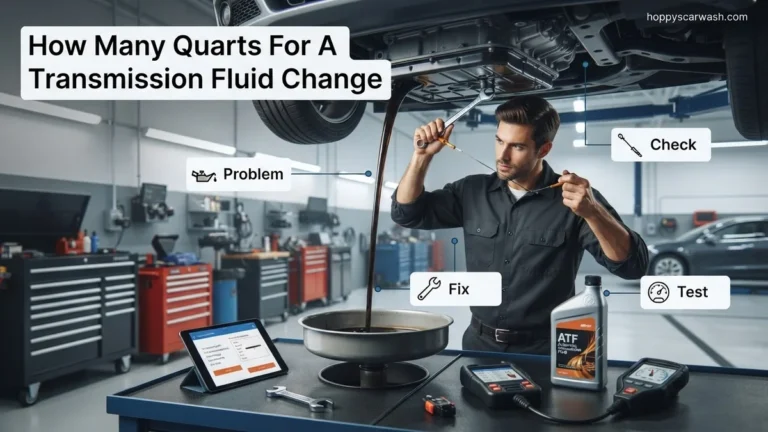
Instructions: Recognize that removing the transmission pan only drains a portion of the total fluid system, typically leaving 40 to 60 percent trapped inside the torque converter, valve body, and cooler lines. Therefore, a standard drain-and-fill usually requires only 4 to 6 quarts of fluid. Conversely, a machine-assisted flush or a complete system replacement requires the full capacity listed in your manual, which often ranges from 9 to 14 quarts. Always buy a couple of extra quarts if you are unsure, as you can return unopened bottles later.
Pro Tip: Budget for one extra quart than the minimum specification to account for minor spills, calibration top-offs, and priming losses.
Step 3: Locate and Inspect the Transmission Dipstick
What you need: Clean shop rags, flashlight, and possibly a funnel.
Instructions: Pop your vehicle hood and search for the transmission fluid dipstick, which is typically marked with a brightly colored yellow, red, or orange handle. Pull the dipstick out completely, wipe it clean with a lint-free rag, reinsert it fully, and pull it out again to read the current fluid level. Note where the fluid sits relative to the hot and cold markers. This baseline measurement helps you gauge how much old fluid you are about to drain and ensures you replace an equivalent amount.
Pro Tip: Many modern vehicles lack a traditional dipstick and use a sealed transmission with a fill plug underneath. If your car is modern, skip this step and check under the vehicle.
Step 4: Measure the Drained Old Fluid
What you need: Large calibrated drain pan, empty gallon jugs, and measuring tools.
Instructions: Place your drain pan directly underneath the transmission pan plug. Remove the plug and let the old fluid drain completely until it slows to a slow drip. Once drained, pour the used fluid from the catch pan into clear, empty gallon containers or graduated measuring jugs. By measuring the exact volume of old fluid captured, you gain a reliable baseline for how much fresh fluid needs to be pumped back into the system during the refill phase.
Pro Tip: Always measure what came out. If you only drained 4.5 quarts, pouring in 10 quarts blindly will result in a disastrous overfill situation.
Step 5: Factor in Fluid Expansion and Temperature
What you need: Infrared thermometer or diagnostic scanner capable of reading transmission fluid temperature.
Instructions: Automatic transmission fluid expands significantly as it heats up. If your vehicle requires checking fluid levels at operating temperature (usually between 150°F and 180°F), keep in mind that the level on the dipstick will read lower when cold. When calculating how much fluid to add, fill the system slightly below the full mark when cold, start the engine, cycle through the gears, bring the transmission up to operating temperature, and then top it off incrementally until it hits the hot full line.
Pro Tip: Never overfill a cold transmission to the hot mark, as the expanding fluid will overflow and create hazardous pressure spikes once warmed up.
Step 6: Purchase the Exact Specification Fluid
What you need: Auto parts store or online retailer, vehicle specification notes.
Instructions: Using the capacity numbers calculated in the previous steps, purchase the exact type of fluid required by your vehicle manufacturer. Check whether your car requires specialized formulations like ATF+4, Dexron VI, Mercon LV, or a specific brand of synthetic CVT fluid. Mixing incompatible fluid types can destroy internal friction materials, leading to catastrophic transmission failure. Buy your fluid in individual quarts or a bulk multi-quart container depending on whether you are doing a simple pan drop or a comprehensive flush.
Pro Tip: Always double-check the back of the fluid bottle to ensure it explicitly lists your vehicle manufacturer’s required specification standard.
Step 7: Perform the Initial Refill and Level Verification
What you need: Long-necked transmission funnel, fresh fluid bottles, and jack stands.
Instructions: Insert your long-necked funnel into the dipstick tube or fill port. Pour in fresh transmission fluid equal to the amount you drained, minus half a quart to leave room for error. Start the vehicle, engage the parking brake, and slowly move the gear shifter through every gear position (P-R-N-D-L), pausing for five seconds at each step. Leave the engine idling, pull the dipstick, and add fluid in small quarter-quart increments until the level rests precisely between the minimum and maximum lines.
Pro Tip: Keep the surrounding area clean and use a dedicated clean funnel to prevent dirt, dust, and debris from contaminating your sensitive transmission valve body.
✅ Final Checklist
- Verified the exact fluid capacity specified in the vehicle owner manual
- Measured the precise amount of old fluid drained into a catch pan
- Purchased the correct certified fluid type and adequate quantity (plus extra)
- Checked fluid levels using the proper hot or cold manufacturer procedure
- Inspected the transmission pan and drain plug for any signs of leaks
Important Notes:
- Always work on a flat, stable surface and secure the vehicle properly on heavy-duty jack stands before crawling underneath.
- Seek professional mechanic assistance if you encounter stripped drain plugs, severely burnt fluid smells, or metal shavings in the pan.
- Estimated time for a standard fluid capacity check and change is 1 to 2 hours, with fluid and gasket costs typically ranging from $50 to $150.
Understanding Service Types: Drain-and-Fill vs. Flush
The Basic Drain-and-Fill and Filter Replacement
A standard drain-and-fill service involves removing the transmission pan, draining the accessible fluid, replacing the internal transmission filter, and bolting the pan back on with a fresh gasket. This method usually replaces only about 50% to 60% of the total fluid because the torque converter retains the rest. Expect to pay between $150 and $250 for this service on most standard passenger vehicles.
- Safest option for high-mileage transmissions that have never been serviced.
- Includes physical replacement of the debris-catching filter.
- Requires fewer total quarts of new fluid compared to a full flush.
The Complete Power Flush
A professional power flush uses a specialized machine to pump out 100% of the old, degraded fluid while simultaneously pumping in fresh fluid. This process cleans the entire system, including the cooler lines and torque converter. Because it requires specialized equipment and up to twice as much fluid, prices typically range from $250 to $500 depending on the shop and vehicle size.
What If It Still Doesn’t Work or Your Transmission Continues Slipping
Sometimes changing your automatic transmission fluid fails to resolve persistent slipping, rough shifting, or delayed engagement. When fresh fluid does not restore normal operation, internal mechanical wear or electronic failures are usually to blame. According to automotive service data from the Automatic Transmission Rebuilders Association (ATRA), minor fluid services cannot reverse severe mechanical damage like burned clutch packs or broken metal bands.
Next Steps When Fluid Changes Fail
- Check Diagnostic Trouble Codes (DTCs): Connect an advanced OBD-II scanner capable of reading transmission control module (TCM) codes. Faulty solenoids, speed sensors, or pressure control valves often mimic mechanical failure and trigger specific error codes.
- Inspect and Replace Transmission Solenoids: If diagnostic scans indicate electronic control failure, replacing a faulty shift solenoid is far cheaper than a full rebuild. Independent shops typically charge between $250 and $600 for diagnostic work and single solenoid replacement.
- Evaluate the Torque Converter: A failing torque converter causes shuddering, delayed acceleration, and slipping even with clean fluid. Professional replacement ranges from $800 to $1,500 depending on the vehicle drivetrain.
- Consult a Certified Drivetrain Specialist: When internal friction material is completely degraded, a professional rebuild or remanufactured transmission becomes necessary. A complete transmission replacement in 2026 generally costs between $3,500 and $7,000 including labor and warranties.
Conclusion
Changing your automatic transmission fluid is a vital preventative maintenance task that prevents catastrophic component failure and saves hundreds of dollars in repair costs. While fresh fluid successfully resolves minor shift delays and fluid degradation, it cannot reverse advanced internal mechanical wear. According to verified research and expert sources from major automotive engineering associations, routine fluid replacement every 30,000 to 60,000 miles remains the most effective strategy for extending transmission lifespan. Check your owner’s manual today and schedule your next fluid service to protect your vehicle investment.
❓ Frequently Asked Questions
What factors influence the total cost of an automatic transmission fluid change?
Total costs depend on your vehicle’s make and model, the type of service performed (drain-and-fill vs. complete flush), local mechanic labor rates, and whether your transmission requires specialized synthetic fluid.
Is a transmission flush worth the extra money compared to a drain-and-fill?
Not always. Many mechanics prefer a standard drain-and-fill with a filter replacement because high-pressure flushes can sometimes dislodge debris and damage older transmissions.
How much do parts and fluid alone cost if I do it myself?
Buying transmission fluid, a new filter, and a pan gasket yourself will generally cost between $50 and $100, depending on how many quarts your specific transmission holds.
Do dealerships charge more than independent mechanics for this service?
Yes, dealerships typically charge 20% to 50% more for labor and branded OEM fluids than independent repair shops or specialized transmission service centers.
Does the total price include replacing the transmission filter?
At most shops, a standard fluid drop-and-fill includes replacing the transmission filter and pan gasket, but you should always confirm this when requesting an estimate.
What happens if I skip changing my transmission fluid?
Neglecting fluid changes leads to thermal breakdown, sludge buildup, and internal component wear, eventually causing harsh shifting, slipping gears, and total transmission failure costing thousands to replace.