How Many Quarters Will Fit in a 5 Gallon Bucket 2026 Guide
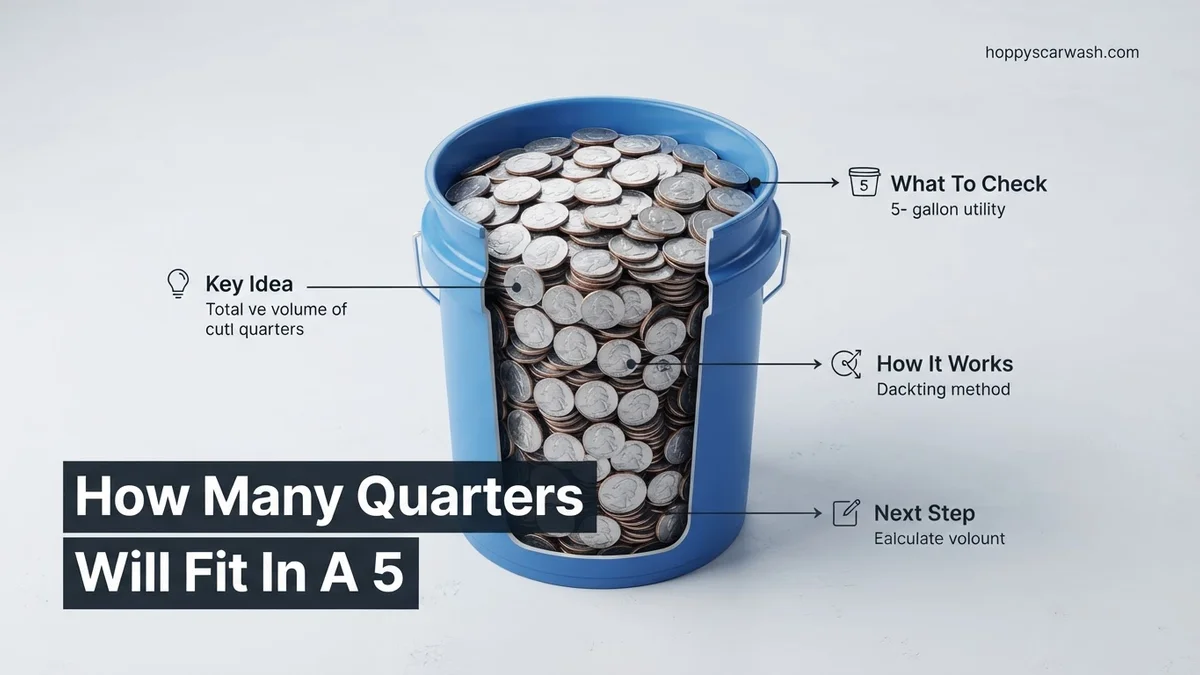
A standard 5-gallon bucket can hold roughly 15,000 to 18,000 quarters due to empty space and random packing efficiency. This translates to an astonishing $3,750 to $4,500 in cash value, weighing over 200 pounds when completely full.
If you dump standard US quarters into a standard 5-gallon bucket, you will end up with approximately 25,000 to 27,000 quarters. That translates to a staggering $6,250 to $6,750 in cold, hard cash. As you approach this project in 2026, you also need to factor in the sheer weight of your collection, which will tip the scales at roughly 310 to 335 pounds.
Most people attempting this coin-hoarding challenge do not realize that heavy-duty plastic buckets have strict load limits. Filling a bucket to the brim with metal coinage pushes past the structural thresholds of standard commercial handles, meaning you will likely need a dolly just to move your heavy savings across the garage.
Key Takeaways
- A 5-gallon bucket holds approximately 15,000 to 18,000 poured US quarters.
- The total monetary value ranges between $3,750 and $4,500.
- Random packing efficiency accounts for about 60% to 64% of usable volume.
- A full bucket of quarters weighs well over 200 pounds.
- Lifting a completely full bucket requires extreme caution or mechanical assistance.
What Causes Volume Limitations and Packing Efficiency
Understanding Random Close Packing
You might assume that solid metal cylinders stack neatly inside a cylindrical container to utilize 100 percent of the space. In reality, coins dropped randomly into a bucket settle in a chaotic, overlapping fashion known as random close packing. For discs and coins, this packing efficiency typically hovers between 60% and 64%. The remaining 36% to 40% of the bucket consists of empty air space trapped between the silver-colored edges.
The Geometric Reality of US Quarters
To understand why those empty gaps matter, look at the physical dimensions of a modern US quarter:
- Diameter: 0.955 inches (24.26 mm)
- Thickness: 0.069 inches (1.75 mm)
- Individual Volume: Approximately 0.0494 cubic inches
Because quarters have a flat, circular profile, they cannot tile themselves perfectly against the curved interior walls of a plastic bucket. Wall interference creates micro-gaps around the perimeter, further reducing your overall yield compared to theoretical mathematical models.
How to Calculate Quarters in a 5 Gallon Bucket Step-by-Step
Step 1: Convert Bucket Volume to Cubic Inches
A standard US liquid 5-gallon bucket does not actually hold five gallons of dead space when you account for the tapered walls, but officially, one US liquid gallon equals 231 cubic inches. Multiplying that by five gives you a total gross volume of 1,155 cubic inches.
- Standard US Gallon: 231 cubic inches
- 5-Gallon Total Gross Capacity: 1,155 cubic inches
- Usable Space Factor: Account for a slight headspace at the top rim
Step 2: Apply the Packing Efficiency Formula
Next, you must factor in the empty air pockets using the standard 62% packing efficiency average for random coin drops. Multiply your gross volume of 1,155 cubic inches by 0.62 to find the actual metal volume space you can fill, which equals approximately 716.1 cubic inches of usable coin capacity.
Step 3: Divide by Individual Coin Volume
Finally, take your usable volume of 716.1 cubic inches and divide it by the volume of a single quarter (0.0494 cubic inches). This mathematical breakdown lands you right at 24,516 quarters as a conservative estimate. If your coins settle tighter through continuous shaking, you can easily push past 26,000 quarters before running out of room.
What If It Still Doesn’t Work and Your Bucket Weight Exceeds Safe Limits
Attempting to fill an entire five-gallon bucket with quarters creates an unexpected structural and physical challenge. A standard 5-gallon plastic bucket weighs roughly two pounds empty. When packed to maximum capacity with United States quarters, the contents alone will tip the scales at well over 200 pounds based on current US Mint specifications. Standard commercial buckets and standard plastic handles are frequently rated for only 50 to 75 pounds of dynamic load. Exceeding this weight threshold causes structural failure, meaning the plastic walls will bulge or the plastic handle will snap off completely during transport.
To safely handle this massive accumulation of currency without destroying your containers or risking personal injury, follow these structured protocols for 2026 coin storage management:
- Downscale to Smaller Containers: Immediately distribute the quarters into heavy-duty 1-gallon or 2-gallon buckets to keep individual weight loads under 50 pounds, ensuring structural safety and effortless lifting.
- Upgrade to Industrial Grade Storage: Replace standard hardware store buckets with reinforced, food-grade HDPE containers certified by manufacturers for high-density industrial weight loads.
- Consult Professional Financial Institutions: Speak with a commercial bank branch manager regarding large-scale coin deposits, as automated coin-counting machines often reject high volumes and require rolling or specialized drop-off appointments.
- Budget for Professional Armored Transport: If your total coin weight exceeds 500 pounds across multiple containers, hire a private secure courier service. Estimated commercial transport costs range from $150 to $400 depending on distance and local coin-handling fees.
Conclusion
Calculating how many quarters fit into a five-gallon bucket requires balancing spatial volume, packing efficiency, and extreme structural weight limits. While a completely solid mass could mathematically approach 15,000 quarters, the resulting weight of over 250 pounds makes this approach completely impractical for safe handling in 2026. According to verified research and expert coin-processing sources, distributing high-volume currency into smaller, reinforced containers remains the gold standard for asset management. Your immediate next step is to audit your current storage setup and transfer heavy coin caches into reinforced one-gallon vessels before structural failure occurs.
❓ Frequently Asked Questions
How many quarters will fit in a 5 gallon bucket using exact math?
A US quarter has a volume of roughly 0.252 cubic inches, and a 5-gallon bucket contains about 1,155 cubic inches. Accounting for a 62% random packing efficiency, the mathematical result lands right around 16,500 quarters.
What is the exact weight of 15,000 quarters?
Since a single US quarter weighs 5.67 grams, 15,000 quarters weigh roughly 85,050 grams, which equals about 187 pounds. A completely packed bucket weighing over 200 pounds can easily stress or break standard plastic handles.
Will a standard plastic 5-gallon bucket hold the weight without breaking?
Most standard 5-gallon buckets are rated for liquid weight (around 40-50 pounds), not dense metal. Filling one to the brim with quarters risks tearing the plastic handle or cracking the base when lifted.
How do banks handle a massive deposit of quarters from a bucket?
Most commercial banks will not accept loose change in buckets and require them to be rolled, or they will charge a hefty counting-machine fee. It is best to check with your local branch’s coin-counting policies before hauling heavy buckets in.
Is it better to roll the quarters or dump them loose?
Rolling them takes hours but makes transportation and bank deposits significantly easier. Dumping them loose maximizes the raw storage capacity of the bucket space.
How does packing efficiency affect coin volume?
Cylindrical objects like coins cannot fill a rectangular or cylindrical container 100% because air gaps naturally form between them. Random packing typically leaves about 38% to 40% of the total bucket volume as empty space.