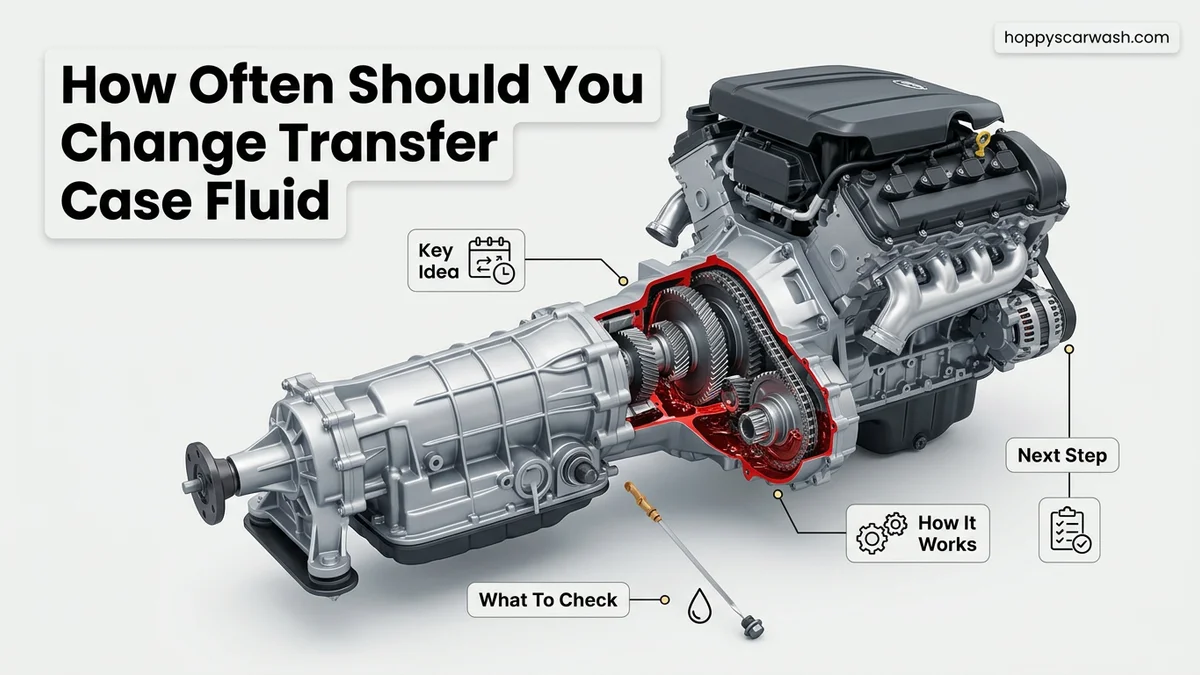
How Often Should You Change Transfer Case Fluid 2026 Guide
Most vehicles require a transfer case fluid change every 30,000 to 50,000 miles, depending on usage and drivetrain type. Neglecting this maintenance can lead to catastrophic internal gear failure and expensive repairs. Severe conditions like frequent towing or off-roading require cutting these intervals in half.
For most four-wheel-drive and all-wheel-drive vehicles on the road in 2026, you should change your transfer case fluid every 30,000 to 50,000 miles. If you drive a modern heavy-duty truck or push your vehicle through extreme off-road conditions, that interval often shrinks to every 15,000 to 30,000 miles.
Ignoring this vital maintenance routine leads to severe internal component wear, overheating, and eventual transfer case failure that can easily cost thousands of dollars to repair. Getting the timing right protects your drivetrain and keeps your vehicle capable when you need traction the most.
Key Takeaways
- Change your transfer case fluid every 30,000 to 50,000 miles under normal driving conditions.
- Heavy towing, hauling, and off-roading require shortening the fluid change interval significantly.
- AWD vehicles often have different fluid requirements and change schedules than traditional 4WD trucks.
- Unusual grinding noises or difficulty shifting into 4WD indicate contaminated or degraded fluid.
- Always consult your specific vehicle owner manual for exact fluid capacities and specifications.
What Causes Transfer Case Fluid Breakdown and Wear
Thermal Stress and Friction
Your transfer case works continuously to split power between your front and rear axles. Every time you engage four-wheel drive or navigate a tight turn in an all-wheel-drive vehicle, the internal gears, chains, and clutch packs generate massive amounts of heat. This thermal cycling bakes the fluid over time, causing its chemical additives to shear down and lose their lubricating properties.
Metal Particulate Accumulation
As the gears mesh and shift sleeves slide into place, microscopic metal shavings inevitably shear off into the fluid. Even with magnetic drain plugs capturing large debris, suspended metallic particles act like a liquid sandpaper. This contaminated fluid accelerates wear on bearings, synchronizers, and seals. Changing the fluid flubs out this abrasive sludge before it can score metal surfaces.
Master Transfer Case Fluid Maintenance in 7 Simple Steps
Knowing how often you should change your transfer case fluid is vital for keeping your four-wheel-drive or all-wheel-drive vehicle operating smoothly. Neglecting this crucial drivetrain component can lead to catastrophic internal gear failure, expensive repairs, and stranded adventures. This comprehensive guide walks you through determining your specific fluid change intervals, inspecting fluid health, and executing the maintenance process like a seasoned mechanic.
Step 1: Consult Your Factory Owner Manual
What you need: Your vehicle’s physical owner manual or digital access to the manufacturer maintenance schedule.
Instructions: Start by looking up the specific maintenance intervals for the transfer case fluid in your vehicle. Manufacturers categorize usage into normal and severe operating conditions. If you frequently tow heavy trailers, drive off-road through deep mud or sand, operate in extreme sub-zero or desert temperatures, or make many short trips in stop-and-go city traffic, you fall under the severe service category. For severe service, cut the recommended normal mileage interval in half to protect your gears adequately.
Pro Tip: Never rely strictly on generic online forums for fluid intervals, as axle and transmission configurations vary wildly even within the same model year.
Step 2: Understand the General Mileage Benchmarks
What you need: A basic understanding of standard automotive drivetrain maintenance timelines.
Instructions: While specific requirements vary by make and model, most modern transfer cases require a fluid change every 30,000 to 50,000 miles under normal driving conditions. Heavy-duty trucks used for commercial towing or frequent off-roading often need this service as early as every 15,000 miles. Conversely, some light-duty crossover vehicles with sealed, light-duty all-wheel-drive systems might stretch up to 60,000 or 100,000 miles. Always lean on the conservative side because fresh fluid is vastly cheaper than a replacement transfer case assembly.
Pro Tip: Keep a dedicated automotive logbook in your glove box or use a car maintenance tracking app to record your mileage and service dates accurately.
Step 3: Recognize the Warning Signs of Degraded Fluid
What you need: Your senses of sight, sound, and touch while operating the vehicle.
Instructions: Pay close attention to how your vehicle behaves when shifting into four-wheel drive or navigating tight turns. If you hear a grinding, whining, or clicking noise coming from underneath the center of the vehicle, your fluid may be heavily contaminated or dangerously low. Furthermore, if the vehicle hesitates, binds, or refuses to smoothly engage four-wheel-drive mode, old fluid losing its friction-modifying properties is frequently the culprit. Do not wait for a mileage milestone if these physical symptoms present themselves.
Pro Tip: A persistent burning smell after highway driving can indicate that your transfer case fluid is overheating and breaking down rapidly.
Step 4: Perform a Visual Fluid Inspection
What you need: A vehicle jack, jack stands, wheel chocks, a 3/8-inch ratchet, and a clean piece of cardboard or clear tubing.
Instructions: Secure your vehicle on a flat, level surface, engage the parking brake, and safely elevate it using sturdy jack stands. Locate the transfer case situated behind the transmission in the center of the vehicle. Always remove the upper fill plug before removing the lower drain plug to ensure you can refill the unit. Insert a clean zip tie or piece of flexible tubing into the fill hole to siphon or scoop a small sample of the fluid. Examine its color and consistency directly in good lighting.
Pro Tip: If the fill plug is stripped or heavily rusted, apply penetrating fluid and let it soak for at least thirty minutes before attempting to loosen it.
Step 5: Analyze the Fluid Condition and Debris
What you need: A white shop towel or paper towel, and a flashlight.
Instructions: Wipe your fluid sample onto the white towel. Healthy transfer case fluid (whether automatic transmission fluid, gear oil, or specialized synthetic fluid) should be translucent, relatively clear, and reddish, amber, or light brown in color. If the fluid is pitch black, smells intensely burnt, or contains a thick, metallic sludge with visible metal flakes, your transfer case requires an immediate fluid change and internal inspection. A small amount of fine metallic paste on a magnetic drain plug is normal wear, but actual metal shavings indicate failing bearings or gears.
Pro Tip: Never mix fluid types. Always verify whether your specific transfer case requires ATF (like Dexron VI) or heavy gear oil (like 75W-90) to prevent internal seal destruction.
Step 6: Drain and Refill the Transfer Case
What you need: Fresh manufacturer-approved fluid, a catch pan, a fluid transfer pump, new crush washers, and appropriate wrenches.
Instructions: Position your catch pan directly beneath the lower drain plug. Remove the plug and allow the old fluid to drain completely until it slows to a steady drip. Clean the magnetic drain plug thoroughly to remove trapped metallic debris, install a fresh crush washer, and torque it down to factory specifications. Using your fluid pump, fill the transfer case through the upper fill hole until the fluid level reaches the exact bottom lip of the fill opening. Install a new washer on the fill plug and tighten securely.
Pro Tip: Drive the vehicle for five minutes after the fluid change, then lift it back up to quickly recheck for leaks around both plugs.
Step 7: Establish a Long-Term Maintenance Schedule
What you need: A calendar reminder, a smartphone app, or a service sticker for your windshield.
Instructions: Now that your transfer case has fresh fluid, create a recurring reminder to inspect or change it based on your driving habits. If you drive roughly 12,000 miles per year under mixed conditions, set a reminder every three years for a standard fluid replacement. If you frequently submerge your vehicle in water crossings, check the fluid immediately afterward, as water can easily contaminate transfer case breathers and ruin the fluid instantly, turning it into a milky pink or brown milkshake.
Pro Tip: Bundle your transfer case fluid change with your regular differential and transmission service intervals to knock out your entire drivetrain maintenance simultaneously.
✅ Final Checklist
- Verified factory fluid type and capacity requirements
- Confirmed upper fill plug could be removed prior to draining
- Cleaned magnetic drain plug and installed fresh crush washers
- Filled transfer case precisely to the fill-plug threshold level
- Checked for leaks after a short test drive
Important Notes:
- Always support your vehicle with rated jack stands; never crawl under a car supported solely by a hydraulic jack.
- Seek professional mechanic assistance if drain plugs are seized, stripped, or if you discover large metal chunks in the drained fluid.
- Estimated DIY time is 1 to 2 hours, with a cost ranging from $30 to $100 depending on fluid capacity and type.
How to Determine Your Vehicle Exact Service Schedule
Decoding Manufacturer Guidelines for 2026
Vehicle manufacturers often split maintenance into normal and severe service schedules. While a highway-only commuter car might see recommended intervals stretch to 60,000 miles, the reality of driving in 2026 usually pushes most vehicles into the severe category. Always consult your owner manual, but keep these standard baselines in mind:
- Standard Duty (Light AWD crossovers): 50,000 to 60,000 miles
- Moderate Duty (Traditional 4WD SUVs): 30,000 to 50,000 miles
- Severe Duty (Heavy-duty trucks, towing, off-roading): 15,000 to 30,000 miles
Evaluating Your Real-World Driving Habits
Your calendar matters just as much as your odometer. If your vehicle is approaching the five-year mark even with low mileage, the fluid additives have likely degraded from age and thermal cycles alone. Frequent towing, hauling heavy payloads, driving through deep water, or living in extreme climates all mean you should pull your service interval forward by at least 30 percent.
Step-by-Step Guide to Identifying Bad Transfer Case Fluid
Inspecting your transfer case fluid requires a systematic approach to accurately assess degradation. Waiting for a catastrophic failure will result in expensive component replacements.
Visual and Olfactory Inspection
Checking the condition of your fluid involves a direct physical assessment using a clean extraction syringe or dipstick. Follow these steps to evaluate the fluid:
- Park the vehicle on a completely level surface, engage the emergency brake, and allow the transmission and transfer case to cool down completely to prevent severe burns.
- Locate the fill plug on the transfer case housing, clean the surrounding exterior area thoroughly with a wire brush, and remove the plug carefully.
- Insert a clean fluid transfer pump hose or dipstick into the reservoir and draw a small sample of the fluid into a clear container.
- Examine the color and clarity of the fluid under bright light; healthy fluid is typically translucent red, amber, or light brown depending on the specified formulation.
- Smell the extracted sample to check for a distinct, pungent, burnt odor, which indicates severe thermal breakdown and excessive internal component friction.
According to automotive engineering data from the Society of Automotive Engineers (SAE), dark black fluid mixed with visible metallic suspended particles indicates advanced mechanical wear of the internal chain and gears.
What If Your Transfer Case Still Slips After Fluid Service
Replacing degraded fluid is an effective maintenance procedure, but it cannot reverse advanced mechanical component damage. If your four-wheel-drive system continues to slip, shudder, or fail to engage cleanly after a fresh fluid change, underlying hardware failures are likely present.
Consider these critical fallback steps to resolve persistent operational issues:
- Check the electronic shift motor, actuator, and internal encoder ring for electrical faults, corrosion, or stripped plastic gear teeth, which are common failure points in modern computer-controlled transfer cases.
- Inspect the front and rear drive shafts, universal joints, and CV joints for excessive play or binding that mimics transfer case slippage under load.
- Verify that all four tires match in brand, tread depth, and exact circumference; uneven tire wear causes constant drivetrain bind and mimics internal transfer case failure.
- Consult a certified drivetrain specialist or transmission shop to perform a comprehensive diagnostic scan for stored diagnostic trouble codes (DTCs) in the four-wheel-drive control module.
- Prepare for professional component rebuild or replacement if internal mechanical failure is confirmed; professional rebuild services typically range from $1,500 to $3,500 depending on the vehicle make and model.
Conclusion
Maintaining clean transfer case fluid is essential for the longevity and reliability of your four-wheel-drive or all-wheel-drive system. Adhering to strict service intervals prevents premature gear wear and costly mechanical failures. According to verified research and expert sources from major automotive manufacturers, routine preventative maintenance remains the single most effective strategy to avoid unexpected breakdowns. Take action today by checking your vehicle service manual and scheduling your 2026 transfer case fluid inspection.
❓ Frequently Asked Questions
How often should you change transfer case fluid for heavy towing?
If you frequently tow heavy trailers or haul heavy loads, you should service your transfer case every 15,000 to 30,000 miles to prevent thermal breakdown.
What are the common signs of old transfer case fluid?
Common symptoms include whining or grinding noises while driving, a burning smell underneath the vehicle, and difficulty engaging four-wheel drive modes.
Is transfer case fluid the same as transmission fluid?
Not always. While some transfer cases use automatic transmission fluid, many require specific manual transmission fluids or heavy-duty gear oils.
Does city driving count as severe service for transfer cases?
Frequent stop-and-go city driving generally does not impact the transfer case as much as heavy loads, but extreme climate conditions might warrant earlier changes.
Can I check the transfer case fluid condition myself?
Yes, you can check the fluid level and color by removing the fill plug on the transfer case housing and inserting a clean dipstick or finger.
Why do AWD transfer cases fail faster than 4WD units?
AWD systems engage constantly to manage traction on various surfaces, creating continuous friction and heat that degrades the fluid quicker than selectable 4WD systems.