How Much Does Firestone Charge to Install Tires 2026 Guide
Firestone typically charges between $20 and $30 per tire for standard mounting and balancing services. Bringing tires purchased from a third-party retailer often incurs slightly higher labor fees than buying them directly in-store.
At Firestone Complete Auto Care, you can generally expect to pay between $25 and $30 per tire for standard mounting and balancing. If you are purchasing a full set of four tires, your baseline installation cost will typically land right around $100 to $120 before taxes and extra shop supplies.
Knowing these exact costs helps you budget accurately for your next maintenance visit in 2026. While buying tires online or in-store is a major expense, the installation fees can easily catch you off guard if you do not check the itemized breakdown ahead of time.
Key Takeaways
- Expect to pay $20 to $30 per tire for standard mounting and balancing services at Firestone.
- Buying tires directly from Firestone can sometimes lower or bundle your overall installation labor costs.
- Extra charges for old tire disposal typically add around $2 to $5 per tire.
- TPMS (Tire Pressure Monitoring System) service kits may add an extra fee if replacements are needed.
- Lifetime balancing and alignment packages require an upfront investment but save money on long-term wear.
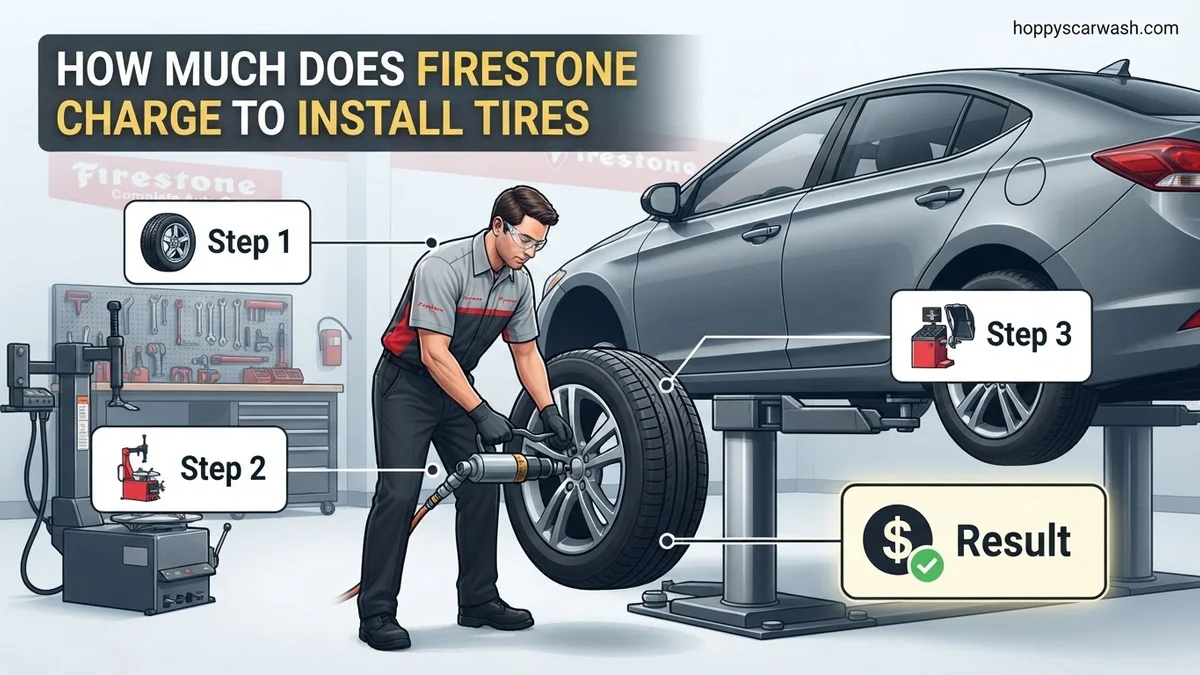
What Causes Variations in Firestone Tire Installation Costs
Not every customer walks out of a Firestone service center paying the exact same installation rate. Several distinct factors directly influence the final total on your receipt when you bring your vehicle in for new rubber.
Wheel Size and Tire Profile
The physical size of your wheels dictates how difficult the mounting process is for the technician. Standard passenger cars with 15-inch or 16-inch wheels sit at the lowest end of the pricing spectrum. If you drive a modern SUV or truck equipped with 20-inch or larger low-profile rims, expect a surcharge. Larger wheels require more labor-intensive handling on specialized mounting machines to avoid damaging the rim.
Where You Bought Your Tires
Where you acquired your tires plays a massive role in what Firestone charges you. If you purchase your tires directly from Firestone Complete Auto Care, they frequently bundle installation promotions or offer discounted mounting packages. Conversely, if you bring tires shipped from an online retailer to a Firestone shop for installation-only service, you will likely pay a higher standard labor rate per tire.
Mastering Firestone Tire Installation Costs in 6 Simple Steps
Navigating automotive service pricing can often feel overwhelming, especially when you need new rubber for your vehicle. Understanding how much Firestone charges to install tires requires a clear breakdown of base mounting fees, mandatory disposal charges, and optional warranties. This practical walkthrough will help you decode Firestone’s pricing structure, prepare your budget accurately, and avoid unexpected service counter surprises.
Step 1: Evaluate the Base Mounting and Balancing Fee
What you need: Your tire size, vehicle make and model, and a preliminary quote from your local Firestone Complete Auto Care shop.
Instructions: The foundational cost of putting a new tire on a wheel typically ranges from $22 to $28 per tire at Firestone locations. This base rate covers removing your old tire from the wheel rim, mounting the new tire, and performing a standard spin balance to ensure a smooth, vibration-free ride at highway speeds. Keep in mind that low-profile tires, large truck tires (over 20 inches), or specialty performance tires may incur an additional surcharge of $5 to $10 per tire due to the specialized equipment and extra labor required to protect expensive rims.
Pro Tip: Always ask if your quote includes balancing for all four wheels, as some promotional pricing only covers the mounting portion.
Step 2: Account for Valve Stem Replacements and TPMS Service
What you need: Inspection of your current tire pressure monitoring system (TPMS) sensors and valve stems.
Instructions: When installing new tires, standard rubber valve stems are usually replaced as a best practice to prevent slow leaks, costing around $3 to $5 each. If your vehicle is equipped with electronic TPMS sensors, Firestone will typically charge a service fee (roughly $5 to $7 per wheel) to replace the service pack components, including the internal core, cap, and grommet. If a TPMS sensor is broken or entirely dead, replacing the sensor unit itself can add $50 to $100 per wheel depending on whether it requires OEM or programmable aftermarket hardware.
Pro Tip: Never reuse old rubber valve stems; the rubber degrades over time and failing to replace them can lead to dangerous pressure loss within weeks.
Step 3: Factor in Tire Disposal and Environmental Fees
What you need: Local municipal recycling regulations and your state’s specific waste disposal tax laws.
Instructions: State laws and environmental regulations require service centers to properly recycle old, worn-out tires. Firestone will charge a tire disposal fee, commonly known as a state recycling fee or environmental fee, which generally ranges from $3 to $8 per tire depending on your geographic location. This mandatory charge ensures that your old treads are safely hauled away to authorized recycling facilities where they can be repurposed into crumb rubber for playgrounds, turf, or asphalt rather than sitting in a local landfill.
Pro Tip: You cannot opt out of this fee by taking your old tires with you in most corporate service centers, as state environmental compliance mandates tracking of all removed scrap tires.
Step 4: Decide on Wheel Alignment Packages
What you need: Assessment of your current tire wear patterns and a vehicle steering alignment check.
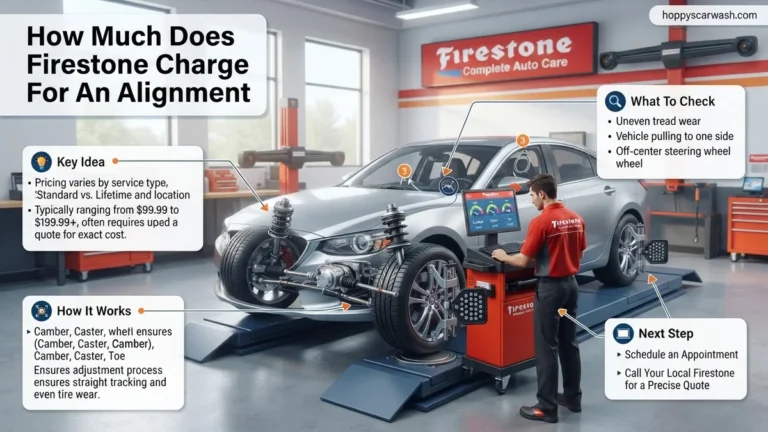
Instructions: While not strictly part of the physical tire installation, Firestone strongly recommends a professional four-wheel alignment when installing a brand-new set of tires to protect your investment. A standard alignment check is often free, but a full front-end or four-wheel adjustment typically costs between $90 and $130. Alternatively, Firestone frequently offers a lifetime alignment package for around $200 to $250, which allows you to bring your car back for alignments as often as every 6,000 miles for as long as you own the vehicle.
Pro Tip: If your old tires show feathering or uneven inner-edge wear, purchasing an alignment is mandatory to prevent your new tires from balding prematurely within 10,000 miles.
Step 5: Review Road Hazard Protection and Warranty Options
What you need: Information regarding your driving habits, daily commute routes, and pothole frequency.
Instructions: Firestone offers optional road hazard protection certificates for their tires, which typically cost between 10% to 15% of the tire’s purchase price per unit. This certificate covers free repair for nail punctures or full tire replacement if the rubber suffers unrepairable sidewall damage from a pothole or road debris within the first year or specified tread depth. Standard manufacturer treadwear warranties are included for free with the purchase of qualifying tires, but road hazard coverage provides absolute peace of mind against unexpected road hazards.
Pro Tip: Read the fine print on road hazard certificates to see if the replacement cost is prorated based on remaining tread depth after the initial free-replacement period.
Step 6: Combine Offers and Calculate the Total Out-the-Door Price
What you need: A calculator, promotional coupons, Firestone credit card offers, or mail-in rebate forms.
Instructions: Total your individual costs by multiplying the base mounting fee ($25), disposal fee ($5), and valve stem fee ($4) per tire, bringing basic installation services to roughly $135 to $160 for a set of four, exclusive of the actual tire purchase price. Add in alignment and road hazard protection if desired, which can bring the total service labor and extra fees package to $250 to $350. Before paying at the counter, check Firestone’s online portal for seasonal promotions, instant manufacturer rebates, or promotional financing offers that can slash up to $100 off your final bill.
Pro Tip: Always request a printed, itemized estimate before handing over your keys so you can review and question any unexpected line items.
✅ Final Checklist
- Verify that the itemized invoice clearly separates tire purchase price from installation, balancing, and disposal fees.
- Confirm that all four wheels have been dynamically spin-balanced to eliminate high-speed steering wheel vibrations.
- Check that proper tire pressures (psi) match the manufacturer placard located inside the driver-side door jamb.
- Inspect the wheel rims for any cosmetic scratches or torque wrench marks resulting from the mounting process.
- Ensure you have received and filed all warranty paperwork, rebate submission forms, and service receipts.
Important Notes:
- Always drive your vehicle back to the shop or check your lug nut torque values manually using a torque wrench after driving the first 50 to 100 miles.
- Seek professional help immediately if your steering pulls hard to one side or if your dashboard TPMS warning light stays illuminated after leaving the garage.
- Estimated total service time for standard tire installation, balancing, and alignment is 1.5 to 2.5 hours, with total installation labor and fee costs averaging $130 to $350 depending on alignment and protection selections.
How to Calculate Your Total Firestone Tire Installation Price Step-by-Step
Arriving at your final out-the-door price requires looking beyond the basic mounting fee. Firestone invoices include mandatory shop fees and state-regulated charges that you must factor into your 2026 automotive budget.
Breaking Down the Mandatory Fees
Beyond the core mounting and balancing charge, you will see a few standard line items on your estimate. Understanding these individual costs prevents any surprises at the register:
- Tire Disposal Fees: Usually ranging from $3 to $8 per old tire, this covers the environmental recycling cost mandated in most states.
- Valve Stems or TPMS Service: Standard rubber valve stems are cheap, but if your tire pressure monitoring system sensors need new service kits or replacement nuts, add $5 to $10 per wheel.
- Shop Supplies and EPA Fees: A small percentage fee (usually 5% to 10% of labor) is added to cover shop rags, weights, and lubricants.
Running the Math for a Full Set of Four
To see how this adds up, imagine you are installing four standard 17-inch tires purchased directly from Firestone. Your baseline mounting and balancing might total $110. Add four disposal fees at $5 each ($20 total), new valve stems at $15 total, and a $10 shop supply fee. Your actual installation-related costs climb to around $155 before local sales tax.
How to Save Money on Firestone Mounting and Balancing Fees
Automotive service costs can add up quickly, but savvy drivers can utilize several proven strategies to reduce their total Firestone tire installation bill in 2026. Dealerships and major service centers frequently offer promotional discounts that savvy consumers can leverage.
Look for Manufacturer Mail-In Rebates
Major tire brands like Bridgestone, Firestone, Michelin, and Goodyear routinely partner with service centers to offer seasonal rebates. Purchasing a set of four qualifying tires during promotional windows often yields mail-in or digital prepaid cards ranging from $50 to $100. According to automotive consumer research, combining these manufacturer rebates with standard service packages is the single most effective way to lower overall costs.
Time Your Purchase with Holiday Promotions
Firestone Complete Auto Care frequently runs holiday sales events during major retail weekends such as Memorial Day, Labor Day, and Black Friday. Industry data shows that installation packages or balancing services are occasionally discounted or bundled entirely with the purchase of a full set of tires during these promotional periods. Always check the current offers section on the official Firestone website before booking your appointment.
-
Actionable steps to secure the best deal:
- Browse current promotional offers online before visiting a local Firestone shop.
- Ask the service advisor specifically if any bundle deals apply to your tire tier.
- Inquire about the Firestone Credit Card, which frequently offers promotional deferred interest or special cardholder-only rebates on major maintenance services.
What If Your Firestone Installation Includes Unexpected Extra Fees
Sometimes the final bill at the service counter exceeds the initial online quote. Understanding standard industry practices helps you identify legitimate charges versus unnecessary add-ons during your 2026 service visit.
Common Discrepancies and State Regulations
State laws dictate mandatory fees that service centers must collect. For instance, state tire disposal fees and environmental waste recycling charges are legally required in most jurisdictions. However, optional services like alignment checks or extended road hazard warranties should always require explicit customer approval before technicians perform the work.
-
Steps to handle unexpected charges at the counter:
- Review the itemized estimate line by line before handing over your keys or payment.
- Decline unauthorized add-ons immediately if they were not agreed upon during the drop-off consultation.
- Request a detailed explanation for any mandatory state disposal or shop supply fees if they seem unusually high.
- Escalate the issue to the store manager if a quoted promotional installation price was not correctly applied to your final invoice.
What If It Still Doesn’t Work?
If your local Firestone center cannot accommodate your budget or schedule, alternative service routes remain available for your tire installation needs.
- Compare pricing with competing national chains such as Discount Tire, Pep Boys, or local independent mechanics who may offer lower labor rates.
- Utilize mobile tire installation services that bring the mounting and balancing equipment directly to your home or office for ultimate convenience.
- Consult an independent ASE-certified repair shop for a secondary quote if specialized suspension or TPMS sensor labor is driving up the cost.
- Seek professional mediation through corporate customer service channels if you experience a billing dispute at a specific franchise location.
- Expect alternative independent shop installation fees to range between $20 and $35 per tire depending on your geographic market.
Conclusion
Navigating Firestone tire installation costs requires an understanding of standard mounting, balancing, and disposal fees that typically total $120 to $160 for a set of four. By leveraging manufacturer rebates, checking seasonal promotional discounts, and reviewing itemized quotes carefully, vehicle owners can avoid unexpected expenses. According to verified research and automotive consumer experts, comparing local service rates and asking for bundled packages remains the most effective strategy for managing maintenance budgets in 2026. Schedule your next appointment today after confirming current online offers to secure the best possible value.
❓ Frequently Asked Questions
What is included in Firestone’s standard tire installation fee?
The standard fee typically covers mounting the new tires onto your wheels, replacing the valve stems, and dynamically balancing each tire using specialized weights.
How much does Firestone charge to install tires purchased online?
When you bring tires bought from another retailer, Firestone usually charges a standalone labor fee that can range from $25 to $40 per tire depending on wheel size and location.
Can I get lifetime balancing when I buy installation at Firestone?
Yes, Firestone frequently offers lifetime balancing packages or alignment add-ons that ensure your tires wear evenly for the duration of their tread life.
Are wheel alignments included when Firestone installs new tires?
Wheel alignments are rarely included in the base installation price and must usually be purchased as an additional service, though package deals are often available.
Do low-profile or large-diameter tires cost more to install at Firestone?
Yes, larger rims (usually 18 inches and above) and low-profile tires require extra care and equipment, resulting in slightly higher mounting fees.
Should I make an appointment for tire installation at Firestone Complete Auto Care?
Booking an appointment online or by phone is strongly recommended to minimize wait times, as walk-in availability depends entirely on current shop volume.