How Much Does It Cost to Install a Leveling Kit 2026 Guide
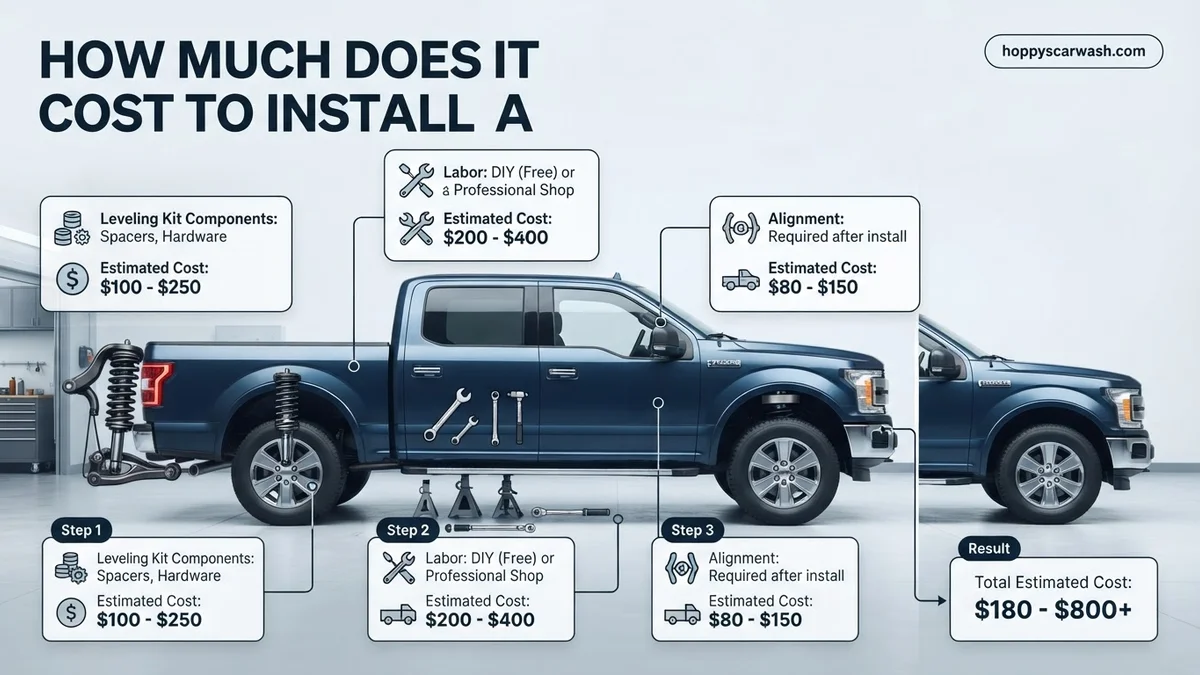
Installing a truck or SUV leveling kit typically costs between $300 and $1,300 total, depending heavily on parts and labor rates. While the leveling kit hardware itself ranges from $50 to $500, professional installation usually adds $200 to $800 in labor charges.
A standard leveling kit installation typically costs between $300 and $1,500 total in 2026. This price combines the hardware itself, professional labor hours, and post-installation alignment services. If you purchase a basic spacer kit and have an independent shop install it, you will likely land on the lower end of that spectrum. High-end performance strut replacements installed at a dealership will push you toward the maximum.
Getting your truck or SUV sitting level completely changes its stance. It eliminates the factory rake—where the front sits lower than the rear—and creates clearance for slightly larger tires. Knowing the exact financial investment helps you budget properly without running into surprise shop fees.
Key Takeaways
- Standard leveling kits cost between $50 and $500 for parts alone.
- Professional shop labor typically ranges from $200 to $800 depending on the suspension type.
- A mandatory wheel alignment adds $100 to $250 to the final project cost.
- Strut spacers are generally cheaper to install than full replacement coilovers.
- Hidden costs may include headlight adjustments and minor trimming for larger tires.
What Causes Variations in Leveling Kit Installation Costs
Type of Suspension Design
The specific mechanical layout of your vehicle dictates both parts and labor pricing. Different trucks utilize different methods to raise the front end:
- Strut Spacers: Common on modern half-ton trucks like the Ford F-150 or Toyota Tundra. Parts cost $100 to $300, and labor takes 2 to 4 hours.
- Torsion Keys: Found on older or heavy-duty trucks with torsion bar front suspensions. These parts run $75 to $200, and installation is usually quick, keeping labor around $150 to $300.
- Coil Spring Spacers: Used on vehicles with solid front axles, like Jeep Wranglers or older RAM trucks. Parts cost $50 to $150, making this the most budget-friendly route.
- Replacement Coilovers: A premium upgrade that replaces the entire factory shock and spring assembly. Parts alone range from $600 to $1,500 before labor.
Vehicle Make, Model, and Shop Rates
Your geographic location and choice of repair facility heavily influence the final bill. Dealership service centers in major metropolitan areas charge upwards of $150 to $250 per hour in 2026. Independent off-road specialty shops often charge a flat-rate labor fee ranging from $250 to $600 for standard spacer installations. Furthermore, luxury or heavy-duty platforms with complex electronic suspension components require extra diagnostic calibration time, increasing your labor hours.
Master Truck Leveling Kit Costs in 7 Simple Steps
Calculating the true financial investment of installing a leveling kit involves much more than just purchasing the metal spacers or struts. Whether you drive a Ford F-150, Ram 1500, or Toyota Tacoma, understanding the breakdown of parts, labor, and hidden fees prevents budget surprises. This comprehensive walkthrough guides you through evaluating every single expense associated with leveling your truck so you can plan your vehicle upgrade like a seasoned professional.
Step 1: Evaluate Your Truck Model and Suspension Type
What you need: Your vehicle owner’s manual, a tape measure, and basic knowledge of your truck’s current front suspension setup (independent front suspension versus solid front axle).
Instructions: Start by identifying the specific year, make, and model of your truck, as suspension designs dictate the type of leveling kit required. Measure the distance from the center of your front wheel hub straight up to the bottom of the fender lip, then do the same for the rear. The difference between these two measurements is your factory rake (usually 2 to 3 inches). Trucks with coil-over strut assemblies require different components than those with torsion keys or leaf springs, directly impacting your baseline parts budget.
Pro Tip: Never guess your suspension type by looking at photos online. Crawl under your truck with a flashlight to verify if you have factory struts, independent torsion bars, or a solid axle.
Step 2: Research and Select Your Leveling Kit Hardware
What you need: Access to automotive parts websites, manufacturer specifications, and a notepad to compare prices.
Instructions: Choose between the three primary types of leveling kits: strut extensions (bov-style spacers), replacement lifted struts, or torsion keys. Strut extensions are the most budget-friendly, typically costing between $50 and $200. Full replacement strut assemblies offer superior ride quality but range from $300 to $700. Torsion keys for trucks like older Chevys and GMCs generally cost $75 to $250. Select a reputable brand (such as Rough Country, Bilstein, or Fox) that matches your performance expectations and driving habits.
Pro Tip: Avoid ultra-cheap, unbranded aluminum spacers sold online; they can crack under heavy stress and compromise your vehicle safety.
Step 3: Calculate Professional Installation Labor Costs
What you need: Local mechanic quotes, phone or email access to off-road specialty shops, and your vehicle details.
Instructions: Call at least three local auto repair shops or 4×4 specialty outfitters to request quotes for labor only, assuming you supply the parts. Professional leveling kit installation generally takes 2 to 4 hours. Depending on your geographic location and shop labor rates (which range from $100 to $200 per hour), expect to pay between $250 and $600 for professional installation alone. Independent shops may offer lower rates, while dealerships will typically charge on the higher end of that spectrum.
Pro Tip: Ask shops if their labor quote includes a post-installation safety check. Choosing a shop that specializes in trucks ensures they won’t over-torque or misalign your steering components.
Step 4: Factor in Mandatory Wheel Alignment Expenses
What you need: Alignment shop pricing and a commitment to handling this immediately after installation.
Instructions: Altering your front suspension geometry by raising the front end will inevitably throw off your toe, camber, and caster angles. Failing to get an alignment will cause rapid, uneven tire wear and poor handling. Contact local alignment racks or tire shops to price out a professional 4-wheel alignment, which typically costs between $100 and $250. Some premium off-road shops bundle this into their total installation quote, but always verify before dropping off your keys.
Pro Tip: Look for lifetime alignment packages if you plan on keeping your truck for many years, as you may need minor adjustments down the road.
Step 5: Anticipate Hidden Supporting Component Costs
What you need: Inspection of your current suspension wear items (ball joints, control arms, sway bar links) and extra upgrade funds.
Instructions: When lifting the front end of a truck, factory control arms and ball joints often operate at extreme angles, leading to accelerated wear. Depending on the height of your kit (anything over 2 inches), you may need aftermarket upper control arms, which cost $300 to $650. Additionally, if you plan to upgrade to larger tires to fill the newly cleared wheel well gap, factor in $800 to $1,500 for a set of larger all-terrain tires.
Pro Tip: If your truck has more than 60,000 miles on the odometer, budget for replacement ball joints now, as installing them simultaneously saves you double labor charges.
Step 6: Weigh DIY Installation Savings Versus Risk
What you need: A garage workspace, hydraulic floor jack, heavy-duty jack stands, metric socket set, torque wrench, and spring compressors (if doing strut work).
Instructions: If you possess advanced mechanical skills and proper safety equipment, performing the installation yourself can save you $250 to $600 in labor. Allocate a full Saturday (6 to 8 hours) for the job. You will need to safely lift the front end, support the frame, disconnect sway bar links and tie rods, unbolt the factory strut assembly, install the leveling spacer or new strut, and torque all suspension fasteners back to factory specifications while the suspension is loaded.
Pro Tip: Never compress coil springs without professional-grade spring compressors; stored spring energy is extremely dangerous and can cause severe injury if mishandled.
Step 7: Total Your Expenses and Finalize Your Budget
What you need: Your compiled list of parts, labor quotes, alignment fees, and potential upgrade costs.
Instructions: Add up all individual estimates to get your true final cost. A basic budget setup using budget strut spacers, professional installation, and an alignment will total around $400 to $900. A mid-tier setup with quality replacement struts, labor, alignment, and new upper control arms will run $1,000 to $1,800. If you add new larger tires and wheels into the mix, your total project cost can easily exceed $3,000. Review your budget to ensure you are comfortable with the total investment before purchasing any parts.
Pro Tip: Always keep a 10% financial cushion in your budget for unexpected hardware breakage, rusted bolts, or seized alignment cams.
✅ Final Checklist
- Verified that the leveling kit matches the exact year, make, model, and drive type (2WD vs 4WD) of your truck.
- Obtained clear estimates for parts, professional labor, and post-installation wheel alignment.
- Accounted for potential extra hardware costs such as differential drop kits or aftermarket upper control arms.
- Planned for safe transportation to an alignment shop immediately following the installation.
Important Notes:
- Suspension modifications involve critical steering and safety components; never compromise on the quality of hardware or professional alignment.
- Seek professional help immediately if you encounter rusted subframe bolts, lack heavy-duty jack stands, or feel uncomfortable working with high-tension coil springs.
- Estimated total time ranges from 4 to 8 hours depending on DIY versus professional route, with overall project costs spanning from $200 (DIY budget parts + alignment) to $1,800+ (premium parts, labor, alignment, and supporting components).
How to Calculate Total Parts and Labor Expenses
Breaking Down Hardware and Mechanical Labor
To accurately project your out-of-pocket expenses, you must separate the physical components from the mechanic’s time. A standard cost breakdown for a typical half-ton truck in 2026 looks like this:
- Leveling Kit Hardware: $100 to $500 for quality steel or polyurethane components.
- Professional Installation Labor: $200 to $800, depending on shop complexity and regional wage variations.
- Mandatory Wheel Alignment: $100 to $250 to adjust your steering geometry after altering ride height.
Hidden Fees to Watch Out For
When you request a quote from a local shop, always ask if the estimate is all-inclusive. Many quotes exclude essential secondary services that pop up during the installation process. If your truck has high mileage, rusted factory hardware may need to be cut off and replaced, adding minor parts fees. Additionally, changing your front suspension geometry frequently requires a headlight re-aim or an electronic steering angle sensor calibration, which can add $50 to $150 to your final invoice.
How to Budget for Hidden Fees Like Alignments and Modifications
When calculating the total expense of upgrading your suspension, focusing solely on the hardware and baseline labor can lead to unexpected budget overruns. According to automotive service data from 2026, additional ancillary services frequently add 30% to 50% to the initial project estimate.
Essential Post-Installation Services
Altering your truck’s factory rake fundamentally changes its suspension geometry. You cannot skip these necessary secondary procedures:
- Professional Wheel Alignment: Raising the front end shifts caster and camber angles. A four-wheel alignment is mandatory immediately following installation, typically costing between $100 and $250 depending on your vehicle’s specific steering setup.
- Headlight Recalibration: Lifting the front end points your headlights upward, which can blind oncoming traffic. Modern trucks with automated LED or projector systems often require sensor recalibration, costing roughly $75 to $150.
- Speedometer and ADAS Calibration: If your leveling kit clears the path for significantly larger tires, your vehicle’s computer must be reprogrammed. Advanced Driver Assistance Systems (ADAS) may also need recalibration to ensure safety sensors function correctly.
Hardware and Clearance Modifications
Beyond standard alignment fees, physical modifications may be required to prevent component rubbing. Mechanics often charge extra labor hours if upper control arms must be replaced to prevent premature ball joint wear on trucks lifted over two inches. Furthermore, trimming the inner plastic fender liners or pinch welds to accommodate larger off-road tires can add $100 to $300 in shop labor if not handled at home.
What If Professional Labor Quotes Are Too High?
If professional labor quotes exceed your budget, tackling the installation yourself or exploring alternative financing options can significantly reduce overall project expenses. Independent shops and dealerships often charge premium hourly rates, but careful planning provides viable workarounds.
Alternative Approaches to Reduce Costs
- Pursue DIY Installation: With basic mechanical tools, a reliable floor jack, heavy-duty jack stands, and a spring compressor, a competent DIYer can complete the job in a home garage. This eliminates the $250 to $800 labor charge entirely.
- Source Independent Mechanics: Dealerships charge upwards of $150 to $225 per hour, whereas trusted local independent suspension specialists often charge $90 to $130 per hour for the exact same mechanical work.
- Bundle Services: Ask local alignment shops if they offer discounted packages when you purchase the leveling kit, installation, and alignment directly through them as a combined service bundle.
- Negotiate Quote Items: Review your written estimate line by line to eliminate redundant diagnostic fees or inflated parts markups often added by national service chains.
What If Your Lift Settles Unevenly or Causes Vibrations?
Sometimes a freshly installed leveling kit introduces unexpected ride quality issues or uneven measurements. If your truck exhibits problems after the upgrade, follow these troubleshooting steps to resolve them safely:
- Check Torque Specifications: Re-torque all suspension bolts, control arms, and strut mounts to factory specifications after driving the first 50 to 100 miles, as settling components frequently cause minor looseness and clunking noises.
- Inspect CV Axle Angles: Excessive CV axle angles on four-wheel-drive trucks can cause severe vibrations during acceleration. If vibrations persist, install a differential drop kit to correct the angle, typically costing $50 to $150 in parts.
- Verify Ground-to-Fender Measurements: Measure all four corners on a completely level surface. Minor discrepancies under a quarter-inch are normal due to fuel tank placement and driver weight, but larger variances indicate incorrectly seated springs or mismatched spacers.
- Consult a Suspension Professional: If vibration or steering wander cannot be eliminated through alignment adjustments, take the vehicle to a certified alignment specialist for a comprehensive steering component audit. Professional diagnostic fees generally range from $100 to $200.
Conclusion
Installing a leveling kit is one of the most cost-effective ways to improve your truck’s stance and tire clearance, with total investments typically ranging from $100 for DIY spacer kits to over $1,500 for professional coilover systems and alignments. According to verified research and expert automotive sources, proper budgeting for post-installation alignments and potential hardware modifications ensures long-term vehicle safety and prevents premature suspension wear. Your next actionable step is to collect written quotes from at least two local certified shops to compare baseline labor rates before purchasing your kit.
❓ Frequently Asked Questions
What is the average price difference between strut spacers and replacement coilovers?
Strut spacers are the most affordable option, with parts costing $50 to $200. In contrast, full replacement performance coilovers can cost anywhere from $600 to over $1,500 for the hardware alone.
Why is a wheel alignment required after installing a leveling kit?
Changing the ride height alters the factory suspension geometry, which directly affects your wheel angles. A professional alignment is essential to prevent rapid tire wear and ensure safe handling.
How long does a professional shop take to install a leveling kit?
Most professional mechanics and suspension shops complete a standard leveling kit installation in about 2 to 4 hours. Complex suspension systems or rusted components on older trucks can extend this timeframe.
Are there any hidden costs associated with leveling kit installation?
Beyond parts and labor, you should budget for a wheel alignment ($100-$250). If you upgrade to larger tires afterward, you may also face costs for tire mounting, balancing, or minor plastic trimming.
Does installing a leveling kit void my truck’s factory warranty?
Under federal law, a dealership cannot void your entire factory warranty simply because you installed aftermarket parts. However, they can deny warranty coverage for a specific component if it can be proven that the leveling kit directly caused the failure.
Is it cheaper to install a leveling kit or a full suspension lift kit?
Leveling kits are significantly cheaper, with total installed costs rarely exceeding $1,300. Full suspension lift kits require extensive parts replacement and labor, frequently pushing total costs between $2,000 and $5,000 or more.