How Do You Know When Catalytic Converter Is Bad 2026 Guide
Recognizing a failing exhaust component early prevents severe engine damage. Sluggish acceleration, a persistent rotten egg smell, and the check engine light are the primary indicators that your catalytic converter is going bad.
You know your catalytic converter is going bad when your car experiences a sudden loss of acceleration, a persistent rotten egg smell from the exhaust, or illuminated dashboard lights like a P0420 diagnostic trouble code. As emissions standards tighten in 2026, modern vehicle computers monitor these exhaust components more strictly than ever, making early detection critical to avoid sudden engine stalls and catastrophic repair bills.
Ignoring these warning signs doesn’t just hurt your fuel economy; a completely clogged converter can trap extreme heat, cause backpressure, and ultimately destroy your engine. Recognizing the physical and performance red flags early on saves you from getting stranded and helps you pass mandatory state or regional emissions tests.
Key Takeaways
- A sudden drop in fuel economy often points to a clogged converter.
- Rattling noises underneath indicate broken internal honeycomb mesh.
- OBD-II code P0420 specifically signals low catalyst system efficiency.
- Sulfur smells occur when sulfur gases fail to convert properly.
- Engine misfires and oil leaks are frequent root causes of failure.
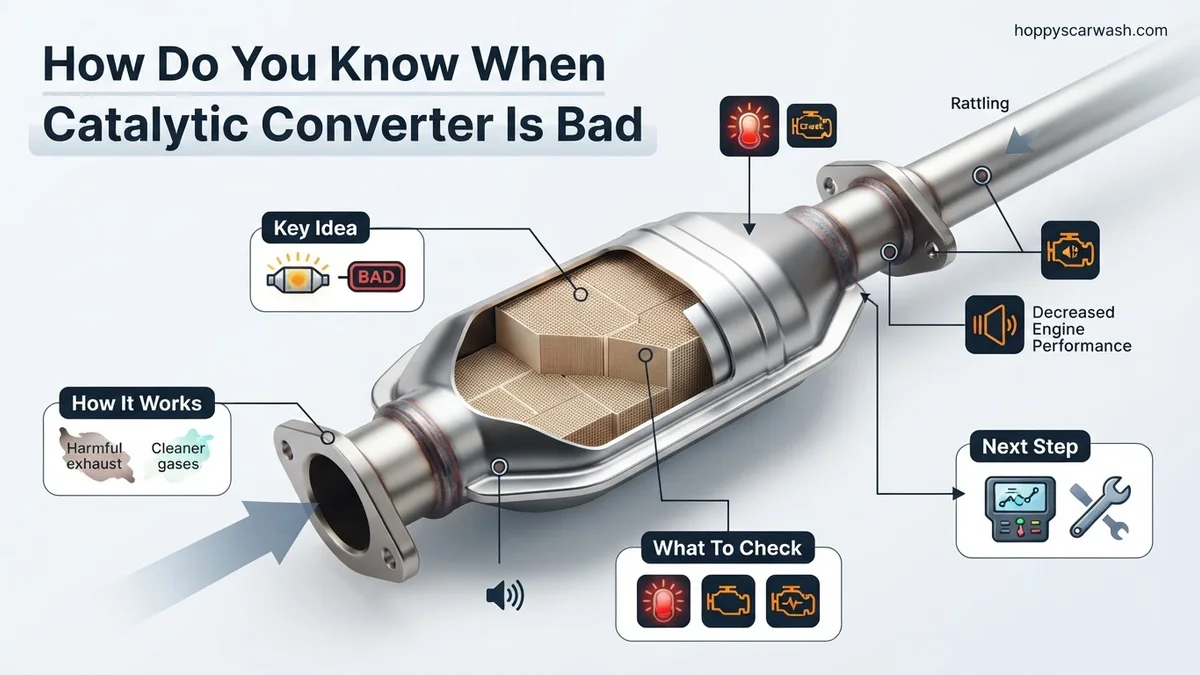
Top Symptoms and Warning Signs of a Bad Catalytic Converter
Severe Performance Drops and Engine Sluggishness
When the internal honeycomb structure of a converter melts or collapses, it chokes off the exhaust flow. You will notice your car feels remarkably sluggish when you press the gas pedal. Acceleration becomes unresponsive, and the vehicle may struggle to maintain highway speeds or climb steep hills.
The Distinct Rotten Egg Exhaust Smell
A healthy catalytic converter transforms toxic sulfur gases into odorless compounds. When the component fails, unburned sulfur makes its way out of your tailpipe. If you smell a strong odor resembling rotten eggs or sulfur every time you drive, your converter’s catalyst coating has degraded.
- Engine Misfires: Unburned fuel entering a hot converter causes internal overheating and rapid structural failure.
- Dark Exhaust Smoke: Excessive black or gray smoke points to a rich fuel mixture that quickly ruins the converter.
- Abrupt Stalling: A severely clogged exhaust path prevents the engine from breathing, causing it to die completely under a load.
How to Diagnose and Fix Failing Catalytic Converters Like an Expert
Your vehicle’s catalytic converter is a critical component responsible for reducing harmful exhaust emissions before they exit the tailpipe. When this vital part begins to fail, it can severely restrict exhaust flow, drastically reduce engine performance, and trigger frustrating dashboard warnings. Knowing how to identify the early warning signs can save you from being stranded on the highway or facing catastrophic engine damage. This comprehensive walkthrough provides a methodical approach to accurately diagnosing a failing catalytic converter right in your own garage.
Step 1: Check for Dashboard Diagnostic Trouble Codes (DTCs)
What you need: An OBD2 scanner or code reader, and your vehicle’s owner manual.
Instructions: Locate the OBD2 port underneath your vehicle’s dashboard, typically near the driver’s left knee. Plug in your diagnostic scanner and turn the ignition key to the ON position without starting the engine. Follow the scanner prompts to read stored trouble codes. Look specifically for codes P0420 and P0430, which indicate catalyst system efficiency below threshold for Bank 1 and Bank 2. These codes are the most direct computer-generated indicators that your catalytic converter is underperforming or failing entirely.
Pro Tip: Do not just clear the codes and ignore them; if the underlying restriction or engine misfire isn’t fixed, the codes will quickly return.
Step 2: Perform the Tailpipe Exhaust Pressure Test
What you need: A helper, work gloves, and a piece of cardboard or a heavy rag.
Instructions: Start the vehicle’s engine and let it idle until it reaches normal operating temperature. Have your helper gently rev the engine to around 2,500 RPM while you cautiously place your hand or a folded piece of cardboard a few inches away from the tailpipe opening. Pay close attention to the force and volume of the exhaust air pulsing out. If you feel very little exhaust pressure, or if the airflow feels sluggish and weak compared to how the engine is revving, it strongly suggests that the internal honeycombed matrix of the catalytic converter has melted, collapsed, or become heavily clogged, choking the engine.
Pro Tip: Always wear thick gloves during this test, as exhaust gases are extremely hot and can cause severe burns.
Step 3: Conduct a Visual and Thermal Inspection
What you need: A reliable infrared thermometer (pyrometer) or a flashlight, safety glasses, and a floor jack with jack stands.
Instructions: Safely elevate and secure the vehicle using a jack and heavy-duty jack stands. Start the engine and let it run for roughly 15 minutes. Using your infrared thermometer, carefully measure and compare the exhaust pipe temperature immediately before the catalytic converter and immediately after it. A healthy converter typically operates hotter at the outlet than the inlet due to the chemical reaction taking place. If the inlet temperature is significantly higher than the outlet temperature, or if the converter housing is glowing a dull red in low light, the unit is severely plugged and failing.
Pro Tip: Never touch the exhaust components with your bare hands, as they easily reach temperatures exceeding 600 degrees Fahrenheit.
Step 4: Evaluate Engine Performance and Drivability Symptoms
What you need: A test drive route and your attentive driving senses.
Instructions: Take your car out for a brief test drive and pay close attention to how the engine responds when you press the accelerator. Notice if the vehicle struggles to accelerate, feels sluggish when climbing hills, or refuses to rev past 3,000 to 4,000 RPM. A clogged converter traps exhaust gases in the combustion chamber, creating massive backpressure that suffocates the engine. If your car feels like it is towing an invisible anchor, or if you notice a distinct, sulfurous rotten-egg smell wafting from the exhaust or engine bay, your converter is severely degraded.
Pro Tip: Address poor performance immediately; driving with a severely clogged converter can force unburnt fuel back into the engine and melt your pistons.
Step 5: Inspect Fuel Economy and Cold Start Behavior
What you need: Your trip odometer, recent fuel receipts, and a notepad.
Instructions: Calculate your miles per gallon over your last two fill-ups and compare it to historical averages. A failing catalytic converter frequently causes a sudden, unexplained drop in fuel economy because the engine computer struggles to maintain the proper air-fuel ratio. Additionally, pay attention to how the vehicle behaves during morning cold starts. If the engine hesitates, stumbles, or immediately stalls out when shifting into gear, the exhaust restriction is likely trapping too much residual exhaust gas inside the cylinders before the metal components have expanded.
Pro Tip: Keep a running log of your fuel efficiency so you can spot sudden downward trends before major dashboard lights illuminate.
Step 6: Test for Upstream Engine Issues Causing Failure
What you need: A digital multimeter, a spark plug socket, and a compression tester.
Instructions: Remember that catalytic converters rarely fail on their own; they are usually victims of another underlying engine problem. Before installing a replacement, check your spark plugs and ignition coils for signs of oil fouling or misfires. Use a multimeter to test oxygen sensor switching speeds. If your engine has been running rich due to a leaking fuel injector or a bad mass air flow sensor, unburnt fuel will enter the hot converter, ignite inside it, and melt the precious metal substrates within hours.
Pro Tip: Always fix the root cause of a catalytic converter failure (like a misfire or oil leak) before installing a new unit, otherwise the new part will fail quickly too.
✅ Final Checklist
- OBD2 scanner used to confirm P0420 or P0430 error codes are present
- Exhaust backpressure tested and verified at the vehicle tailpipe
- Infrared temperature readings taken before and after the converter housing
- Drivability symptoms evaluated during a controlled test drive
- Root causes such as engine misfires or oil leaks identified and noted
Important Notes:
- Always allow the vehicle exhaust system to cool completely for at least two hours before attempting any mechanical repairs or component removal.
- If you lack advanced mechanical tools or the ability to safely lift and secure your vehicle, seek professional help from a certified automotive technician.
- Estimated professional repair time is 2 to 4 hours, with total replacement costs ranging from $500 to $2,500 depending on vehicle make, model, and emissions requirements.
What Causes Catalytic Converter Failure and Efficiency Loss
Upstream Engine Issues and Fuel Contamination
Catalytic converters rarely fail on their own. They are usually the victim of another mechanical problem in your engine. If your spark plugs are worn, your ignition coils are weak, or your fuel injectors are leaking, unburned fuel enters the exhaust system. This raw fuel ignites inside the converter, melting the delicate precious metals and ceramic core.
Internal Contamination and Oil Consumption
Internal engine wear is another primary enemy of your exhaust system. If your vehicle burns oil due to failing piston rings or worn valve seals, oil byproducts coat the converter’s honeycomb grid. This blockage stops the chemical reactions required to clean your exhaust, rapidly dropping your catalyst efficiency below legal limits.
- Coolant Leaks: A blown head gasket pushes antifreeze into the combustion chamber, creating a thick white residue that coats and ruins the converter catalyst.
- Low-Quality Fuel: Consistently using contaminated fuel or unapproved fuel additives accelerates the breakdown of internal components.
- Physical Bottoming Out: Road debris or deep potholes can crack the outer casing and shatter the fragile internal substrate.
Step-by-Step Diagnostic Guide to Test Your Catalytic Converter
Diagnosing a failing emissions component requires systematic testing to separate a blocked substrate from upstream engine issues. According to automotive service data from 2026, proper verification prevents costly misdiagnoses. Follow these structured steps to evaluate your exhaust system.
Step 1: Check Exhaust Temperatures
- Bring your engine up to normal operating temperature by driving for 15 minutes.
- Safely elevate the vehicle and secure it on jack stands.
- Use an infrared thermometer to measure exhaust pipe temperature immediately before the converter.
- Measure the temperature immediately after the converter outlet.
- Compare the two readings carefully.
A functional component should show an outlet temperature that is at least 100 degrees Fahrenheit hotter than the inlet. If the outlet reads cooler or matches the inlet, the internal matrix is severely clogged or restricted.
Step 2: Perform a Backpressure Test
- Remove the upstream oxygen sensor from the exhaust manifold.
- Thread a backpressure gauge firmly into the oxygen sensor port.
- Start the engine and hold it at a steady 2,500 RPM.
- Read the pressure gauge carefully.
Industry standards indicate that backpressure should not exceed 1.5 psi at idle and 3 psi at 2,500 RPM. Readings significantly higher than these thresholds confirm a restricted exhaust flow.
What If It Still Doesn’t Work?
If you have installed a new catalytic converter and the check engine light or performance symptoms return, a deeper underlying issue is likely damaging your components. Unburned fuel or excessive oil consumption will quickly ruin a brand-new unit.
- Check for upstream engine misfires: Unburned raw fuel entering the hot exhaust will melt the precious metals inside the honeycomb matrix. Repair failing spark plugs, ignition coils, or fuel injectors immediately.
- Test for oil or coolant leaks: Worn piston rings or a failing head gasket introduce oil or antifreeze into the exhaust stream. This coats the catalyst and neutralizes its chemical reaction capabilities.
- Inspect the oxygen sensors: Upstream and downstream air-fuel ratio sensors that report inaccurate data will cause the engine computer to run rich or lean, destroying the new hardware.
- Consult a certified professional: If diagnostics remain inconclusive, take your vehicle to a licensed repair facility equipped with advanced exhaust gas analyzers and oscilloscope testing tools.
- Budget for professional repair costs: According to 2026 automotive service pricing data, professional replacement of a catalytic converter typically ranges from $1,200 to $2,500 depending on the vehicle make, model, and state emissions compliance requirements.
Conclusion
Recognizing how do you know when catalytic converter is bad saves you from catastrophic engine damage and unexpected roadside breakdowns. Left unaddressed, a severely clogged exhaust system will rob your engine of power and eventually cause it to stall completely. According to verified research and automotive expert sources, addressing root causes like misfires alongside exhaust repairs ensures long-term reliability. Your immediate next step is to perform an infrared temperature test or scan your vehicle for diagnostic trouble codes today.
❓ Frequently Asked Questions
How do you know when catalytic converter is bad versus an oxygen sensor?
While both trigger a check engine light, a bad O2 sensor usually affects fuel trim locally, whereas a bad converter causes systemic performance drops, extreme heat under the floorboards, and rattling noises.
What causes a catalytic converter to fail prematurely?
Premature failure is almost always caused by an upstream issue, such as unburned fuel entering the exhaust due to engine misfires, oil leaks past worn piston rings, or coolant leaks from a blown head gasket.
Will a bad catalytic converter cause my car to fail an emissions test?
Yes, a failing or clogged converter cannot properly reduce harmful tailpipe emissions, which will cause your vehicle to fail state or regional smog and emissions inspections.
Can cleaning a catalytic converter fix the problem?
If the converter is merely coated with carbon deposits, specialized fuel additives or professional decarbonizing treatments can sometimes restore efficiency, but they will not fix melted or physically broken internal structures.
How can I check for a clogged catalytic converter using a temperature gun?
Using an infrared thermometer, measure the exhaust pipe temperature directly before and after the converter. If the outlet temperature is significantly lower than the inlet temperature, the converter is likely clogged.
Does a rattling sound always mean the catalytic converter is bad?
A rattling sound from underneath the car often means the internal ceramic honeycomb matrix has broken apart. However, check for loose heat shields first, as they create a very similar rattling noise.