How Do You Know When You Need a Wheel Alignment in 2026
Recognizing how do you know when you need a wheel alignment saves your tires and suspension from premature damage. Key warning signs include your car pulling to one side, an off-center steering wheel, and uneven tread wear. Addressing these symptoms promptly ensures safer handling and better fuel efficiency.
You need a wheel alignment when your car pulls consistently to one side, your steering wheel sits crooked while driving straight, or you notice rapid, uneven wear on your tire tread. Modern vehicles feature sophisticated suspension systems that shift out of place over time due to road hazards.
Hitting deep potholes, striking curbs, or even minor fender benders can knock your wheels out of specification. By 2026, navigating poorly maintained city streets makes suspension maintenance more critical than ever to protect your tire investment and maintain vehicle control.
Key Takeaways
- Car pulling consistently to the left or right indicates an improper wheel alignment.
- A crooked steering wheel while driving straight points to misaligned suspension geometry.
- Vibrations in the steering wheel often signal alignment issues or unbalanced tires.
- Uneven or rapid tire tread wear requires an immediate professional alignment check.
- Routine preventative alignments should generally be performed every 6,000 miles.
What Are the Top Signs and Symptoms That You Need a Wheel Alignment
Steering and Handling Clues
Your vehicle communicates alignment issues directly through the steering wheel and overall handling performance. Ignoring these physical cues leads to premature tire replacement and reduced fuel efficiency.
- Vehicle Pulling: Your car drifts to the left or right when you try to maintain a straight path on a flat surface.
- Crooked Steering Wheel: You drive straight ahead, but your steering wheel is visibly turned to an angle instead of centered.
- Loose Steering Response: The steering feels spongy, unresponsive, or wanders across the lane requiring constant micro-corrections.
- Vibration at Speeds: The steering wheel shakes noticeably, often indicating a combination of balance and alignment faults.
Visual and Audible Indicators
You can spot alignment problems by inspecting your tires directly or listening to how they interact with the road surface.
- Uneven Tread Wear: One side of a tire wears down significantly faster than the other, commonly known as feathering or camber wear.
- Squealing Tires: Your tires emit chirping or squealing noises during normal cornering maneuvers at moderate speeds.
- Failure to Return: After completing a turn, the steering wheel does not naturally snap back to the center position on its own.
How to Diagnose and Fix Wheel Alignment Like an Expert
Knowing when your vehicle requires a wheel alignment is crucial for maintaining optimal handling, maximizing tire lifespan, and ensuring safety on the road. Misalignment happens gradually over time due to hitting potholes, clipping curbs, or normal suspension wear. This guide provides a systematic, step-by-step approach to evaluating your vehicle’s alignment status so you can catch issues before they destroy your tires or compromise your steering control.
Step 1: Perform the Safe Straight-Line Test
What you need: A flat, empty, straight stretch of paved road (like a quiet highway or long parking lot) and a safe vehicle speed of about 45 to 50 miles per hour.
Instructions: Find your safe stretch of road with minimal crosswinds. Gently let go of the steering wheel for just two or three seconds while maintaining your foot lightly on the accelerator. Observe how the vehicle behaves. Does it track straight, or does it immediately pull to the left or right? A healthy vehicle should track relatively straight for a short distance. If your car veers sharply toward the shoulder or centerline within a couple of seconds, your front wheels are likely pointing out of parallel.
Pro Tip: Always account for road crown, as roads are intentionally sloped toward the edges for drainage, which can cause a slight natural pull.
Step 2: Inspect the Steering Wheel Center Position
What you need: Your eyes and a stretch of familiar, flat roadway where you know the wheels should be pointing straight ahead.
Instructions: Drive down a straight road and pay close attention to the physical position of your steering wheel emblem or spokes. When the car is moving directly forward without turning, is the steering wheel perfectly centered? If you notice that you have to hold the steering wheel at a 10-degree or 20-degree angle just to go straight, your thrust angle is off. This symptom strongly indicates that your steering geometry has been knocked out of alignment, often after a sharp impact with a curb.
Pro Tip: Never rely solely on a crooked steering wheel to diagnose alignment; sometimes an improper steering gear installation can cause this, but alignment is the most common culprit.
Step 3: Conduct a Visual Tread Wear Inspection
What you need: A flashlight, clean rags to wipe down the tire rubber, and your sense of touch to feel the tread blocks.
Instructions: Park your car on a flat surface, turn the front wheels completely to one side so the tread is fully exposed, and inspect the inner and outer shoulders of the tires. Run your bare hand across the tread surface from the inside edge to the outside edge. Does it feel smooth, or does it feel like the scales of a fish (feathering)? Look closely for excessive wear on just one edge of the tire. Inner edge wear usually points to excessive negative camber, while outside edge wear indicates toe-in or positive camber issues.
Pro Tip: Feathering is typically felt as smooth in one direction and sharp or jagged when rubbed in the reverse direction, which is a classic sign of incorrect toe alignment.
Step 4: Check for Steering Wheel Vibration and Shaking
What you need: Variable driving speeds ranging from neighborhood streets up to highway speeds of 65 mph.
Instructions: Accelerate your vehicle onto the highway and observe the tactile feedback coming through your hands on the steering wheel. Does the wheel vibrate, buzz, or shake continuously? While wheel balance issues usually cause vibrations at specific speeds (like 55 to 65 mph), severe toe misalignment can also cause a wandering sensation accompanied by a continuous shimmy or shaky feedback as the tires scrub against the pavement.
Pro Tip: If the vibration is accompanied by a steering wheel tug when braking, you may have a combination of alignment issues and warped brake rotors.
Step 5: Listen for Unusual Driving Noises
What you need: A quiet cabin with the radio turned off and the windows rolled up.
Instructions: Drive at moderate speeds on smooth asphalt and listen carefully to the sounds coming from your tires and wheel wells. Do you hear a constant humming, roaring, or thumping noise that sounds similar to a bad wheel bearing? Extreme tire scrub caused by severe misalignment can wear the tread blocks unevenly, creating a loud rotational tire noise that increases in pitch and volume as your vehicle speeds up.
Pro Tip: If the noise changes pitch when you gently swerve left and right, it is more likely a failing wheel bearing rather than just alignment tire noise.
Step 6: Test Steering Wheel Returnability
What you need: A safe intersection or empty parking lot where you can execute a low-speed 90-degree turn.
Instructions: Make a turn at an intersection, and as you complete the turn, relax your grip and let the steering wheel slide freely through your hands as you straighten out. In a properly aligned vehicle, the caster angle creates natural forces that cause the steering wheel to smoothly return to the center position on its own. If the steering wheel feels sluggish, refuses to return, or requires you to manually push it back to center, your caster and steering geometry are out of specification.
Pro Tip: Lack of steering returnability not only damages tires but also puts extra strain on your power steering pump and steering rack components.
Step 7: Check Recent Mileage and Suspension History
What you need: Your vehicle maintenance log or service records from the past 12 to 24 months.
Instructions: Calculate how many miles have passed since your last wheel alignment. As a general rule of thumb, vehicles need an alignment check every 6,000 miles or at least once a year. Furthermore, check if you have recently replaced suspension parts such as struts, control arms, tie rod ends, or ball joints. Any time suspension components are unbolted or replaced, the wheel alignment is completely disrupted and must be recalibrated immediately.
Pro Tip: Never replace steering or suspension parts without scheduling an immediate professional wheel alignment afterward to protect your investment.
✅ Final Checklist
- Verified vehicle tracks straight on a flat road without excessive pulling
- Confirmed steering wheel is centered when driving straight ahead
- Inspected tire tread for uneven, premature, or feathering wear patterns
- Evaluated steering wheel for unusual vibrations or looseness at highway speeds
- Tested steering wheel returnability after completing low-speed turns
Important Notes:
- Safety considerations: Driving with severe misalignment can drastically reduce emergency braking and handling response, increasing accident risk in wet weather.
- When to seek professional help: Always take your car to a certified alignment shop utilizing computerized laser alignment racks if any of the above symptoms persist.
- Estimated time and cost range: A professional computerized wheel alignment typically takes 45 to 60 minutes and costs between $75 and $150 depending on whether you need a front-end or four-wheel alignment.
What Causes Your Vehicle Wheels to Go Out of Alignment
Impact Damage From the Road
The primary reason your wheels go out of alignment involves sudden, heavy impacts with road hazards. Your suspension geometry relies on precise millimeter measurements that easily shift under physical stress.
- Potholes: Hitting a deep winter pothole at highway speeds places massive shock loads on your control arms and tie rods.
- Curb Strikes: Parking too aggressively and bumping into concrete curbs forces the wheel assembly backward or outward.
- Speed Bumps: Crossing speed bumps too quickly jars the suspension components, altering the camber and toe angles.
Wear and Tear Over Time
Even without dramatic impacts, normal driving dynamics alter your alignment settings gradually throughout the lifespan of your vehicle.
- Worn Suspension Parts: Rubber bushings, ball joints, and struts degrade over time, creating play in the wheel assembly.
- Normal Spring Sag: Vehicle springs sag as they age, changing the ride height and throwing off factory alignment angles.
- Component Replacement: Installing new steering racks or suspension parts inherently disrupts the prior alignment configuration.
How to Fix Alignment Issues with a Professional Service
Correcting misaligned wheels requires specialized optical or laser alignment machines capable of reading angles down to a fraction of a degree. Attempting a DIY string alignment in your driveway will rarely achieve the precision demanded by modern steering geometries. Professional technicians rely on computerized racks to adjust your vehicle back to strict manufacturer specifications.
What to Expect During a Professional Service
Understanding the standard shop procedure helps demystify the service and ensures you receive complete value for your investment. Modern 2026 service standards dictate a rigorous multi-step protocol before any wrench touches your suspension components.
- Initial Test Drive: A technician drives your car to evaluate steering wheel centering, tracking accuracy, and pull severity.
- Chassis Inspection: The shop hoists the vehicle to check for worn ball joints, tie rods, and bushings that would prevent a proper alignment.
- Mounting Sensors: High-resolution digital sensors clamp onto all four wheels to measure camber, caster, and toe angles in real time.
- Computerized Adjustments: The technician mechanically adjusts the suspension tie rods and control arms until the software registers green indicators across all metrics.
- Final Verification: A post-adjustment road test confirms the steering wheel tracks straight and returns smoothly to center after a turn.
According to data compiled by the Car Care Council, routine alignment services take between 45 to 60 minutes. National averages place the cost of a standard front-end or four-wheel alignment between $75 and $150, depending heavily on your vehicle make, model, and advanced driver assistance system (ADAS) recalibration requirements.
What If the Pulling Continues After a Wheel Alignment
Occasionally, a vehicle continues to pull to one side or display steering anomalies even after a fresh laser alignment. When precision machinery confirms your angles are within factory specs, the root cause usually stems from underlying mechanical or tire-related anomalies.
Troubleshooting Persistent Steering Issues
If your car still tracks poorly after a professional service, consider these fallback steps to isolate the issue:
- Check for Tire Conicity: Unevenly worn or defective internal tire belts can cause a persistent pull known as tire pull. Swap your front tires from side to side; if the pull reverses direction, the tire is the culprit rather than the alignment.
- Inspect Tire Pressures: Even a 3 to 4 PSI variance between left and right tires can create a noticeable directional pull. Verify that all four tires match the vehicle placard specifications located inside the driver’s door jamb.
- Test for a Dragging Brake Caliper: A stuck slide pin or seized caliper piston can cause constant friction on one side, dragging the vehicle off-center. Feel your wheel rims carefully after a drive to check for excessive, abnormal heat.
- Examine Steering Components: Worn steering rack mounts, failing wheel bearings, or damaged control arm bushings can flex under load and alter geometry dynamically. Have a certified technician perform a secondary stress test on the suspension bushings.
If these troubleshooting steps fail to resolve the problem, return to the alignment shop immediately to request a warranty recheck. Most reputable service centers offer a 30-day or 6,000-mile adjustment warranty at no additional charge.
Conclusion
Ignoring misaligned wheels accelerates tread wear, degrades fuel efficiency, and compromises emergency handling capabilities. Catching the warning signs early saves you hundreds of dollars in premature tire replacements. According to verified research from the Rubber Manufacturers Association, maintaining correct wheel alignment and proper inflation can extend tire life by up to 12,000 miles. Make it a priority to schedule a professional four-wheel alignment check at your next routine oil change or at least once every year.
❓ Frequently Asked Questions
How do you know when you need a wheel alignment based on steering feel?
If your steering wheel feels loose, vibrates excessively, or remains crooked when you are driving straight down a flat road, your vehicle likely requires a wheel alignment.
What is the simple safety test to check wheel alignment?
Find a safe, straight stretch of empty road and briefly let go of the steering wheel. If your car immediately drifts or pulls significantly to one side, your alignment is off.
How do potholes and curbs affect your wheel alignment?
Hitting deep potholes, striking curbs, or going over severe speed bumps too quickly can knock your suspension components out of place and alter your wheel angles.
What is the difference between wheel balancing and a wheel alignment?
Wheel balancing corrects weight imbalances in the tire and wheel assembly to stop vibrations, whereas wheel alignment adjusts the suspension angles so the tires meet the road correctly.
Do new tires always require a wheel alignment?
While not strictly mandatory, getting a wheel alignment when installing new tires is highly recommended to protect your investment and ensure even tread wear from day one.
What are the three main angles adjusted during an alignment?
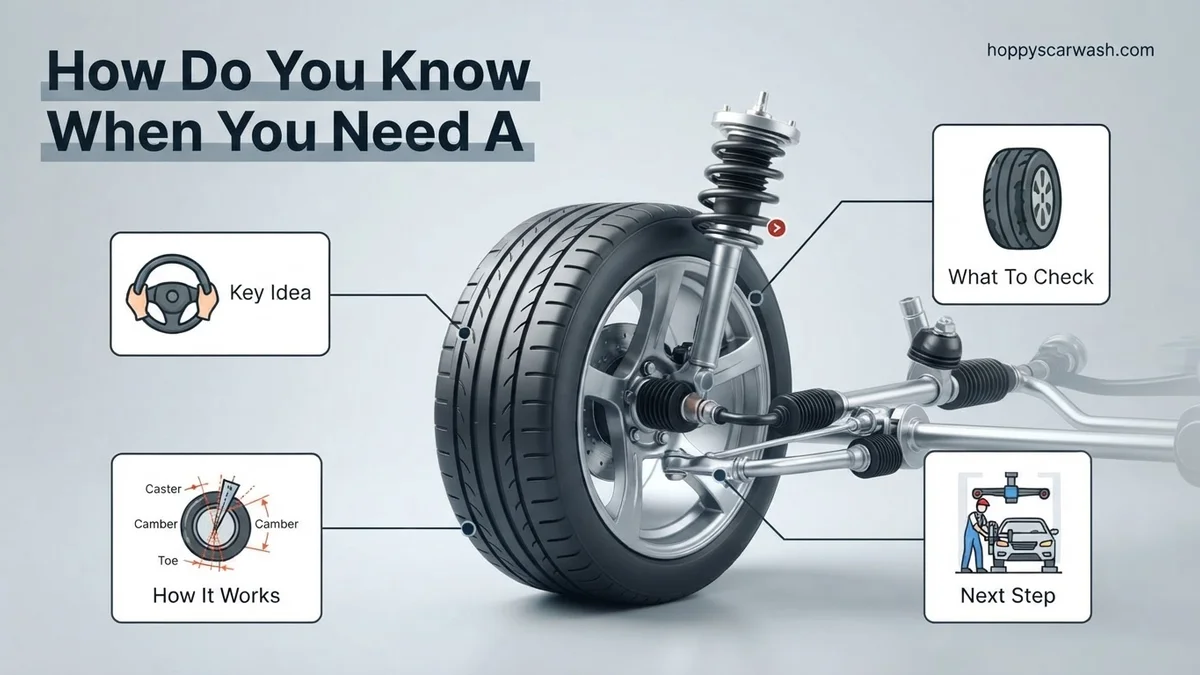
The three primary angles adjusted by technicians are camber, caster, and toe, each controlling how your tires make contact with the pavement.