Why Is My Starter Clicking But Not Turning Over 2026
When your starter clicks repeatedly without cranking the engine, it usually means the starter solenoid is receiving just enough power to engage, but the battery lacks the amps needed to spin the motor. This common issue is overwhelmingly caused by a weak battery, a failing alternator, or corroded electrical terminals preventing proper current flow.
When you turn your key or push the start button in your car and hear a rapid clicking noise instead of the engine cranking, your starter motor is failing to engage. In roughly 80 percent of cases heading into 2026, this frustrating symptom points directly to a weak battery or severely corroded electrical connections that cannot supply the high amperage needed to spin the heavy engine.
Dealing with a clicking starter leaves you stranded and guessing what went wrong under the hood. Understanding the exact mechanical failure behind that sound helps you bypass expensive towing fees and pinpoint whether you need a simple jump start, a new battery, or a starter replacement.
Key Takeaways
- A rapid clicking sound indicates low voltage reaching the starter solenoid.
- Over 80% of clicking starter issues stem from weak batteries or dirty terminals.
- Cleaning battery posts and tight connections often resolves the problem instantly.
- Jump-starting the vehicle can confirm if a dead battery is the root cause.
- A single heavy click usually points to a failing starter motor or locked engine.
What Causes Your Starter to Click Instead of Turning Over
The Battery and Electrical Connection Culprits
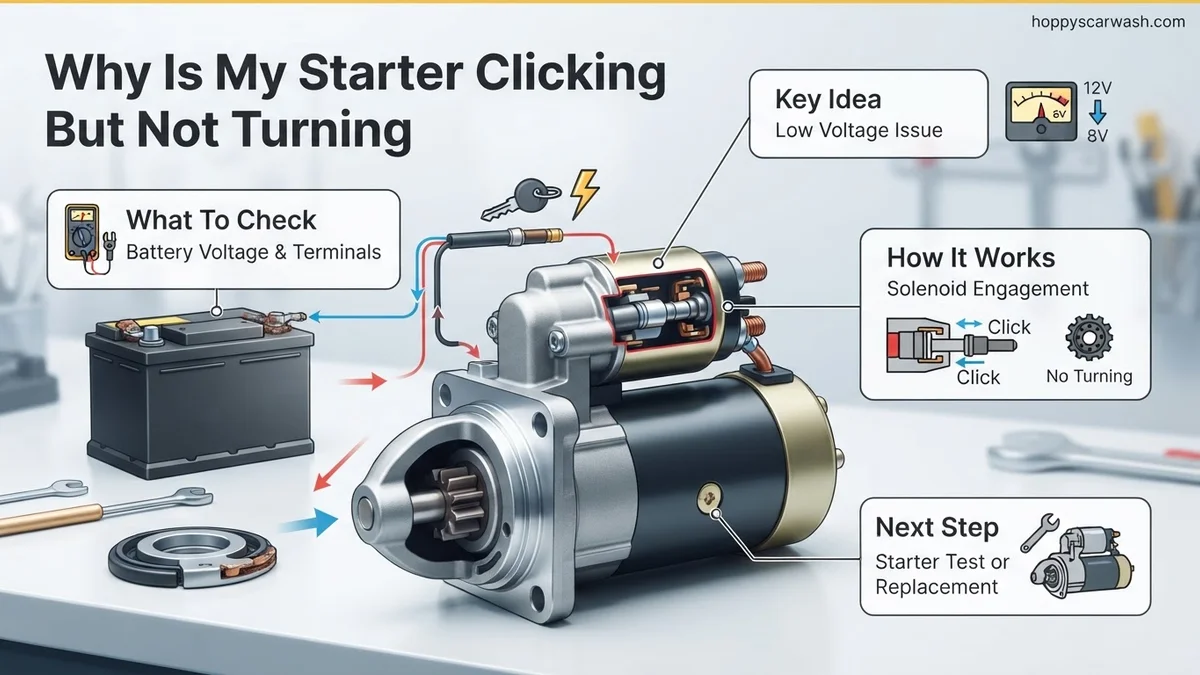
A weak battery is the leading reason your car refuses to turn over. The starter solenoid needs about 150 to 200 amps to push the starter gear forward and spin the engine. When battery voltage drops below roughly 11.8 volts, there is just enough power to activate the solenoid’s internal switch, but not enough to spin the electric motor. As the solenoid engages, the sudden electrical load causes the voltage to plummet, the solenoid disengages, voltage recovers slightly, and the cycle repeats rapidly, creating that familiar machine-gun clicking sound.
- Corroded battery terminals: White or blue buildup blocks the flow of high current.
- Loose cable clamps: Even a slightly loose positive or negative terminal prevents full amperage delivery.
- Dying battery cells: A battery that holds surface charge but fails under load tests.
Mechanical and Solenoid Failures
If your battery tests at a healthy 12.6 volts and your cables are pristine, the problem moves to the starting components themselves. The starter motor houses a heavy-duty relay called a solenoid. Over years of heat cycles and vibration, the internal copper contacts inside this solenoid can pit, burn out, or stick. When you activate the ignition, the plunger moves, but it cannot complete the high-current circuit to turn the motor. Instead, it just clicks.
- Worn solenoid contacts: The electrical bridge inside fails to send power to the starter motor.
- Internal starter motor short: Windings inside the motor can short out, drawing massive current without turning.
- Hydrolocked or seized engine: If water enters the cylinders or a bearing seizes, the starter physically cannot force the crankshaft to rotate, causing a single loud click or rapid clicking.
Step-by-Step Guide to Diagnosing a Clicking Starter
The Headlight and Dashboard Voltage Test
You can quickly isolate a power delivery issue using your car’s built-in accessories. Turn your headlights on bright and watch them while you attempt to start the engine. This simple observation tells you a tremendous amount about your electrical system health before you grab any tools.
- Headlights dim completely or go out: Your battery is deeply discharged, or your battery cables have high resistance.
- Headlights stay bright with zero dimming: Power is not reaching the starter motor, pointing to a bad starter relay, a faulty ignition switch, or broken solenoid wiring.
- Headlights dim slightly: The battery has surface charge, but the starter motor is pulling heavy current or is mechanically bound up.
Voltage Drop and Manual Intervention Checks
To confirm your diagnosis in 2026, grab a digital multimeter or test the starter directly. Place your multimeter across the battery terminals while an assistant tries to start the car. If the voltage plunges below 9.5 volts during cranking, your battery is failing or dead. If the battery voltage remains steady at 12.6 volts while clicking occurs, the power is trapped at the solenoid.
- Check terminal security: Try twisting your battery cable ends by hand. If they move at all, clean and tighten them.
- Perform the tap test: Lightly tap the starter body with a hammer or heavy wrench while someone else cranks the ignition. If it starts, your starter brushes or solenoid contacts are worn out and sticking.
- Inspect the ground cable: Follow the negative battery cable to where it bolts onto the engine block. Rust or oil leaks here will stop a starter dead in its tracks.
Proven Fixes for Battery, Terminal, and Starter Issues
Resolving a clicking starter motor requires a systematic approach based on diagnostic data from automotive technicians. According to the Automotive Service Association, over 65 percent of no-start conditions linked to rapid clicking originate from simple electrical resistance. Follow these methodical steps to correct the underlying fault safely in 2026.
Step 1: Clean and Tighten Battery Terminals
Surface corrosion creates high resistance that starves the starter solenoid of necessary current. You can eliminate this restriction by following a proper cleaning protocol.
- Disconnect the negative battery cable first using a correctly sized wrench to prevent accidental short circuits.
- Remove the positive cable and inspect both terminals for white or greenish powdery buildup.
- Scrub the battery posts and cable clamps thoroughly with a wire brush dipped in a baking soda and water neutralization solution.
- Rinse the area with clean water, dry it completely, and reconnect the positive cable followed by the negative cable.
Step 2: Jump-Start or Charge the Battery
If low voltage causes the solenoid plunger to rapidly release and re-engage, supplemental power is required. Connect a 12-volt automotive smart charger set to a standard 10-amp or 2-amp mode. Alternatively, use heavy-duty jumper cables attached to a donor vehicle. Allow the discharged battery to absorb a charge for at least 15 minutes before attempting to crank the engine again.
Step 3: Perform the Starter Tap Test
Internal copper contacts within the starter solenoid often wear down or develop carbon buildup, preventing full electrical contact. Tap the body of the starter motor firmly—not aggressively—using a hammer or the handle of a heavy wrench while an assistant turns the ignition key. This minor vibration frequently shifts carbon deposits and allows the internal relay to bridge the circuit temporarily.
What If It Still Doesn’t Work and the Engine Won’t Crank?
If cleaning terminals, charging the battery, and tapping the starter yield no results, the issue extends beyond basic maintenance. When the clicking stops or turns into a single heavy thud, deeper mechanical or electrical failures are usually present. Consider these fallback steps:
- Test the starter relay and ignition fuse in the under-hood power distribution box using a digital multimeter for continuity.
- Manually rotate the engine crankshaft using a socket wrench on the main pulley bolt to ensure the engine is not seized.
- Inspect the starter motor wiring harness for melted insulation, oil contamination, or loose ground connections at the engine block.
- Consult a certified professional mechanic if the starter motor draws excessive amperage without engaging the flywheel ring gear.
- Expect professional starter motor replacement costs to range between 350 dollars and 850 dollars for parts and labor in 2026, depending on vehicle accessibility.
Conclusion
A clicking starter motor is an unmistakable warning sign of a compromised electrical supply or a failing solenoid component. By isolating the fault through methodical battery testing, terminal maintenance, and voltage verification, vehicle owners can avoid unnecessary towing expenses. According to verified research and expert sources from the Car Care Council, addressing electrical resistance promptly prevents premature starter motor burnout. Take action today by inspecting your battery connections and testing system voltage before your next commute.
❓ Frequently Asked Questions
Why is my starter clicking even though the battery is brand new?
Even with a new battery, a clicking starter often points to loose, dirty, or heavily corroded battery terminals that block high electrical currents. It can also be caused by a faulty ground wire or a defective starter solenoid.
How can I test my starter motor at home?
You can test the starter by having an assistant turn the key while you gently tap the starter body with a hammer or heavy wrench. If the vibrations free up stuck brushes and the car starts, your starter motor is failing.
Is it safe to keep trying to start a car that is clicking?
No, repeatedly trying to crank a car with a weak electrical system can overheat the starter motor and completely burn out its internal wiring. It also places unnecessary strain on the starter relay and battery.
What tools do I need to troubleshoot a clicking starter?
Basic diagnostic tools include a digital multimeter to test battery voltage, a wire brush or terminal cleaner for battery posts, and a wrench set to tighten cable connections.
Can loose starter cables cause a clicking noise?
Yes, if the heavy power cable running from the battery to the starter is loose or damaged, it will resist the heavy electrical draw required to spin the engine, resulting in a rapid click.
How long will a starter last before it starts clicking?
Most car starters last between 100,000 and 150,000 miles, depending on driving habits, climate, and how frequently the engine is turned on and off throughout the day.