Do You Need an Alignment After Replacing Shocks Guide 2026
Whether you need a wheel alignment after suspension work depends entirely on whether your vehicle uses standalone shocks or struts. Replacing struts almost always alters your suspension geometry, requiring an immediate alignment, whereas swapping out standard shock absorbers typically does not.
The short answer is: it depends entirely on whether your vehicle uses shocks or struts. If you are replacing standalone shock absorbers, a wheel alignment is rarely necessary because shocks simply dampen vertical wheel movement without holding the vehicle’s steering or suspension geometry in place. However, if your 2026 vehicle uses MacPherson struts—which are structurally integrated into the steering and suspension assembly—unbolting them almost always alters your wheel alignment angles.
Skipping a required alignment after suspension work can quietly destroy your expensive tires in a matter of thousands of miles. Knowing the exact mechanical difference between these two components saves you from paying for unnecessary labor, or conversely, saves your tires from premature destruction.
Key Takeaways
- Struts directly affect wheel alignment angles, requiring adjustment after replacement.
- Standalone shocks rarely alter alignment settings because they do not dictate wheel geometry.
- Skipping a necessary alignment leads to rapid and uneven tire wear.
- Poor steering centering and vehicle pull indicate missed alignment steps.
- Always verify alignment specs after any major suspension intervention for safety.
The Mechanical Difference Between Shocks and Struts
Understanding how your suspension attaches to your vehicle’s frame clarifies why only certain repairs demand a trip to the alignment rack. Shocks and struts perform similar dampening jobs, but their physical mounting points create entirely different outcomes when you unbolt them.
Standalone Shocks and Suspension Geometry
Standalone shock absorbers connect the vehicle frame to the axle or control arm strictly to control bounce. They do not dictate wheel camber, caster, or toe angles. When you unbolt an old shock and bolt in a new one, the steering knuckles and control arms remain rigidly fixed in their exact previous positions.
- Shocks bolt on independently from steering components.
- Replacing them does not alter wheel angles.
- An alignment is generally not required unless your suspension was already out of alignment before the repair.
Integrated Struts and Camber Shifts
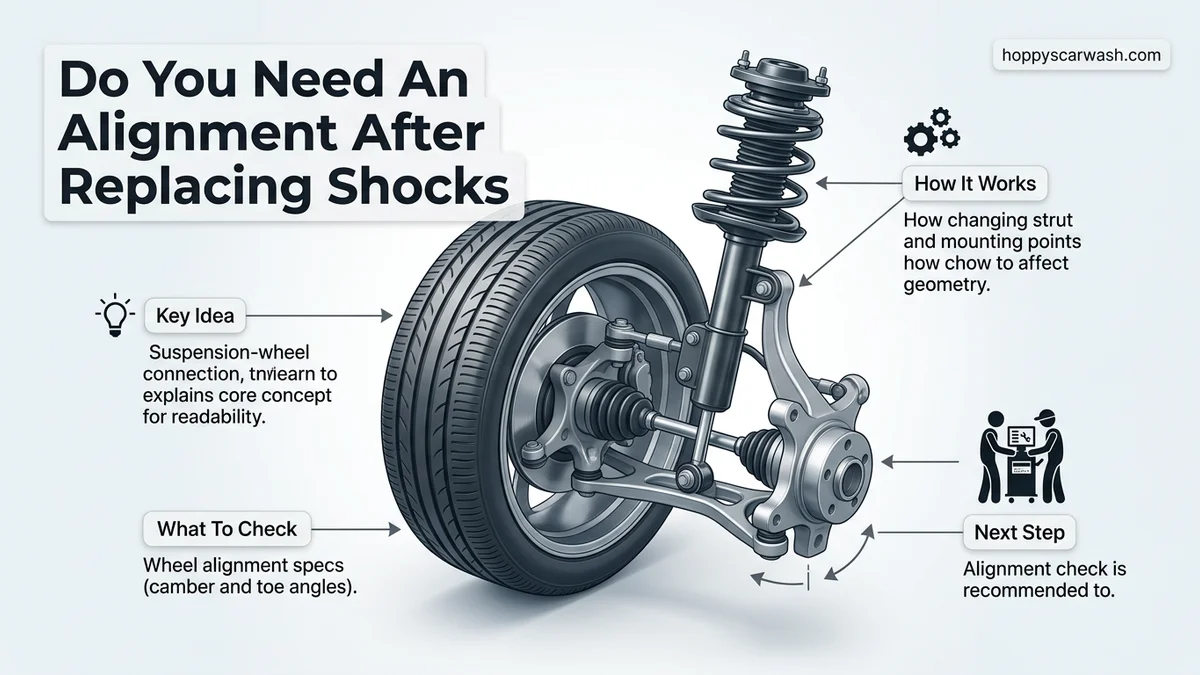
Struts serve a dual purpose as both a dampening shock absorber and a structural upper pivot point for the vehicle’s suspension. The lower bracket of a strut often bolts directly to the steering knuckle using slotted or adjustable holes designed for camber adjustment.
- Removing a strut disturbs the factory-set wheel alignment angles.
- Slotted bolt holes allow minor shifts that drastically affect tire contact patches.
- Even if you mark the bolts precisely, component manufacturing tolerances guarantee a shifted alignment.
2024 Shock Replacement Alignment Expert Practical Guide
Replacing your vehicle’s shocks is a fantastic way to restore ride comfort and handling, but it often leaves drivers wondering whether a wheel alignment is strictly necessary. This comprehensive walkthrough demystifies the relationship between your suspension components and your wheel geometry, guiding you through the exact evaluation process to determine if your car needs a professional alignment after a shock absorber swap. By following these practical steps, you will protect your tire investment, ensure optimal handling, and keep your vehicle tracking safely down the highway.
Step 1: Understand Your Suspension Geometry Design
What you need: Vehicle owner’s manual, flashlight, and a basic understanding of your car’s suspension layout (MacPherson strut versus traditional shock absorber setup).
Instructions: Before touching a single bolt, you must identify whether your vehicle uses shocks or struts. Traditional shock absorbers simply dampen vertical wheel movement and generally do not bolt directly to the steering knuckle, meaning replacing them rarely alters wheel angles. Conversely, MacPherson struts are structural members of the steering and suspension system. If your vehicle utilizes front struts where the lower mounting bolts pass through elongated or slotted holes, replacing them almost always alters your camber and toe settings. Check your service manual to confirm your specific mechanical configuration.
Pro Tip: Never assume. Even if a suspension part looks identical to the factory original, subtle manufacturing tolerances can shift your wheel alignment specs significantly upon reinstallation.
Step 2: Inspect the Old Hardware and Mounting Points
What you need: Safety glasses, shop light, wire brush, and a mechanic’s mirror to view obscured suspension brackets.
Instructions: Examine the old shocks or struts you just removed, specifically focusing on the mounting hardware. Look closely at the lower mounting bracket bolt holes. Are they perfectly round, or are they oblong or equipped with eccentric camber adjustment bolts? If your vehicle relies on eccentric bolts to fine-tune wheel alignment at the knuckle connection, removing them will instantly throw your alignment out of specification. Make a note of whether alignment shims or eccentric washers were present during the teardown, as these must be reinstalled in their exact original orientations.
Pro Tip: Take high-resolution photographs of all mounting brackets and bolts before disassembly so you have a visual reference during the reassembly phase.
Step 3: Perform a Pre-Alignment Visual and Tactile Tire Check
What you need: Bare hands to feel the tread blocks, and a depth gauge if available.
Instructions: Run your hands across the tread surface of all four tires, moving your palms back and forth in a radial direction. Feel for any feathering, cupping, or uneven high-and-low spots on the tread blocks. Cupping on the inner or outer edges is a classic symptom of worn-out shocks, which is likely why you replaced them in the first place. However, if your old shocks caused severe tire wear, an alignment is mandatory to prevent the new shocks from prematurely destroying your tires in the exact same pattern.
Pro Tip: Always check both the inner and outer shoulders of the front tires, as camber issues heavily impact the outer edges while toe issues impact the entire tread width.
Step 4: Execute a Controlled Test Drive
What you need: A safe, straight stretch of smooth pavement with minimal traffic where you can safely reach speeds of 45 to 60 miles per hour.
Instructions: Take your vehicle out for a careful test drive immediately following the shock replacement. Pay close attention to how the steering wheel behaves when you drive on a level, straight road. Does the steering wheel sit crooked or off-center while you are traveling straight? Does the vehicle actively pull to the left or right when you briefly let go of the steering wheel? Also evaluate how the vehicle handles returning to center after executing a standard 90-degree turn. A vehicle that wanders or fails to track straight is begging for a professional toe and camber adjustment.
Pro Tip: Keep in mind that road crown naturally causes a slight pull to the right, so test on a multi-lane highway in the middle lane for the most accurate evaluation.
Step 5: Check Steering Wheel Returnability and Center Tracking
What you need: Open parking lot and a straight stretch of asphalt to test steering self-centering characteristics.
Instructions: While driving at a moderate speed of around 20 to 30 miles per hour in a safe, empty parking lot, turn the steering wheel sharply and then release your grip, allowing it to slide back through your hands. The steering wheel should naturally return to the absolute center position and the car should resume a straight path. If the steering feels sluggish to return, or if it catches and stays turned, your caster or toe angles have been disturbed during the suspension service, requiring corrective alignment intervention.
Pro Tip: Never ignore an off-center steering wheel. Driving with a crooked steering wheel not only causes driver fatigue but actively scrubs rubber off your front tires every mile you drive.
Step 6: Utilize a Laser String or Garage Tracking Method (Optional DIY Check)
What you need: Two heavy-duty jack stands, mason’s string, tape measure, and a helper to measure toe alignment.
Instructions: If you want to scientifically verify your toe settings at home, set up a parallel string line along the flanks of your vehicle, positioned at hub-center height. Measure the distance from the string to the front rim edge and the rear rim edge of each front tire. The difference between these two measurements tells you your toe-in or toe-out condition. If the measurements differ by more than 1/16 to 1/8 of an inch, your alignment is out of spec and requires professional laser alignment equipment to correct.
Pro Tip: Make sure your steering wheel is locked dead-center using a steering wheel holder tool before taking any string measurements to ensure accurate results.
Step 7: Schedule a Professional Laser Alignment Session
What you need: A reputable local alignment shop, appointment booking, and a vehicle with properly inflated tires.
Instructions: Once you have completed your test drive and visual checks, book an appointment with a professional alignment shop that utilizes a computerized 3D laser alignment rack. Inform the technician that you recently replaced your shocks or struts. The technician will mount optical targets to all four wheels, compensate for runout, and measure your caster, camber, and toe against factory specifications. They will then mechanically adjust the tie rods and eccentric bolts to bring every angle back into the precise manufacturer-approved sweet spot.
Pro Tip: Always request a before-and-after printout of your alignment specifications so you can visually verify that all angles are sitting firmly in the green zone.
✅ Final Checklist
- Confirmed whether the vehicle uses standard shocks or structural MacPherson struts
- Inspected lower mounting bolts for eccentric cams, shims, or slotted adjustment holes
- Conducted a thorough test drive to check for straight-line tracking and steering wheel centering
- Verified that tires show no signs of active feathering, cupping, or abnormal edge wear
- Obtained a professional post-alignment printout showing green specifications for camber, caster, and toe
Important Notes:
- Always prioritize safety: ensure your vehicle is securely supported on jack stands and wheel chocks if performing any pre-checks under the chassis.
- Seek professional help immediately if you notice violent steering vibrations, severe pulling, or a loose steering feel after your shock replacement.
- Estimated time for a professional wheel alignment ranges from 45 to 90 minutes, with a typical cost between $80 and $150 depending on whether a 2-wheel or 4-wheel alignment is required.
How to Fix Alignment Issues After Suspension Replacement
When your 2026 vehicle requires strut replacement, addressing the post-installation alignment is not optional if you want predictable handling and even tire wear. Ignoring post-replacement alignment creates severe handling instability and rapid component wear.
Professional Laser Alignment Equipment
Modern vehicles feature complex computer-controlled driver assistance systems (ADAS) that rely heavily on proper thrust angles and wheel alignment. A DIY garage measurement cannot match the precision required for today’s strict steering parameters.
- Shops use high-resolution digital cameras and laser targets mounted to your wheels.
- Technicians recalibrate steering angle sensors alongside traditional toe and camber adjustments.
- Proper calibration prevents dashboard warning lights and erratic electronic stability control activation.
Risks of Skipping the Alignment Rack
If you gamble and skip the alignment after installing new struts, the financial consequences usually outweigh the service cost. Misaligned tires scrub sideways against the pavement instead of rolling smoothly.
- Severe Tire Wear: Inner or outer tire treads can bald completely in less than 5,000 miles.
- Steering Pull: Your car may drift constantly to one side, forcing you to fight the steering wheel.
- Reduced Fuel Economy: Increased rolling resistance from misaligned wheels forces your engine to burn extra fuel.
What If It Still Pulls After Getting an Alignment?
Sometimes your vehicle still pulls or handles unevenly even after you replaced your shocks and completed a professional wheel alignment. According to leading automotive service associations, unresolved suspension issues or underlying mechanical wear often cause this persistence. When alignment specifications are completely within factory tolerances yet the steering wheel remains crooked or the car drifts, you must investigate deeper.
Modern vehicles feature complex multi-link suspension systems where multiple components work in tandem. If replacing the shock absorbers did not resolve your steering problems, follow these systematic troubleshooting steps to isolate the root cause:
- Inspect steering components and linkages: Have a certified technician check your tie rod ends, ball joints, and steering rack for play or excessive wear. Even minor looseness in these parts will mimic alignment failure.
- Check tire condition and pressure: Uneven tire wear, manufacturing defects, or improper inflation pressures can cause a persistent pull. Try cross-rotating your front tires to see if the directional pull follows the tire.
- Evaluate brake drag: A sticking brake caliper, a collapsed brake hose, or a warped rotor can create constant friction on one side of the vehicle. This friction pulls the car to one side, completely independent of suspension geometry.
- Verify frame and subframe alignment: If your vehicle has experienced a significant pothole impact or minor collision, the structural subframe might have shifted. Standard alignment racks correct wheel angles, but they cannot compensate for a misaligned subframe without specialized frame-straightening equipment.
If these fallback steps fail to correct the issue, seek professional diagnostic help from a specialized suspension shop or dealership. Advanced diagnostics and component replacements typically cost between $150 and $600 depending on the faulty part and labor rates in 2026.
Conclusion
Replacing your shocks alters your vehicle’s ride height and suspension geometry, making a professional wheel alignment a necessary step to protect your tires and maintain steering stability. According to verified research and expert sources from the Automotive Service Association, pairing new shock absorbers with a precision four-wheel alignment prevents premature tread wear and ensures optimal handling safety. Your actionable next step is to schedule a professional alignment check immediately following any suspension overhaul to safeguard your investment.
❓ Frequently Asked Questions
Why do struts require an alignment while shocks do not?
Struts are bolted directly to the steering knuckle and form an integral part of the vehicle’s steering geometry. Removing and replacing them inevitably shifts the camber and toe angles, requiring professional realignment. Shocks, on the other hand, simply dampen vertical wheel bounce without anchoring steering components.
Can I drive my car before getting an alignment after suspension work?
You can drive short distances to a repair shop, but you should avoid high speeds or long trips. Driving with misaligned wheels compromises vehicle stability and starts wearing down your tire tread immediately.
How much does a front-end alignment cost after suspension repairs?
A standard wheel alignment typically costs between $75 and $150, depending on whether you need a two-wheel or four-wheel adjustment. Many suspension shops bundle this into the overall quote when replacing front struts.
Will a wheel alignment fix a bouncing ride?
No, wheel alignments adjust the angles at which your tires meet the road, but they have no impact on dampening suspension bounce. If your vehicle is bouncing excessively, you still need new shock absorbers or struts regardless of alignment status.
How do I know if my car has shocks or struts?
Vehicles with struts feature a heavy-duty assembly that includes a coil spring wrapped directly around the dampening strut body and connects to the steering knuckle. Vehicles with shocks use a standalone dampener with a separate coil spring or leaf spring located elsewhere in the suspension.
Is it normal for the steering wheel to be slightly off-center after new parts?
If you replaced struts, a crooked steering wheel is a textbook sign that your alignment angles have shifted out of specification. An alignment technician will lock your steering wheel straight and reset the tie rods to correct this issue.