How Long Does Rustoleum Spray Paint Take To Dry 2026 Guide
Most standard Rust-Oleum spray paints take 20 to 40 minutes to dry to the touch and can be handled after 1 hour. However, complete drying and full curing depend heavily on formula types, temperature, and humidity levels.
Standard Rust-Oleum Painter’s Touch 2X Ultra Cover spray paint takes about 20 minutes to dry to the touch, 1 hour to handle safely, and can be recoated within 20 minutes or after 48 hours. If you are planning a DIY project in 2026, knowing these exact timelines prevents ruined finishes and smudged paint.
Waiting the correct amount of time between coats is the single biggest factor in avoiding wrinkles, bubbles, and peeling. Whether you are painting metal patio furniture or wooden shelves, understanding these drying stages ensures a smooth, professional result every single time.
Key Takeaways
- Standard Rust-Oleum dries to the touch in 20 to 40 minutes.
- Recoat within 1 hour or wait 48 hours to avoid wrinkling.
- Full curing takes up to 7 days depending on environmental conditions.
- High humidity and low temperatures significantly slow down drying times.
- Thin multiple coats dry much faster than one heavy application.
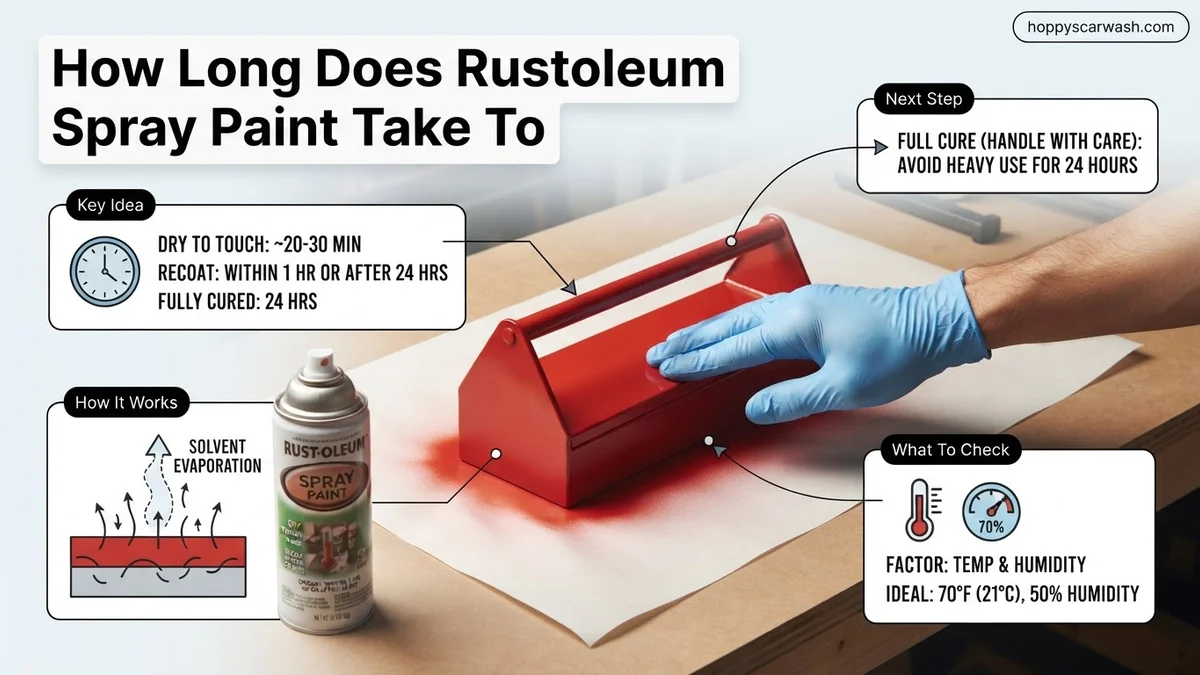
Understanding Rust-Oleum Drying Stages and Timelines
Drying paint goes through distinct chemical phases. Knowing the difference between dry-to-the-touch and fully cured keeps your project safe from accidental fingerprints and dents.
Dry to the Touch and Handle Times
When you spray paint an object, you need to know when you can safely move it or apply a second layer. Different product lines have slightly different drying benchmarks.
- Dry to the touch: Typically takes 20 to 30 minutes for standard enamels. The solvents have evaporated enough that light contact will not leave a fingerprint.
- Dry to handle: Usually takes 1 hour. You can carefully pick up the object without leaving marks, though the paint is still vulnerable to heavy pressure.
- Fully cured: Takes up to 24 to 48 hours. The paint achieves its maximum hardness and chemical resistance during this window.
The Critical Recoat Window
Applying your next layer at the right time matters just as much as the initial drying phase. Missing the window can ruin your finish.
- Within 20 minutes: You can apply additional coats while the surface is still tacky.
- After 48 hours: If you miss the initial 20-minute window, you must wait 48 hours for the first coat to fully cure before sanding lightly and spraying again.
- Risk of bubbling: Spraying a new coat between 1 hour and 24 hours traps solvents underneath, causing unsightly wrinkling and blistering.
How Temperature and Humidity Affect Spray Paint Drying
Environmental conditions dictate how fast chemical solvents evaporate from your spray paint. Even in 2026, the laws of physics still dictate that weather changes your drying schedule.
Temperature and Solar Heat
The ideal temperature range for applying Rust-Oleum spray paint is between 50°F and 90°F (10°C to 32°C). Temperature directly impacts solvent release rates.
- Temperatures below 50°F: Solvents evaporate very slowly. This drastically extends dry-to-touch times beyond an hour and can prevent proper curing altogether.
- Temperatures above 90°F: High heat causes the paint to dry too fast in the air before it even hits the surface, resulting in a rough, sandy texture known as dry spray.
- Direct sunlight: While warmth helps, blistering can occur if metal surfaces get excessively hot under direct midday rays.
Humidity and Moisture Levels
Moisture in the air plays a massive role in how your paint film forms and hardens. High humidity traps moisture within the drying paint layers.
- Ideal humidity: Keep your workspace below 85 percent relative humidity for the best results.
- High humidity effects: Excess moisture slows down evaporation, leading to a dull or cloudy finish, especially on glossy paints.
- Rain and dew: Never spray paint outdoors if rain is approaching within a few hours, or if heavy morning dew is likely to settle on the wet paint.
Step-by-Step Guide to Applying and Recoating Safely
Achieving a professional finish with Rust-Oleum spray paint requires careful adherence to manufacturer recoat windows. According to official Rust-Oleum technical data sheets, improper timing between coats is the leading cause of wrinkling and paint failure.
Applying the Initial Coats
Proper preparation ensures the paint cures evenly within the standard 20-to-to-40-minute touch-dry window. Follow these procedural steps for the initial application:
- Shake the aerosol can vigorously for one minute after the mixing ball begins to rattle.
- Hold the nozzle 10 to 16 inches away from the surface, spraying in a steady, back-and-forth motion with slight overlap.
- Apply multiple thin, light coats rather than one heavy layer to prevent sagging and prolong drying times.
- Allow the paint to sit undisturbed in a well-ventilated area until it reaches the dry-to-touch state.
Safe Recoating Procedures
To safely apply a second coat without causing the underlying layer to wrinkle or lift, adhere strictly to the recoat guidelines. Follow these steps:
- Check the surface condition by touching an inconspicuous area to confirm it is completely dry.
- Apply subsequent coats within the designated window of under 1 hour or wait a full 48 hours.
- If the 1-hour window is missed, lightly scuff the cured surface with fine-grit sandpaper to promote mechanical adhesion.
- Wipe away all sanding dust with a tack cloth before applying the final coat.
What To Do If Your Rust-Oleum Spray Paint Won’t Dry
If your Rust-Oleum spray paint remains tacky or soft long past the standard 24-hour full-cure window, environmental factors or application errors are usually to blame. High humidity and thick coats trap solvents beneath the surface film. Try these fallback steps to resolve the issue:
- Move the painted object to a climate-controlled indoor space where relative humidity stays below 50 percent and ambient temperature sits at 70°F.
- Set up an oscillating fan to circulate air across the surface, which accelerates solvent evaporation without overheating the coating.
- If the paint remains wet or sticky after 72 hours, use mineral spirits or paint stripper to completely remove the compromised layer.
- Sand the bare substrate smooth, clean it thoroughly, and reapply the paint in thinner coats under optimal weather conditions.
- For specialized industrial or automotive finishes that fail to cure due to a bad batch, contact Rust-Oleum customer support for product replacement, which typically involves a cost range of $8 to $15 per can.
Conclusion
Mastering the drying timeline for Rust-Oleum spray paint prevents project flaws and ensures a durable, long-lasting finish. By respecting the 20-minute touch-dry window and the 24-hour full-cure threshold, you eliminate the risk of tacky surfaces and ruined coats. According to verified research and manufacturer specifications from paint industry experts, controlling ambient temperature and humidity remains the single most critical factor for success. Your actionable next step is to test your local workspace conditions with a hygrometer before beginning your next spray project.
❓ Frequently Asked Questions
What is the difference between dry to touch and fully cured?
Dry to the touch means the surface is no longer tacky, while fully cured means the paint has reached maximum hardness and durability throughout all layers.
Can I paint in cold weather using Rust-Oleum?
Painting in temperatures below 50°F (10°C) will drastically slow down drying times and may cause the paint to wrinkle or fail to cure properly.
What happens if I recoat outside the recommended window?
Recoating between 1 and 48 hours can cause the fresh solvent to wrinkle and lift the underlying layer, ruining the finish.
How can I speed up the drying time for spray paint?
Ensure proper ventilation, keep the workspace between 70°F and 80°F, maintain moderate humidity, and apply very thin, even coats.
Why is my Rust-Oleum spray paint still sticky after 24 hours?
This is usually caused by high humidity, applying coats that are too thick, or painting in temperatures that are too cold.
Does Rust-Oleum 2X Ultra Cover dry faster than standard formulas?
Rust-Oleum 2X Ultra Cover dries to the touch in about 20 minutes, which is comparable to standard formulas, but requires similar wait times for full recoating.