How Do You Know How Many Cylinders Your Car Has 2026 Guide
Knowing how do you know how many cylinders your car has is simple when you check under the hood or review your vehicle documents. Most passenger cars feature 4, 6, or 8 cylinders which dictate engine power and layout. You can easily identify your cylinder count using a physical inspection or your vehicle identification number.
You can find out how many cylinders your car has in less than two minutes by popping the hood and counting the spark plug wires, checking your vehicle identification number (VIN) online, or reading the engine cover badge. Most modern cars in 2026 feature either a 3-cylinder, 4-cylinder, V6, or V8 engine configuration.
Knowing your exact cylinder count matters for several practical reasons. When you order replacement spark plugs, ignition coils, or custom engine parts online, you must select the correct configuration to avoid ordering the wrong components. It also helps you understand your vehicle’s fuel economy expectations and routine maintenance costs before heading to a mechanic.
Key Takeaways
- Count the spark plug wires or ignition coils under the hood for a quick answer.
- Check the vehicle emissions sticker located under the hood for displacement details.
- Decode your VIN online or read the tenth digit for engine specifications.
- Review your owner’s manual or vehicle registration card for official engine data.
- Look for engine cover badges that often display V6, V8, or 2.0L turbo markers.
What Causes Confusion About How Many Cylinders Your Car Has
Modern Plastic Engine Covers Hide Everything
If you pop the hood of a modern 2026 vehicle, you likely will not see a raw metal engine block. Automakers now cover almost the entire top of the engine with large, molded plastic acoustic covers. These shrouds dampen noise and give the engine bay a clean look, but they completely conceal the spark plugs, ignition coils, and fuel rails. Unless you know how to safely remove these plastic shields or look past them, counting components visually becomes nearly impossible.
Marketing Badges and Trim Names Can Be Misleading
Car manufacturers rarely stamp the actual cylinder count directly onto the rear trunk badge anymore. Instead, you see alphanumeric badges like 35 TFSI, T8, or EcoBoost. These marketing terms focus on power output, turbocharging, or hybrid capability rather than raw engine architecture. A buyer looking at a 2026 crossover might assume a higher number on the rear badge refers to the number of cylinders, leading to widespread confusion.
Unlocking Your Engine’s Secrets: Determining Your Car’s Cylinder Count Made Easy
Whether you are ordering replacement spark plugs, tuning your engine, or simply satisfying your mechanical curiosity, knowing the exact number of cylinders your car has is essential information for every vehicle owner. This comprehensive walkthrough provides multiple foolproof methods to identify your engine configuration, ranging from quick visual checks under the hood to decoding hidden vehicle identification numbers, ensuring you get accurate answers every single time.
Step 1: Check the Vehicle Owner’s Manual
What you need: Your car’s physical owner’s manual, or internet access to find a digital copy online.
Instructions: Open your glove compartment and locate the vehicle owner’s manual. If you cannot find the physical book, visit the manufacturer’s official website or a repository like ManualsLib to search for your car’s exact make, model, and year. Once you have the manual open, navigate to the “Specifications” or “Engine Specifications” section, which is typically found near the back of the book. Look for a row labeled “Engine Type,” “Displacement,” or “Cylinders.” It will explicitly state whether your vehicle features a 3-cylinder, 4-cylinder, 6-cylinder, or 8-cylinder engine.
Pro Tip: Do not rely on generic manuals from the same model family, as engine options often change dramatically between trim levels and model years.
Step 2: Inspect the Under-Hood Emission Control Label
What you need: A flashlight and a clean rag to wipe away dust under the hood.
Instructions: Pull the hood release lever inside your car, secure the hood open, and scan the underside of the hood or the metal radiator support panel for a white or yellow Vehicle Emission Control Information (VECI) sticker. This federally mandated sticker contains vital engine data. Look closely at the engine displacement listing, usually measured in liters (e.g., 2.0L, 3.5L, 5.0L), followed by or paired with a clear designation of the cylinder layout and count, such as “L4” for a 4-cylinder inline engine or “V6” for a 6-cylinder V-configuration.
Pro Tip: On older vehicles, these stickers can fade or peel. If it is unreadable, move directly to the physical spark plug wire inspection method.
Step 3: Count the Spark Plugs or Ignition Coils
What you need: A flashlight and basic mechanical safety awareness.
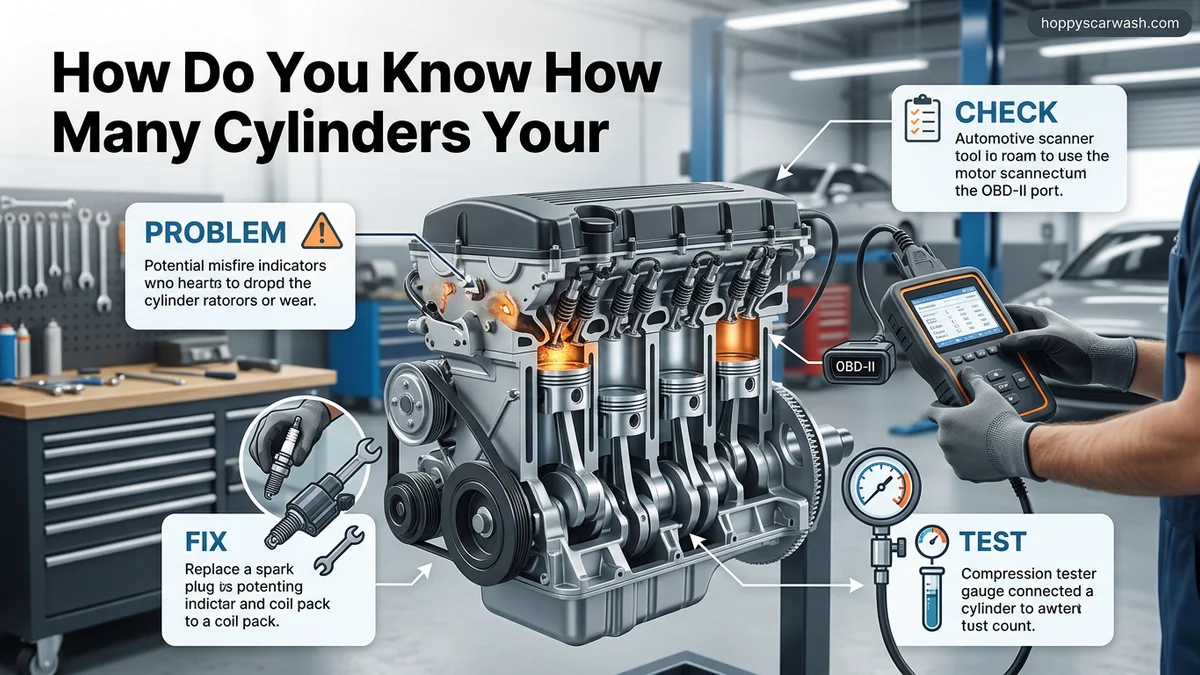
Instructions: Locate the engine cover if your car has one, and gently snap or unscrew it off to expose the top of the engine block. Look for the ignition coils or spark plug wires. Modern fuel-injected cars typically have one individual ignition coil sitting directly on top of each spark plug, while older cars feature heavy-duty spark plug wires leading from a distributor to each cylinder. Carefully count every single individual ignition coil pack or spark plug connector you see in a row or array. The total count directly equals the number of cylinders in your engine.
Pro Tip: On V6 and V8 engines, remember to count both banks of the engine (left and right sides) to ensure you do not accidentally miss half of your cylinders.
Step 4: Decode the Vehicle Identification Number (VIN)
What you need: Your car’s 17-digit VIN, found on your insurance card, vehicle registration, or through the driver’s side dashboard visible through the windshield.
Instructions: Write down your car’s 17-character VIN. The eighth digit of this alphanumeric code is the engine code designated by the manufacturer. Next, open a web browser on your smartphone or computer and navigate to a reputable VIN decoder website, such as NHTSA’s official decoder. Enter the 17-digit code into the search bar and submit. The resulting technical specifications report will break down your exact engine build, explicitly stating the total cylinder count alongside horsepower ratings and fuel type.
Pro Tip: Pay close attention to letters versus numbers in the VIN—zeros and capital letter ‘O’s are frequently confused, which can alter your decoding results.
Step 5: Examine the Engine Displacement Badging
What you need: Good eyesight and access to the exterior of your car.
Instructions: Walk around the outside of your vehicle and look for chrome emblems or plastic badges on the trunk lid, rear fenders, or front grille. Manufacturers frequently badge cars with their engine displacement sizes, such as “2.5T,” “3.0,” or “5.7 HEMI.” While a displacement number like 2.0L or 2.5L typically indicates a 4-cylinder engine, and 3.0L to 4.0L often points to a 6-cylinder engine, you can cross-reference these numbers with standard automotive configurations if you know your specific brand’s engine lineup.
Step 6: Research Using Your License Plate Number
What you need: Your vehicle’s license plate number and state of registration, plus a smartphone.
Instructions: If you are away from the vehicle and cannot check the engine bay or VIN, open an automotive parts website like AutoZone, Advance Auto Parts, or RockAuto. Instead of searching by year, make, and model, many modern auto parts portals allow you to search via your license plate and state. Enter your registration details into the parts finder tool. Once the system pulls up your specific vehicle profile, click on the “Engine” or “Ignition” category to view the exact factory-installed cylinder count associated with your license plate.
Pro Tip: This method works best for factory-original vehicles; if a previous owner performed an engine swap, the database might reflect the original factory engine rather than the current modification.
✅ Final Checklist
- Verified the engine specifications using the official owner’s manual or VECI emission sticker.
- Counted the exact number of physical ignition coils or spark plug connectors under the hood.
- Decoded the eighth digit of the 17-digit VIN using an online verification tool.
- Cross-referenced the engine size and cylinder count to ensure total accuracy before purchasing replacement parts.
Important Notes:
- Always ensure the engine is completely cool before removing engine covers or touching ignition components to prevent severe burns.
- If you suspect your engine has been modified or swapped from its original factory configuration, consult a professional mechanic for verification.
- Total time required for these checks is typically 5 to 10 minutes, with a cost of $0 when using free online VIN decoders and manual inspections.
How to Check Under the Hood to Find Your Cylinder Count
Count the Ignition Coils or Spark Plug Wires
The most foolproof physical method to determine your cylinder count is counting the ignition components sitting atop the engine. Follow these quick steps once you safely pop your hood:
- Locate the main engine block (you may need to unclip or pull upward on the plastic engine cover to expose it).
- Look for the individual ignition coils or spark plug wires sticking straight down into the top or sides of the engine.
- Count how many individual coil packs or boots line up in a row (for inline engines) or on each bank (for V-shaped engines).
- If you see four distinct coil packs lined up, you have a 4-cylinder engine. If you see three on one side and three on the other, you drive a V6.
Check the Engine Bay Emissions Label
Automakers place a permanent Vehicle Emission Control Information (VECI) sticker underneath the hood of every car sold. This federally mandated label contains vital technical data about your specific motor. Scan the sticker for engine displacement measurements, which are typically listed in liters (such as 1.5L, 2.0L, or 3.5L). Right beside or just below the displacement size, the label explicitly spells out the total number of cylinders or the exact engine family code you can look up.
How to Fix Documentation Gaps Using Your Vehicle VIN
When engine covers hide your spark plugs and physical identification fails, the Vehicle Identification Number (VIN) remains the ultimate source of truth. Every vehicle manufactured for the 2026 market carries a standardized 17-character VIN that encodes specific powertrain details, including cylinder count and engine displacement.
Decoding the Engine Code Digit
The eighth digit of your vehicle identification number typically designates the specific engine option installed at the factory. According to the Society of Automotive Engineers (SAE) standards, manufacturers use this specific character to map out performance profiles and mechanical configurations.
- Locate your 17-character VIN on the driver-side dashboard near the windshield or on the inside door sticker.
- Identify the eighth character from the left, which serves as the designated engine code identifier.
- Cross-reference that specific alphanumeric character with an official online VIN decoder or your owner manual supplement.
- Review the resulting engine specification sheet to confirm the exact cylinder count and layout.
Using Digital Resources and Manufacturer Portals
Modern vehicle owners can bypass manual decoding by leveraging official digital manufacturer portals. Major automotive brands now provide instant specification lookups through online owner account portals. Entering your complete VIN into a certified dealership parts database or vehicle lookup tool will immediately reveal your exact engine architecture, replacing guesswork with verified factory data.
What If It Still Doesn’t Work?
If you have checked the engine bay, decoded the VIN, and still cannot definitively determine your cylinder count, hidden aftermarket modifications or rare engine swaps may be the cause. When standard identification methods fail, certified automotive professionals can quickly diagnose your powertrain architecture using advanced shop diagnostics.
- Consult a local certified mechanic or dealership service department to perform a quick physical inspection of the engine bay.
- Request an official diagnostic report by providing your registration details and VIN to an authorized service writer.
- Prepare for potential diagnostic fees, which typically range from $50 to $150 depending on local labor rates and inspection complexity.
- Authorize a technician to remove complex acoustic covers or intake manifolds safely if necessary for accurate part replacement or tuning.
Conclusion
Knowing how many cylinders your car has is essential for routine maintenance, spark plug replacement, and purchasing correct replacement parts. Whether you count the ignition coil packs, check the emissions label under the hood, or decode your 17-character VIN, identifying your engine configuration prevents costly repair mistakes. According to verified research and automotive industry standards, utilizing your vehicle identification number remains the most accurate method for confirming factory powertrain specs in 2026. Take the next step today by locating your VIN and running a quick digital lookup to verify your exact engine layout.
❓ Frequently Asked Questions
How do you know how many cylinders your car has without opening the hood?
You can check your vehicle registration, look up your VIN on a free online decoder website, or check the emissions label located inside the driver’s side door jamb or under the hood.
What is the difference between an inline engine and a V-engine configuration?
An inline engine places all cylinders in a single straight line, while a V-engine arranges them in two separate banks angled in a V-shape. Despite the physical layout difference, counting the total number of spark plugs or ignition coils remains the same.
Why would I need to know my cylinder count?
Knowing your cylinder count is essential when purchasing replacement parts like spark plugs, ignition coils, or spark plug wires. It also helps when discussing mechanical repairs or assessing vehicle fuel economy and performance.
Do electric cars have cylinders?
No, fully electric vehicles do not have internal combustion engines, meaning they do not feature cylinders, spark plugs, or traditional engine oil. Instead, they rely purely on electric motors and battery packs.
Can I determine cylinder count by looking at the car’s model name?
Sometimes badge names or trim levels reference engine size, such as a 328i or V8 badge, but relying on physical inspection or documentation is always more accurate.
How many spark plugs does a 4-cylinder engine have?
A standard 4-cylinder engine typically features one spark plug per cylinder, resulting in a total of four spark plugs. Some advanced or older multi-plug designs may feature two per cylinder, but modern standard engines use one per cylinder.